











 Knowledge cannot be expressed adequately without words. … We can frame new words from Sanskrit more freely, more easily and more accurately than is possible either in Greek and Latin with regard to scientific terminology. – Prof. Dr. Raghu Vira
All languages are not equal in value. The degree of accuracy in the expression of concrete ideas is not the same. The time, space and content of language are quite different in Chinese, as compared to any other language of the world. As a rule one does not express in Chinese time (tense and mood), number and gender. There is a peculiar vagueness about the Chinese sentence which is not to be found in other languages. Take the example ‘Go to city’. There can be quite a number of sentences about it such as ‘I go to the City’, ‘I shall go to the city’, ‘I went to the city’, ‘I may go to the city’. Moreover, ‘I’ may be replaced by ‘you’ or ‘he’ or ‘she’. That will be decided by the context. Usually a sentence in literary Chinese does not consist of more than four words.
The German language splits up a compound verb into two parts of which one comes at the end of the sentence. German is a compounding language. That means that a number of words can be put side by side and the prepositions and postpositions and other words denoting relationship between different words can be omitted. This makes the language more compact. More ideas can be put into a sentence than is possible otherwise.
As our knowledge grows, we need more words. Knowledge cannot be expressed adequately without words. Whatever we understand, whatever we note, to that we give a name. The animal needs of man are covered by a thousand words. Child learns these words by the age of eight. By fifteen, a school-going child can learn 5,000 words. In a country like India however, this acquaintance with words does not extend beyond 3,000.
The rudiments of language are learnt by a child by the sheer force of association. These words may not be closely interrelated. For instance, ‘running’ is different from ‘going’; ‘drinking’ is different from ‘eating’. We could say ‘going faster’ in place of ‘running’ and ‘eating water’ in place of ‘drinking’. The Bengalis actually say ‘eating water’. A large number of words in a language connotes a large number of ideas. Knowledge consists in knowing everything as apart from others. For that reason we give things definite names. Charge, accusation and conviction are different words. Stress, strain, pressure and compression are different too. To denote all these by one word would be impossible.
We judge value of languages from the inter-relationship which exists among different words. How many derivatives can a word give? Perhaps two, three, four, ten. How many compounds can a word enter into? Ten, twenty, hundred. A compound word is naturally easier to comprehend. Otherwise it will defeat its purpose. The number of specific suffixes and prefixes as well as the vagaries in a language have to be taken into consideration in judging a language. Every language has got vagaries. But if the vagaries go to such an extent that is becomes difficult to frame generalisations which help to co-relate similar things, then these vagaries are a burden on the language. Language can be an instrument of progress or a hindrance.
Languages may be divided into two groups: (1) fountain languages and (2) borrowing languages. In Europe the fountain language par excellence is Greek. Latin serves as an intermediary between Greek and modern European languages. Greek serves as the fountain language for Arabic and Hebrew also.
Arabic served as a fountain language for some time, but even at its best it borrowed freely from the Greek language. And when it gave words to languages like Persian and Swahili, it was more a matter of political imposition than of scientific necessity. The Persian language was the richer of the two but with Muslim conquest it had to give way to Arabic.
Next we come to Chinese. It has served Japan for developing her entire scientific terminology. After Greek we can give the next place to the Chinese language for enriching other languages. Coming to our own country, our fountain language has been Sanskrit. Sanskrit had been a source-language even for Greek (e.g. the word barometer is derived from Greek baros meaning weight and baros owes its origin to our Sanskrit bhåra). We can frame new words from Sanskrit more freely, more easily and more accurately than is possible either in Greek and Latin with regard to scientific terminology. We have a great codifier of laws of grammar in Påṇini. In his hands, it acquired the greatest precision. His system is veritably a kåmadhenu. Desire what we will and we will get it there. Sanskrit is the most transparent language in the world. It can have prolific expressions. It can write sentences covering ten pages. It can have a compound with two hundred syllables. Along with this profusion of vocabulary and luxuriant growth we also have the brevity of the sutras, where 2, 3 or 4 words are used to express a whole world of ideas and thoughts. The mahākāvya a is set against the single verse pen-pictures of the lyrical writers.
In the domain of scientific terminology we can learn without effort, without feeling that we are learning. The brain can hop from one crag of knowledge to another with agility and ease. The acquisition of technical knowledge through a language should be as easy as possible and in this respect Sanskrit is better than English, French, Japanese or Chinese languages. The chief languages of the world can be grouped as follows as regards their claim to precedence:
(1) Sanskrit together with modern languages derived and inspired by Sanskrit.
(2) Chinese and Japanese.
(3) German, Russian, Dutch, Norwegian, Danish, etc.
(4) English, French, Portuguese, Italian, etc.
(5) Arabic, Persian, Turkish and Urdu.
The last-named language seems to be submerged completely under the weight of European phraseology.
The place allotted to Sanskrit at the top does not mean that it occupies that place, but that it is well qualified to do so. We could aim at achieving such a pre-eminence for Sanskrit. If we fail our place is not at the top. Pāṇini put us at the top thousands of years ago and if we follow in his footsteps, we shall still come to the top. We had to go through centuries of thraldom and servitude. We are at last free and activity is our watch-word today. We shall start where we were choked down and throttled, and in a short while we shall gain our rightful place in the world. – Excerpted from Indianization of Scientific Terms
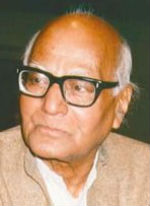
› The late Prof. Dr. Raghu Vira (30 December 1902 – 14 May 1963) was an Indian linguist, scholar, prominent politician, and member of the Constituent Assembly. He was one of the editors of the critical edition of the Mahabharata which was compiled at the Bhandarkar Oriental Research Institute, Pune. Prof. Raghu Vira was a Hindu nationalist and served as Jana Sangh’s president. His son is the scholar Prof. Lokesh Chandra.
Indianization of Scientific Terms: Writings and Notes of the late Prof. Raghu Vira, edited by Prof. Lokesh Chandra, published by Aditya Prakashan, 2/18 Ansari Road, New Delhi 110002.

Filed under: india | Tagged: indianisation of science, raghu vira, sanskrit, scientific terms | 1 Comment »