






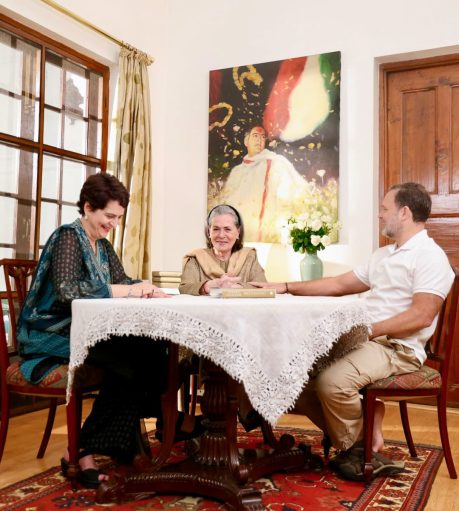
Relying entirely on his memory at a recent family chat, Rahul Gandhi blamed the Indian government of the day for his father’s assassination 35 years ago by Sri Lankan Tamil terrorists, claiming the government was at fault as it had “withdrawn his security”, leaving him fatally vulnerable. – Reshmi Dasgupta
Thanks to technology, what are (or should be) informal family chats or cathartic but ultimately inaccurate blurt-outs become revisionist history. That seems to be precisely the case with the recent “revelation” or “accusation” by India’s 56-year-old leader of the opposition Rahul Gandhi, that his father’s assassination by Sri Lankan Tamil terrorists 35 years ago was actually the Indian government’s fault as it had “withdrawn his security”, leaving him fatally vulnerable.
He relied entirely on his memory for this accusation during an artful on-camera “family chat” with his mother and sister. This does not inspire confidence, as history and government records do not bear him out. It could be excused as the hazy memories of a traumatised child except that unlike in 1984, when he was a teenager at the time of Indira Gandhi’s assassination, he was 21 and studying abroad under an alias when his father was killed in Sriperumbudur.
Admittedly, some 900 million of today’s 1.4 billion Indians were born after 1987 and 1991, the year Rajiv Gandhi sent the troops under the Indian Peace Keeping Force to Sri Lanka and the year he was assassinated, respectively. Even so, the memory of that time has not been wiped out. Roughly 400 million of today’s Indians who lived through that time and remember its details are still around—including this writer. So, Rahul Gandhi’s memory has competition.
Unfortunately for Rahul Gandhi, too many people still remember facts. Such as the Special Protection Group, created first as a unit in 1985 after Indira Gandhi’s assassination in October 1984, was raised specifically for the prime minister and the immediate family. It did not include former PMs. And since Rajiv Gandhi had lost the 1989 elections, and was not PM when campaigning in 1991, he could not possibly have had SPG cover—or had it suddenly withdrawn either.
Having been used to SPG protection for much of his life thanks to his privileged lineage, it may have been easy for Rahul Gandhi to assume it was a Gandhi family prerogative that had been unfairly if lawfully not extended to when a Gandhi was not a PM or the immediate family of one—as happened between 1989 and 1991. Indeed, when Rajiv Gandhi got the Special Protection Group Act passed in 1988 only for sitting PMs, he had not thought of that eventuality either.
Nor was the Gandhi clan presumably aware of this lacuna in the 1988 SPG Act. The Gandhi teenagers, home-schooled since 1984, may not have been aware of goings-on outside 7, Race Course Road. They moved there when 1, Safdarjang Road, became the Indira Gandhi Museum in 1986 before the 1989 Lok Sabha defeat led to them vacating that too for another splendidly isolated abode: the now-famous 10 Janpath. What news could possibly filter through?
Only after their father’s assassination, (despite which the Congress got the most seats but not even a simple majority in the Lok Sabha), when Narasimha Rao became PM of a minority government, he extended the SPG remit to include Rajiv Gandhi’s family in perpetuity. Not that this compassionate and loyal gesture got Rao gratitude from the Gandhis who benefited to the extent of even getting multiple government houses. They only repaid him with humiliation.
At the heart of Rahul Gandhi’s allegation is the mistaken belief that his father was leading the Congress to a resounding victory—despite the buzz at the time to the contrary—and hence his life was in danger. But the very fact that even the sympathy generated by Rajiv Gandhi’s assassination was not enough to propel the Congress to a repeat of the 1984 result should have made Rahul Gandhi realise he was wrong. But he is not a man to acknowledge shortcomings.
No wonder despite SPG facts, Rahul Gandhi now insinuates that some other entity was responsible for his father’s death. It does not matter to him that it would then absolve the Liberation Tigers of the Tamil Eelam terrorists of being the prime conspirators, angered by Rajiv Gandhi’s IPKF intervention. Perhaps that is why his mother and sister also “forgave” the surviving assassination plotters, ignoring the sentiments of the families of the 15 others who died in that blast.
Backing Rahul Gandhi’s “explosive” revelation is his supposed prescience based on accompanying his father to Bihar during the 1991 campaign just before the Tamil Nadu phase. Sonia Gandhi asserted in that same on-camera “family chat” that security was expectedly lax for Rajiv Gandhi in states run by non-Congress parties and mentioned the BJP specifically twice in that context, which was about as off-kilter as Rahul Gandhi’s belated bizarre conspiracy theory.
Why? Because the BJP was not in power in Bihar where Rajiv Gandhi’s election cavalcade was stoned by the crowd, which Sonia Gandhi indignantly recounted in this “chat” with her children. It was a Janata Dal government, with Lalu Prasad Yadav as chief minister, whose Rashtriya Janata Dal is now part of the Gandhi-sponsored INDI Alliance. The BJP had just 39 seats in the 324-member Legislative Assembly in 1991 and less than 12 per cent of the popular vote.
Tamil Nadu was under President’s Rule when Rajiv Gandhi was assassinated. And that is when the weirdness of Rahul Gandhi’s allegations become apparent. Because the caretaker PM at that time was Chandra Shekhar, whose minority government with a Janata Dal breakaway faction had come to power with outside support from Rajiv Gandhi’s Indian National Congress but collapsed when that party withdrew support. The BJP was not in the picture anywhere.
So, is Chandra Shekhar—who cleverly resigned rather than lose a confidence vote in the Lok Sabha and thus remained a caretaker PM in the ensuing general elections—the target of Rahul Gandhi’s allegations? That seems farfetched given his obsession with seeing only a sinister “saffron” hand behind every adverse event. Or did he simply misread the background note he got about Chandra Shekhar’s Samajwadi Janata Party, thinking SJP is actually BJP?
All this, of course, may be dismissed by Rahul Gandhi as irrelevant details, as they are inconvenient to his conspiracy theory. It may be a wrench for him to admit that Narasimha Rao had done his bit to protect the Gandhis in perpetuity as it is impossible for the Gandhis to express gratitude for any political leader’s generosity towards them, as it could then connote that person’s position of relative superiority over them, however brief. That cannot be countenanced.
But they do feel free to lob belated projectiles at unnamed culprits, decades after Rajiv Gandhi’s assassination. Even if at least a few million “ordinary” Indians of above a certain age have recollections to the contrary, backed by documented and recorded political events. Family chat sessions, though somewhat entertaining and occasionally insightful, cannot and should not be accorded the status of oral history, no matter which famous clan’s members are involved. – News18, 27 November 2026
› Reshmi Dasgupta is an eclectic journalist and columnist who writes extensively on lifestyle, culture, food, travel, history, politics, and architecture.
Filed under: india | Tagged: hinduphobia, indian history, indian politicians, rahul gandhi, rajiv gandhi |