







The location of ancient Hindu temples on the contested border between Cambodia and Thailand make it a focal point of tensions between the two nations. – Sushim Mukul
After Thai forces on Wednesday (July 23rd) alleged that they spotted a Cambodian drone along the dense, mountainous Dangrek border, tensions escalated between Thailand and Cambodia. The incident quickly escalated into exchanges of gunfire, rocket attacks, and airstrikes involving F-16 fighter jets. At the heart of the military clashes between the two Southeast Asian neighbours lies an age-old border dispute, a colonial legacy left by the French, where a complex of three ancient Hindu temples, dating back to the 11th century, now stands.
Tensions escalated significantly, with both nations expelling each other’s ambassadors and downgrading diplomatic relations to their lowest level.
The epicentre of the current war is near the Prasat Ta Muen Thom Temple, perched atop dense forests along the ridge which is along the Thailand-Cambodia border.
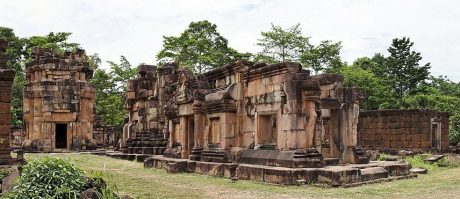
The group of 11th-century Khmer Hindu temples, including Ta Muen Thom, Ta Muen, and Ta Muen Toch, hold cultural and historical significance.
The temple, with a Shivling extracted from rocks, and with Sanskrit inscriptions, also gives a peak into the reach of ancient Indian culture and art forms.
Shiva temple area a flash-point in the Thailand-Cambodia war
Prasat Ta Muen Thom, or “Great Temple of the Grandfather Chicken” in Khmer, is a Khmer Hindu temple built in the 11th century under King Udayadityavarman II. The temple is dedicated to Lord Shiva.
Located on a strategic pass in the Dangrek Mountains, it forms part of an ancient Khmer highway linking Angkor in Cambodia to Phimai in Thailand.
The temple’s location on the contested border between Cambodia’s Oddar Meanchey province and Thailand’s Surin province made it a focal point of tensions between the two nations.
While Cambodia claims ownership based on historical Khmer Empire boundaries, Thailand asserts that the area lies within its territory.
Dedicated primarily to Shiva, Ta Muen Thom houses a Shivling from a natural rock formation in its sanctum sanctorum.
It features a rectangular layout with a south-facing main entrance, which is unusual for Khmer temples. They typically faced east.
Its large gopura (entrance tower) and broad laterite staircase descends towards Cambodia.
Intricate carvings, including depictions of Hindu deities, show the influence of post-Gupta Indian art. These show cultural and artistic links between the Khmer Empire and the offshoots of the Indian Gupta Empire.
How a Hindu temple complex became a Buddhist centre
The Ta Muen Thom complex also includes two smaller temples: Prasat Ta Muen Toch (“Minor Temple of the Grandfather Chicken”), a hospital chapel, and Prasat Ta Muen, a rest house chapel, located within a few hundred metres.
These temples, built during the peak of the Khmer Empire (9th–15th centuries), served as critical stops on the ancient Khmer highway.
Although the temples, protected to some extent, lie mostly in ruins, the ongoing war has brought them into focus.
The proximity of the temple complex to the border, coupled with incomplete boundary demarcation from French colonial maps, has fuelled recurring clashes between the two neighbours.
Initially Shaivite Hindu, the temples later transitioned to Buddhist use as the Khmer Empire embraced Buddhism.
Prasat Ta Muen later became a centre of Mahayana Buddhism, with several structures, including a dharmasala, or rest house for travellers, commissioned by Buddhist King Jayavarman VII.
The temples are specimens of Khmer architecture, where laterite construction with sandstone elements are key features.
How Hindu temples came up on the Cambodia-Thailand border
The temples’ design and iconography trace back to Indian Hindu traditions, which were introduced to Southeast Asia through trade and cultural exchanges, starting in the 1st century.
The Khmer Empire adopted Shaivism and Vaishnavism, influenced by South India’s Pallava dynasty, which had maritime links to far-off lands.
The devaraja (god-king) concept, where rulers were seen as divine embodiments of Shiva or Vishnu, is also similar to the then-contemporary Indian political theology.
These links are evident in the temples’ iconography and Sanskrit inscriptions, which affirm their links to India and its cultural sphere.
These ancient temples were forgotten and lay in ruins. It took a war to bring the temples into public consciousness. – India Today, 24 July 2025
› Sushim Mukul is an editor at India today and writes on geopolitics, culture and heritage.
Filed under: cambodia, india, thailand | Tagged: hindu temples, khmer empire, prasat ta muen thom temple, south asian archaeology, thai-cambodian border conflict | Comments Off on Ancient Hindu temples and the Thai-Cambodian border war – Sushim Mukul