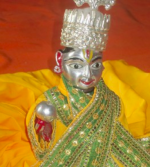








At the Sri Maha Mariamman Kovil in Bangkok, when Thai worshippers kneel and pray to Hindu deities in their local style, leaving with red tilak on their foreheads, it becomes clear how ideas, beliefs and cultures once flowed freely across Asia. – Ajay Kamalakaran
In the bustling business district of Silom, right in the heart of Bangkok, sits a charming Thai rendition of a Tamil Nadu temple complex. Across the street from the shrine, there is a row of shops, where families and young couples buy flowers and pooja offerings before crossing over into the temple. Everything about it, from the vibrant colours and gopuram to the intricate idols, evokes temples of the southern Indian state. The noticeable difference: here, the Indian tricolour flies alongside the flags of Thailand and the kingdom’s royalty.
This temple, built in the late 1870s, has been the centre of Tamil community life in the Thai capital. Once strictly for Hindus, it now welcomes people of all ethnicities and religions.
“It is a temple of Goddess Uma, consort of Shiva, built around 1879 by [a] group of Indians lived (sic) in Bangkok on the purchased land on Silom Road,” a sign in Thai and English reads at the entrance. “At first it was built (sic) a small sala (Indian pavilion) and named Sala Sri Mari Amman.”
The sign does not mention the name of the temple’s founder, but a nearby street, Soi Vaiti, gives it away: it was Vaiti Padayatchi, a Tamil immigrant.
Multiple waves
The historical ties between India and South East Asia date back centuries, and Thailand has always had small Indian communities. But it was the arrival of the British in India that helped facilitate a new wave of Indian immigration.
“The earliest groups [of Indians] to have come in sizable numbers to Thailand appear to have been the Tamils,” academic A. Mani says in his book Indian Communities in Southeast Asia (1993). Many arrived in Phuket in southern Thailand as a result of a “spillover” from Penang and Peninsular Malaysia. “Most of them came to participate in the cattle trade and precious-stone mining, with service groups like the Chettiars following them,” Mani writes.
A larger wave of Indians arrived after the Anglo-Thai (Bowring) Treaty was signed in 1856, liberalising trade in what was then called Siam. As Mani says, these newcomers played an important role in building the “world capitalistic economic mode of trading for … Europeans”.
By the 1870s, as King Mongkut rapidly developed Siam, a number of British entrepreneurs and engineers were drawn to the country along with their subordinates, most of them Tamil. Once they got down to work, Mani says, “they were engaged primarily in … development projects like irrigation, water works, railways and banking.”
Gradual erosion
As Bangkok prospered, immigrants from across India and South East Asia settled in the city, creating multicultural neighborhoods that drew the attention of even Western journalists. “They are Asiatic, but many tongues are heard among them,” The Oregon Daily Journal said in 1907. “The Javanese are gardeners, the Bombay men are merchants, the Tamils, cattlemen and shopkeepers; the Burmese, gem dealers and country peddlers; the Singalese, goldsmiths and jewellers and the Bengalis are the tailors.”
By the early 1870s, a small area of Silom had become an unofficial Tamil neighbourhood, with locals calling Tamils “Kaek”, meaning “guest”. No wonder, when the Mariamman Temple was built around the end of the decade, it became known as Wat Kaek, a name that remains in use today.
“Though today there are other Indian areas in Bangkok,” Mani says, “the early community of Tamils and their temple could have been significant for Bangkok’s indigenous people to use the term ‘Kaek’ only in relation to the worship site of the Tamil Hindus.”
The Tamil community was predominantly male, and it was rare for the men to bring women over from India. Many of them instead married local women from the Mon community, which has roots in southern China.
“All the early marriages of Indian men to indigenous women appear to have been with the Mon women,” Mani says. “This was possible partly due to the fact that Mons were refugees to the Bangkok area and as such were economically depressed; until slavery was abolished many Mons were bonded individuals.”
These marriages led to the gradual erosion of the Tamil language in Bangkok, as children of mixed couples began speaking Thai. Mani notes that the only institution the Tamil community was able to preserve was the Mariamman Temple, which became a symbol of cultural continuity, while other aspects of their heritage faded.
“Until World War II, the community’s temple was managed by newly arriving persons—train drivers from Malaya, or accountants at the Indian bank,” Mani wrote. “As late as 1951, the community could still muster an all-Tamil speaking management committee and publish Tamil books to raise funds.”
As the Tamil community continued to integrate into the wider Thai society, the temple began to get more worshippers from Uttar Pradesh, who chose to call it Sri Maha Umadevi Temple. This shift was not without friction. The “Bajans … and festivals [of those from Uttar Pradesh], their Vaishnavite sect within Hinduism, and their increasing numbers were perceived as a threat to the [temple’s] Tamil-dominated leadership (all members of the Saivite sect),” writes Mani.
As the conflict reached a crescendo by 1920, the migrants from Uttar Pradesh founded their own temple, dedicated to Vishnu, in Bangkok.
Even today, the priests at the Mariamman Temple continue to come from Tamil Nadu, preserving the distinctive Thanjavur feel. Its worshippers, though, have changed. Last week, when I visited, one of the temple’s Tamil priests told me that most visitors today are Thais and ethnic Chinese, many of whom are either seeking a suitable life partner or divine help with marital issues.
Flow of ideas
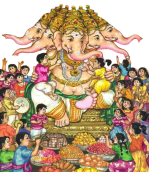
Despite being a Buddhist-majority country, worship of Hindu deities like Ganesha is widespread in Thailand, and the temple’s appeal to locals is not surprising. On festive occasions, Indian expatriates and Thai citizens of Indian origin also visit in large numbers.
“The ancient festival continuing from the Vedic period called Dushera or Navaratri is held annually at the temple annually,” the bilingual sign at the temple entrance says. “The ritual is performed by worship of Uma and other god for ten days-ten nights. At last night of festival, the image of Uma is carrying in procession along the road (sic).”
The sign also mentions that the Uma sculpture was installed as the “principal image” in the temple, while other idols were brought from India as the temple expanded. In 1911, the present boundary wall was built and additional shrines were constructed.
“Very early in its history, the Sri Mariamman Temple came to be recognized as representing Indian culture in Thailand,” Mani writes. “Thus in 1875 King Chulalongkorn, after his visit to India, presented a set of glass lamps to the temple as a token of friendship.”
While the Tamil immigrants found some financial success in Thailand, the country never became as attractive as Malaya or Singapore for those seeking a better life.
Interestingly, Tamil-speaking Muslims migrated to Thailand around the same time as Tamil Hindus. However, the Tamil Muslims did not feel the need to establish separate houses of worship—they prayed in existing mosques and married local Muslims.
Walking through Bangkok, one can still spot locals with partial Indian or Tamil ancestry—descendants of those who came seeking a better future in the 1860s and 1870s.
At the Mariamman Kovil, when Thai worshippers kneel and pray to Hindu deities in their local style, leaving with red pottu (tilak) on their foreheads, it becomes clear how ideas, beliefs and cultures once flowed freely across Asia. This exchange took place long before the rise of European-style nation-states and the concept of national identity cards curtailed it. – Scroll, 24 September 2025
› Ajay Kamalakaran is a writer, primarily based in Mumbai.

Filed under: india, tamil nadu, thailand | Tagged: buddhist societies, hindu culture, hindu-buddhist relations, mariamman temple, tamil culture | Comments Off on Tamil temple in Bangkok is a spiritual sanctuary for all – Ajay Kamalakaran