














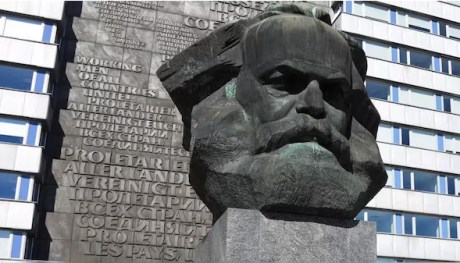
Marx’s personal life was a microcosm of the ideology he birthed: violent rhetoric, personal manipulation, moral inconsistency, and relentless exploitation. – Utpal Kumar
An ideology often mirrors its chief architect. Communism is a prime example. While many try to lay its atrocities at Joseph Stalin’s feet, the seeds of violence, exploitation, and ruthlessness lie deep in the character of Karl Marx himself.
Marx is often venerated as one of the greatest thinkers of modern times, the author of Das Kapital and co-author of The Communist Manifesto, whose ideas shaped the destinies of nations and ignited revolutions. Yet underneath this carefully curated myth lies the brutal reality of Marx—a life marked by personal violence, manipulative opportunism, moral inconsistency, reckless financial irresponsibility, and a shocking disregard for the welfare of even those closest to him.
A Taste for Violence and Domination
Marx’s private letters and political tactics reveal not just a theoretical acceptance of violence, but a genuine appetite for it. His wife Jenny pleaded early on: “Please do not write with so much rancour and irritation.” It was a lifelong pattern.
If author Paul Johnson is to be believed, Marx’s editorial meetings were so loud with shouting they had to shut the windows to avoid alarming passersby. Johnson writes in Intellectuals, “… the rows were perpetual except in Brussels. In Paris his editorial meetings in the Rue des Moulins had to be held behind closed windows so that people outside could not hear the endless shouting.”
Marx’s quarrels were not random; they were often deliberate instruments of domination. From his days as a young radical, he sought to browbeat anyone who disagreed with him, starting with German philosopher Bruno Bauer and extending through nearly every political associate. The brother of Bauer once mocked Marx’s volcanic rages in verse: “Dark fellow from Trier in fury raging, / His evil fist is clenched, he roars interminably, / As though ten thousand devils had him by the hair.”
More troubling still, Marx’s political strategy consistently embraced violence and terror. In 1850, he distributed a “Plan of Action” in Germany explicitly endorsing mob violence and “popular vengeance against hated individuals or public buildings”, urging revolutionaries not merely to condone but to lend such acts “a helping hand”. Marx could even approve of assassination if it served the cause. When a failed attempt was made on Kaiser Wilhelm I’s life in 1878, his fury was directed not at the crime but at the incompetence of the would-be assassin, heaping curses on the man for failing to carry out the deed.
A Deeply Amoral Man
Though Marx cloaked himself in moral earnestness, he dismissed morality itself as “unscientific” and an obstacle to revolution. Russian anarchist Michael Bakunin insightfully remarked that Marx’s zeal for the proletariat was tainted by personal vanity, observing, “Marx does not believe in God, but he believes much in himself. … His heart is not full of love but of bitterness.”
This bitterness often played out through exploitation. It began early. His dying father lamented in 1838 that Marx, only four months into his law course, had already spent more than his father had earned all winter: “You are now in the fourth month of your law course, and you have already spent 280 thalers.” Marx did not even attend his father’s funeral. Instead, he turned his sights on his mother, pressuring her for more funds, justifying it on the grounds that the family was “quite rich” and owed it to him to sustain his “important work”.
He neither pursued regular employment nor made any serious attempt to support his family. From the mid-1840s until Marx’s death, Engels shouldered most of his financial burden. Yet when Engels’ beloved companion Mary Burns died in 1863, Marx responded with a letter that offered the briefest acknowledgement of Engels’ grief before briskly moving on to his real concern: requesting more money.
If Marx’s exploitation of Engels is legendary, equally telling is the way he treated his wife and daughters. The life of his wife was full of misery, largely the result of Marx’s own making. “Every day,” Marx himself conceded, “my wife tells me she wishes she were lying in her grave.”
Ironically, Marx, for all his egalitarian claims, took pride in his wife’s aristocratic lineage. Johnson writes, “Marx was proud of his wife’s noble Scottish descent (he exaggerated it) and her position as the daughter of a baron and senior official in the Prussian government. Printed invitations to a ball which he issued in London in the 1860s refer to her as ‘née von Westphalen’.”
His treatment of his three daughters further underscores his hypocrisy. For all his radicalism, Marx denied them meaningful education and forbade them from pursuing careers. Instead, they were kept at home to play piano and paint watercolours—like any bourgeois daughters—ensuring they were unprepared to make independent lives. He even disapproved of their life partners, referring to one of them disparagingly as “Negrillo” and “The Gorilla” simply because he had some African ancestry.
Squalor and Endless Debt
Despite Engels’ generous subsidies and both his own and his wife’s family fortunes, Marx lived a life of poverty. His annual income never fell below £200—a more than decent sum at that time—yet his family’s silverware, clothes, and even furniture frequently ended up in pawnshops. At one point, Marx was so impoverished he had only one pair of trousers and could alone leave the house.
A Prussian police spy in 1850 reported in detail the Marx household’s squalor: “There is not one clean and solid piece of furniture. Everything is broken, tattered, and torn, with half an inch of dust over everything and the greatest disorder everywhere.”
The report described the living room table piled with manuscripts, children’s toys, dirty cups, pipes, tobacco, and rags. “When you enter Marx’s room smoke and tobacco fumes make your eyes water… Everything is dirty and covered with dust, so that to sit down becomes a hazardous business.”
It was a scene of almost grotesque Bohemian decay.
Johnson believes Marx’s “angry egoism” had physical as well as psychological roots. “He led a peculiarly unhealthy life, took very little exercise, ate highly spiced food, often in large quantities, smoked heavily, [and] drank a lot, especially strong ale, and as a result had constant trouble with his liver. He rarely took baths or washed much at all. This, plus his unsuitable diet, may explain the veritable plague of boils from which he suffered for a quarter of a century. They increased his natural irritability and seem to have been at their worst while he was writing Capital.”
It was at that time he bitterly joked to Engels, “Whatever happens, I hope the bourgeoisie, as long as they exist, will have cause to remember my carbuncles.”
Conclusion
Marx’s personal life, thus, was a microcosm of the ideology he birthed: violent rhetoric, personal manipulation, moral inconsistency, and relentless exploitation. He drained family and friends, lived in squalor while railing against bourgeois hypocrisy, and kept his own daughters under the very constraints he claimed to despise.
Understanding Communism requires looking squarely at Marx himself. In him, we find the violent, exploitative, self-centred tendencies that would, under Lenin, Stalin, and Mao, erupt into horrors on a global scale. The real Marx wasn’t the philosopher-saint he has been made out to be. He was everything but saintly and philosophical. Firstpost, 12 July 2025
› Utpal Kumar is Opinion Editor at Firstpost and News18.

Filed under: world | Tagged: communism, karl marx, marxism, political philosophy, violent rhetoric |











LikeLike