










 “The Modi Committee report on controlling the prices of essential commodities makes eminent sense. Perhaps that’s the reason why a cussed and churlish Prime Minister who has utterly failed in managing the affairs of this nation has done what petty babus are known to do. He has filed and forgotten the report.” – Kanchan Gupta
 In 19th century Great Britain the most indigent among the country’s impoverished masses were provided with shelter and food, or what passed for them, under the Poor Law. And so it was that Oliver Twist, his mother dead and father missing, found himself first at a ‘baby farm’ and then at a workhouse where he was barely able to keep body and soul together. Food for Oliver and his fellow inmates was a dollop of inedible gruel that was carefully rationed by fearsome beadles. There were no second helpings. The boys decided that one of them should try and ask for more — a draw of lots ensued and it fell upon Oliver to be the fall guy. Clutching his bowl, Oliver stepped forward and uttered the six words which have proved to be the most memorable of those penned by Charles Dickens: “Please, sir, I want some more.” Needless to say, those who were in charge of the workhouse, well-fed, well-groomed and well-empowered, did not take kindly to Oliver’s outrageous demand.
In 21st century India we have an expanding underclass, the masses who are wretchedly poor and desperately hungry. The rich live in their plush ivory towers, the middle-classes remain cocooned in their tacky drawing rooms, the rest languish in abject misery. The rich aspire for the moon, the middle-classes aspire to become rich, the miserably impoverished aspire to earn Rs 26 a day so that they can crawl above the poverty line. We have our version of the ‘Poor Law’, drafted by the Army of the Virtuous also known as the National Advisory Council, headed by Ms Sonia Gandhi, and implemented by a Government which has a surfeit of ‘economists’, including one who presides over a decrepit and corrupt regime. It’s called the Mahatma Gandhi National Rural Employment Guarantee Scheme. It’s also the latest means of politicians and babus pocketing cash meant for the poor, a fact established in State after State, including Odisha whose allegedly squeaky clean Chief Minister can reportedly do no wrong.
 In this 21st century India, where food inflation hovers at nearly 11.5 per cent and vegetables are beyond the reach of the ‘common man’, the ‘aam admi’ for whom the Congress toils night and day, it’s only the children of the rich and the middle-classes who can dare say “I want some more” when food is served on the table. Those born into less fortunate families make do with what is available; if there’s nothing to eat, they go to bed hungry. Were they to ask for food, the beadles in charge of this wondrous land of ours, including our ‘economist’ Prime Minister and his ‘economist’ Planning Commission Deputy Chairman, would be mighty displeased. As for the Congress, its leaders have either never known hunger or have forgotten what deprivation means. It’s doubtful they would know the prices of vegetables or milk or fruits, or rice and wheat, for that matter. Such mundane details are not meant for the privileged ruling classes. Their kitchens are taken care of, if not by tax-payers then those who steal on taxes.
The Economic Times provides a good analysis of the latest inflation figures, released last Thursday. Food inflation is at a six-month high of 11.43 per cent with vegetables 25 per cent costlier on an annual basis, fruits dearer by 11.96 per cent, milk by 10.85 per cent and eggs, meat and fish by 12.82 per cent. “This double-digit inflation comes on top of a very high level of price rise recorded in October last year, when it stood at 14.20 per cent — already a ‘high-base’ comparison. The last time food inflation stood this high was on April 9 when it was recorded at 11.53 per cent.” Thankfully, this time we have been spared bogus promises like those made by the Prime Minister earlier. We don’t need to live under the illusion that he will rein in prices in two weeks, four weeks or six weeks. He is either blissfully ignorant of what a kilo of potatoes costs or just doesn’t care anymore. A Regent has other things to worry about, for example, how to keep the Prince occupied with thoughts other than asking him to vacate the masnad.
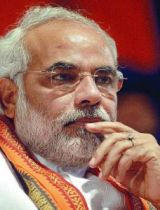 Nevertheless it would be in order to demand an explanation from the Prime Minister as to what has he done with the report submitted by the Working Group on Consumer Affairs headed by Gujarat Chief Minister Narendra Modi. The other members of the committee were the Chief Ministers of Maharashtra, Andhra Pradesh and Tamil Nadu. The committee was set up in April 2010 to suggest ways and means of holding the price line for essential commodities. By early this year, the report was finalised and it has been gathering dust in some corner of the Prime Minister’s Office for the past six months. It’s not a voluminous report crammed with senseless data and meaningless jargon. That’s not Mr Modi’s style. It’s a slim report which lists 20 recommendations with 64 detailed actionable points for their expeditious implementation. Here are some of the recommendations:
Future Markets: Considering the lack of strong linkages between spot and future markets at present, it has been suggested that for the time being essential commodities should be kept out of the future markets.
Price Stabilisation Fund: The setting up of a Price Stabilisation Fund by the Government of India has been suggested to help State Governments in the procurement and distribution of essential commodities in short supply.
Agriculture Markets: They should be liberalised for improving the efficiency of distribution channels from farms to consumers, increasing the participation of organised sector and cooperatives in retailing, including farmers’ markets, agro-processing, storage and cold chains for wastage control and reduction. This is to be backed by a proactive monetary policy. For evolving a single national agriculture market, the setting up of a Ministerial-level co-ordination mechanism at the national and the regional levels for coordinated policy-making has been recommended.
Expanding Priority Sector Lending: The Modi Committee has suggested the immediate enlarging of the scope of priority sector lending in a manner that agriculture marketing activities can become eligible and the ratio of priority sector lending to the agriculture sector can be raised from the current level of 18 per cent.
Minimising Information Asymmetry: The report calls for establishing a mechanism, if necessary by creating a dedicated agency, to collect and disseminate information to all stakeholders on production, imports, stocks and overall availability of essential commodities through extensive use of information technology.
Unbundling FCI: Since the Food Corporation of India plays a major role in the procurement and distribution system of essential commodities, the committee has called for the unbundling of FCI operations for procurement, storage and distribution.
Among the other recommendations of the committee are:
- Preparing a 10-year perspective plan for improving the country’s agri-infrastructure to ensure better linkages for farm production and marketing of farm produce.
- Making offences under Section 10-A of the Essential Commodities Act non-bailable and setting up special courts for the speedy trial of those found violating the law.
- Increasing the period of preventive detention under the Black Marketing Act from six months to one year.
The Modi Committee report on controlling the prices of essential commodities makes eminent sense. Perhaps that’s the reason why a cussed and churlish Prime Minister who has utterly failed in managing the affairs of this nation has done what petty babus are known to do. He has filed and forgotten the report. – The Pioneer, New Delhi, 29 Oct. 2011
» Follow Kanchan Gupta on: http://twitter.com/KanchanGupta. Blog on this and other issues at http://kanchangupta.blogspot.com. Write to him at kanchangupta@rocketmail.com
Filed under: india | Tagged: class, economics, globalisation, indian parliment, inflation, manmohan singh, NAC, poverty, sonia gandhi | Leave a comment »