









What most political commentators miss is the nature of the tectonic shift taking place in India. What we are witnessing is not a mere change in electoral fortunes of different political parties, but a revival, reaffirmation and renaissance of a long suppressed ancient civilisation. – Virendra Parekh
What Bengal thinks today, the rest of India will think tomorrow. This was said once upon a time, when Bengal led the Indian renaissance in the nineteenth century. Though a truncated part of that great land, West Bengal is now on its way to reclaim that status. Three weeks have passed since the Hindu storm swept away the corrupt, decrepit and divisive regime led by Mamata Banerjee. A new Bengal, unimaginable just a couple of months back, is emerging into view under a fresh, no-nonsense and unapologetically nationalist state government. Bangladeshi infiltrators are running back home, fencing of border is underway, namaz on road is banned, temples and other properties of Hindus occupied by hoodlums of the earlier regime are being liberated, dreaded goons are paraded in underclothes through the market and illegal structures are being bulldozed. In short, garbage accumulated over decades of the Congress, Communist and TMC rule is being cleared. This is necessary, though far from sufficient, to put the social and public life back on the rails, and also to attract capital, revive investment and revitalise the industry and economy.
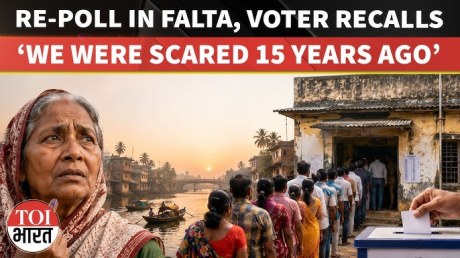
Bengal, powered by Hindu assertion, has accelerated India’s march towards Hindu Rashtra. If there was any doubt left, it was clinched by the re-poll in Falta, until recently a stronghold of Jahangir Khan, a henchman of TMC half-boss Abhishek Banerjee. Election in this constituency was countermanded after the detection of widespread electoral malpractices by Jahangir Khan and his men. In the by-election held on May 21, Khan who had earlier threatened to slit the throat of the police officer who warned him of legal action, meekly withdrew from the context, was untraceable on the polling day and lost deposit.
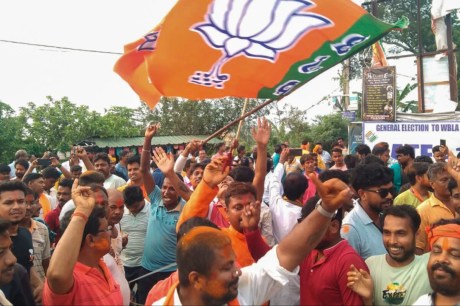
But the election was no longer about any candidate or party. It was about expression of Hindu resolve. The polling was about 87 per cent, unprecedented for a re-poll which could not influence the formation of the government or political scene in the state in any manner. Hindus voted massively, around 97 per cent. Every single vote went to the BJP, which won the seat with a margin of over one lakh votes. Muslims too voted heavily, about 73 per cent, mostly for CPM. Not a single vote went to BJP.
The message is clear. Hindus are capable of sinking their differences and voting as one man, when the crunch comes. And once this happens, all other factors, forces and considerations become just irrelevant. This is bad news for the middlemen who have built careers and fortunes by brokering Muslim votes. It is even more ominous for political parties which are used to appease Muslim vote banks as a sure shot bet to win power. Falta told them that you may win every single Muslim vote and yet may still lose badly.
There is no doubt that Bengal results will shape the political discourse and voter behaviour in the coming months, if not years. Before the Bengal election, Hindus were aware of the existential threat facing them. It was now or never, literally. The results have made them aware of the power of voting unitedly. They have realised that they have only to keep their eyes open, recognise the forces in play, take an informed decision and act upon it. The rest will follow. They realise that goons and strongmen can terrorise people only till they are protected by politicians in power. One that protection is withdrawn, the dreaded mafias are no stronger than sundry pickpockets.
Next year, assembly elections are coming up in seven states: Uttar Pradesh, Uttarakhand, Punjab, Himachal Pradesh, Gujarat, Goa and Manipur. They are still many months away and the situation varies from state to state. So, it would be idle to speculate about the outcome. However, if the thinking and utterances of opposition leaders are any guide, the outcome is quite predictable. Akhilesh Yadav, the SP leader and opposition face in UP, is still talking about PDA (Pichhada or backward, Dalits and Alpasankhyak or minorities, a euphemism for Muslims.) Rahul Gandhi has asked Congress workers to say Muslims, not minorities, as if there was any doubt about whom they had in mind. These leaders are like old generals fighting the last—i.e. previous—battle. They cannot see that the old politics of appeasing Muslims while dividing Hindus has run its course. The system that suffocated Hindu society for decades is on its deathbed and cannot be revived by chanting the tired outdated slogans of secularism or social justice.
What most political commentators, not just opposition leaders, miss is the nature of the tectonic shift taking place in India. What we are witnessing is not a mere change in electoral fortunes of different political parties, but a revival, reaffirmation and renaissance of a long suppressed ancient civilisation. The assertion is not limited to politics. Ordinary people who have nothing to do with politics are noticing, for example, how demography is changing in their own neighbourhood and what it means for them, how Muslim men are targeting Hindu girls and women, how Hindu gods are portrayed in Hindi films, how Christian missionaries are converting tribals and other vulnerable groups and so on. They also realise that the most effective way to stop this multi-fold assault is to unite and hand over political power to leaders who are unapologetically Hindu in their thought, speech and action.
After seven decades of Nehruvian nightmare, we are again in one of the creative periods of Hinduism. We are viewing our ancient faith with fresh eyes. There is a quest for a more dynamic social order which will earn India its rightful place in global comity. We may wish that this awareness had come much earlier. But history or Mahalakal moves at his own pace. He cannot be pushed from behind to move faster; nor can its march be stopped by standing in his path. Growth is slow where roots are deep. And, a few decades are but a moment in the history of an ancient civilisation like India.
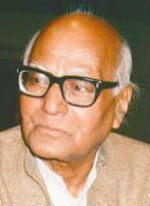
As I write this, I become aware of how prescient Sita Ramji—the late shri Sita Ram Goel—had been. Hindu society is under siege from a united front of anti-Hindu ideologies of Islam, Christianity, Communism and Macaulay-ism and the only way to break this siege is for Hindus to capture political power, he said decades ago, in early 1980s:
“If Hindu society permits this free for all any further, the days of Secularism and Democracy in this country are numbered. Let the Hindus unite and save themselves, their democratic polity, their secular state, and their Sanatana Dharma for a new cycle of civilization, not only for themselves but also the world.” – Hindu Society Under Siege
Sita Ramji penned these words when the word ‘Hindu’ itself was a taboo. Few writers could think on these lines then and fewer still had the courage to put it in as many words. That is what sets him apart.
Sita Ramji’s solution to India’s communal problem was equally bold: Hindu society should claim its lost children back. Not by force, fraud or allurements, but by a quiet realisation of truth about both—their ancient faith and their adopted faith. It may look an impossibly distant goal, but history may vindicate him again.
› Virendra Parekh writes on economics and politics, also on issues related to Indian civilization, history and cultural nationalism.
Filed under: india, west bengal | Tagged: BJP vs TMC, BJP wins, hindu renaissance, hindutva, west bengal elections |