




The debate on human rights has wrongly centred on the rights of the suspects, accused and culprits. India needs to restore balance by highlighting the right of the victims of crime and terrorist acts to retributive justice, innocent citizens’ right to deterrent state action and the security personnel’s right to respond to the challenge adequately. – Virendra Parekh
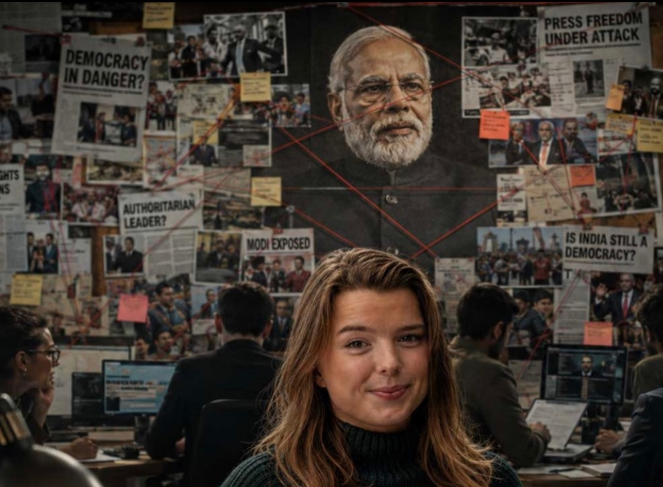
A Norwegian journalist sought to embarrass Prime Minister Narendra Modi during his recent visit to her country. “Why don’t you take questions from the freest press in the world?” she shouted. Mr. Modi, as was scheduled, departed from the scene with his Norwegian counterpart without engaging her. After all, the occasion was a joint statement, not a press briefing and journalists were informed in advance that no questions would be taken. However, the lady, Helle Lyng from Norway’s little-known media house Dagsavisen, was only playing her pre-determined part of being a confrontationist. Soon, Mr. Modi’s “refusal” (even “running way”) to face questions on human rights violation in India became a rage on left-liberal media, duly amplified by local coolies in Indian social media and polity. Sundry trollers basked in the glory of taking potshots at India’s powerful and popular prime minister.
If there was any doubt about Helle Lyng’s agenda, it was removed by her question in the subsequent press briefing when India’s Ministry of External Affairs (MEA) Secretary (West) Sibi George took questions from the press. “Why should we trust you? Can you promise you will stop the human rights violations that go on in your country?” she asked. As can be seen, this was a loaded question. It presumed guilt, as in “When did you stop beating your wife?” Also, notice the double standards. Helle Lyng would not ask the same question of her own Prime Minister Jonas Gahr Store, who was standing beside Mr. Modi. For the unversed, Norway, the nation that sits atop the World Press Freedom Index and fashions itself as a global champion of human rights, has an indigenous people’s rights crisis festering in its own backyard. The Sami people, Norway’s indigenous community, have suffered documented, court-confirmed, and government-acknowledged human rights violations.
But let us remain focused on India. In reply to her question, India’s MEA secretary invoked India’s civilisational legacy and its contribution to humanity, including zero, chess and yoga. He referred to India’s robust democracy, its constitution that guarantees liberty, justice and equality to all citizens and regular, free and fair elections with participation of nearly a billion people. He cited India’s conduct during Covid, when the country came forward to help the world and supplied vaccines to more than 100 countries and medicines to 150 countries. George also cited India’s role during its G20 presidency, pointing out that India brought a divided world together and secured the Delhi declaration. He also highlighted India’s efforts to bring the concerns of the Global South to the main table and the inclusion of the African Union as a permanent member of the G20.
Helle Lyng, apparently, had no patience for all this. She repeatedly interrupted Mr. George to give her a straight reply, who insisted on his right to reply to her question as he thought appropriate. Helle Lyng had reportedly left the conference by the time he came to India’s democracy and constitution.
This is not surprising. Helle Lyng presented and represented a narrative which dominates western perception of India under Narendra Modi. Negativity towards India is not random or occasional. It is structurally entrenched. Deploying colonial imagery, academic bias, commercial economics and an ideological secularism India never signed up for, the western media, academia and NGOs with political agendas have created an image of India that is sliding back on democracy, where human rights are routinely violated, media is repressed and opposition leaders are harassed. Its proponents expect India and Indians to be properly defensive, if not profusely apologetic, every time there is any mention of democracy and human rights. Any detailed, firm and unapologetic response, as the one from the MEA Secretary would only annoy them.
How should India respond? A legitimate and non-offensive option is the one chosen by the Indian spokesman noted above, presenting facts about India and her civilisation. However, his tone was defensive overall, which did not go down well with quite a few citizens and commentators. Echoing their view, Hindol Sengupta suggested that India should have contested Norway’s qualifications for seeking India’s democratic credentials and exposed Norway’s hypocrisy and double standards on climate action, treatment of immigrants and indigenous population. However, Norway is not the only country where the narrative is played. Also, pointing out shortcomings of others will do nothing to change western perception about India.
The bull has to be taken by horns. The narrative has to be busted by exposing its hollowness. India must reject western notions of human rights, minorities and democratic rule by exposing their absurdity when applied to Indian conditions.
A democratic state is founded on individuals, not groups and certainly not religious groups. A secular state would refuse to divide its citizens on religious lines. A democratic secular state, therefore, cannot recognise any minority or majority, except in an electoral sense. However, if certain groups claim special minority rights or privileges on the basis of religion, language or ethnicity, they must also have corresponding special duties and obligations e.g. to respect the sentiments of the majority and respect national customs and traditions. If the majority community has special obligations and responsibilities towards minorities, it must also have corresponding rights and privileges e.g. the right to remain in majority by resisting engineered demographic change and the right to define the cultural ethos of the country.
The debate on human rights has wrongly centred on the rights of the suspects, accused and culprits. India needs to restore balance by highlighting the right of the victims of crime and terrorist acts to retributive justice, innocent citizens’ right to deterrent state action and the security personnel’s right to respond to the challenge adequately. Since the terrorists wilfully trample upon the rights of ordinary citizens who have done them no harm, they (i.e. terrorists) morally forfeit their rights. This should be borne in mind while dealing with them.
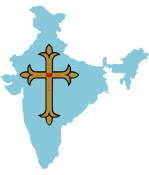
Religious freedom, India should tell the world, includes freedom of followers of ancient, pacifist, non-proselytising natural religions to practice their faith peacefully without being targeted by well-oiled conversion machinery of expansionist ideologies of power, masquerading as religions. Christian missionaries, thus, violate the right of tribal communities and other target groups to follow their ancestral traditions. Governments of countries with such religions have both a right and an obligation to defend them against agents of predatory faiths. Moreover, freedom of religion includes freedom from religion. The rights of atheists and heretics also matter.
Freedom of expression cannot include calls for cessation, vivisection of the country or incitement to violence. It also cannot include ridicule or contempt for any religion, or calls for its eradication.
India is often hectored in the name of diversity. True, India comprises a bewildering diversity of languages, races, creeds, castes, traditions and customs. For that very reason, however, the emphasis in public policy should fall on factors that unite the country (defence, economy, law and order, meritocracy, history and culture) rather than those that divide it. Secondly, every country has a measure of diversity but also a principle of unity that holds it together. That principle has to be respected to preserve the integrity and sovereignty of the country. India’s highly diverse society is held together by its culture and civilisation rooted in Hindu Dharma. Nourishing that unifying principle (e.g. cultural unity) should not be viewed as inimical to diversity.
The approach to democracy etc. outlined above is more realistic and closer to ground reality in most countries. It is also just, fair and practical. India should refine, define and announce it to the world without being apologetic. A defensive attitude will sound death knell of India as it has existed through millennia. This is because unlike the Muslims and Christians in India, Hindu society has no patrons and financiers abroad and has to depend entirely on its own resources from inside its only homeland. It must develop the self-confidence to be itself without seeking certificates of good character from ignorant, prejudiced or agenda-driven outsiders.
› Virendra Parekh writes on economics and politics, also on issues related to Indian civilization, history and cultural nationalism.
Filed under: india, norway, world | Tagged: european hypocrisy, human rights, indian civilisation, indian democracy, norwegian colonialism |