










 My own “belief” is that time will show the wisdom of the sacralisation of Nature early India systematically undertook. As the US astronaut Edgar D. Mitchell said in 1971, during the Apollo 14 mission, saving the planet will take nothing less than “a transformation of consciousness.” – Prof Michel Danino
If all things in this universe are impelled by consciousness — the master idea explored in the previous article in this series (“Consciousness, the Key to Indic Thought”, 6 August) — it stands to reason that all things are potentially sacred. The cosmos itself, to begin with, and this finds its way beyond India’s philosophico-spiritual texts: in his Aryabhatiya (early sixth century CE), the celebrated early Indian mathematician Aryabhata suddenly abandons his dry procedures and formulas to note, as though enthralled by the contemplation of this infinite universe, “Knowing the motion of the Earth and the planets on, one attains the supreme brahman after piercing through the orbits of the planets and stars.” Brahman (not to be confused with the creator god Brahma) is the supreme essence of this universe. Two centuries later, another fine mathematician, Lalla, will echo this thought: “He who acquires a comprehensive knowledge of the celestial sphere … sees, in front of his eyes as it were, the whole universe; he gets spiritually enriched and attains moksha….”
Let us return to earth, which must be equally sacred, as I wrote on “India’s own sacred ecology” (5 December 2016); from that point of view, there is no distinction between heaven and earth, the creator and the created. (Indeed, Indian thought has enjoyed invoking such pairs of “opposites”, only to fuse them back together: Shiva-Shakti, Ardhanarishvara, Purusha-Prakriti, Harihara….) To hold nature and life sacred and occasionally to deify them has not been India’s prerogative: most other pre-Christian cultures did so too, from the Egyptian or the Greek to the Native American and aboriginal cultures, leaving behind moving invocations of Nature’s beauty and bounty as the sustainer of all life.
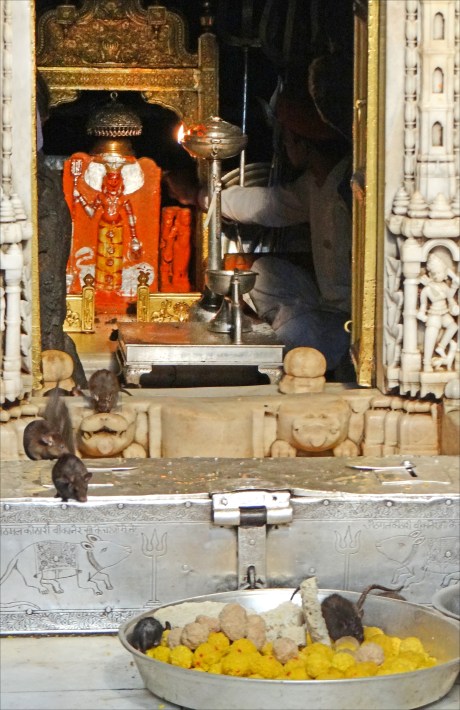
India, however, went further or deeper in giving this concept a body, not content with deifying oceans, mountains, rivers, animals and plants, but integrating all of them in her pantheons, worships, rituals, paintings, sculptures, monuments and literary compositions. It is easy enough to ridicule our “sacred cows”, but the same sacredness extends to all animals, even the humble rat, as Deshnoke’s temple to Karni Mata testifies, sheltering thousands of them. Before we snigger again, let us reflect on the concepts these beliefs attempt to express. Nanditha Krishna’s recent book, Hinduism and Nature, provides a wealth of illustrations of this love story between the two.
But are these mere “beliefs”? They resulted, as every student of history knows, in ecological practices ranging from wildlife and forest conservation to water management and traditions of food growing and sharing—practices we are groping back towards in the current ecological crisis. Indeed, contemporary environmental thinkers, especially those of the “deep ecology” school, have often acknowledged finding inspiration from Hindu, Buddhist and Jain concepts—even as they have rejected the biblical legitimisation of man’s God-given dominance and exploitation of all creation. My own “belief” is that time will show the wisdom of the sacralisation of Nature early India systematically undertook. As the US astronaut Edgar D. Mitchell said in 1971, during the Apollo 14 mission, saving the planet will take nothing less than “a transformation of consciousness.”
The transition to the land is but a small step: imbuing the geography with sacredness began in early Vedic times. Pilgrimage sites and routes, networks of landmarks connected with the two Epics were some of the devices used with great efficiency; in today’s Tamil Nadu, villagers sometimes point to hillocks sitting in the plains as being detached lumps from the mountain Hanuman carried back, flying, from the Himalayas to Lanka. Rocks, caves and shrines were visited by Agastya or Rama or the Pandavas—anyone, in fact, as long as the place and therefore the society living there can somehow be attached to a Greater Story. This construction of a sacred geography, studied by a few scholars such as the anthropologist K.S. Singh or the geographer Rana P.B. Singh, finds no place in our textbooks, even though it was a major contributor to the cultural integration of early India and the building of an Indian identity.
Enough has been said and written on India’s classical arts: the temple builder, the sculptor’s mastery, the dancer’s body or the musician’s instrument. The artists strive to convey through their medium something of the divinity, or to connect us to it by creating a range of emotions in us. In the process, the borderline with profane art is often blurred: even a humble residence can invoke cosmic principles of vastuvidya. Ultimately, nearly nothing of daily life seems to be left out of the exercise: from birth to death, with marriage and childbirth on the way, every stage is an occasion to reconnect to a greater purpose beyond the drab daily routines. Even sexuality can be part of the sacred, as the Brihadaranyaka Upanishad (no, not the Kama Sutra) makes clear.
Food production, sharing and consumption are also part of this vision in which nothing, ultimately, is “secular”. An old legend concerning Thiruvalluvar, the author of the celebrated Kural, narrates how, whenever he sat at his meal served by his wife, he would always keep next to him a toothpick, but would never use it in the end. His wife was intrigued, but perhaps too shy to ask. After a few decades of this ritual, however, curiosity got the better of her and she asked her husband the burning question. “My dear,” he answered, “should you ever have spilled a grain of rice while serving me, I would have picked it with the toothpick, since food is a gift of the gods and not to be wasted; but I never needed to do so, since you never spilled a single grain.” Are there not some lessons here for our current cult of unbridled consumption and wastage? – The New Indian Express, 3 September 2018
» Prof Michel Danino is a French-born Indian author, scholar of ancient India, and visiting professor at IIT Gandhinagar.
Filed under: india | Tagged: ecology, hindu civilisation, hinduism, sacredness of nature | 1 Comment »