









Perhaps the most critical reason Buddhism disapeared from India was that although one could be a lay Buddhist, Buddhism also wanted to remove able-bodied men in their prime from society, to turn them into monks who lived on the dole. Who was supposed to do the work, then? Who was left to protect the family? It was dangerous and impractical for society. And so, Buddhism gradually faded in the land of its birth. – Renuka Narayanan
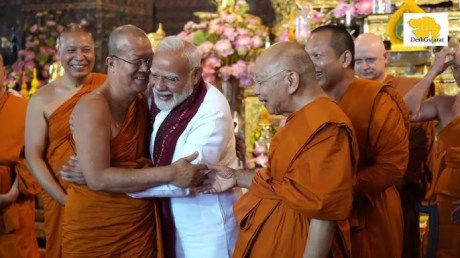
With the Thai government presenting our prime minister with the Tipitaka, I thought it would be nice to revisit Buddhism this week. Tipitaka, in Pali, as in Tripitaka in Sanskrit, means ‘Three Baskets’ and refers to the scriptures of Theravada Buddhism, comprising three collections: the Vinaya Pitaka (Sangha rules), the Sutta Pitaka (teachings and discourses), and the Abhidhamma Pitaka (philosophical commentaries).
The Tipitaka is considered the earliest collection of Buddhist teachings. The Vinaya Pitaka contains the monastic rules and regulations for monks and nuns. The Sutta Pitaka or Sutra Pitaka comprises the Buddha’s discourses and teachings and those of his enlightened disciples. The Abhidhamma Pitaka explains and analyses Buddhist doctrines and philosophical concepts.
Scholars have noted that three specific signs—the Bodhi tree (pipal), the dharma chakra, and the stupa—occur frequently at all major Buddhist sites in North India, and thus concluded that the earliest Buddhist cult practice focused on these.
There is no Ishwara or God in Buddhism (or Jainism). Buddhism is a non-theistic religion, meaning it doesn’t recognise a creator god or a deity who intervenes in the world. Instead, it focuses on personal enlightenment and the Buddha’s concept of a path to liberation from suffering. However, Buddhism later incorporated deities into its cosmology. A particularly popular one is the benign goddess Tara.
As in Hinduism, Buddhists believe in reincarnation and the law of karma, where one’s actions determine one’s future life. The concept of the Bodhisattvas embodies this belief, a Bodhisattva being Gautama Buddha in his former life. The Jataka stories largely pertain to the Bodhisattvas.
Buddhism is not a vegetarian religion. Buddhist cultures across Asia are non-vegetarian, and the Buddha himself is said to have died an agonising death from dysentery after eating spoiled pork. The Dalai Lama, a prominent modern Buddhist figure, eats meat. Vegetarianism is a personal choice without judgment.
As in Hinduism, elephants are revered in Buddhism as symbols of fortune and protection. They are featured in important Jataka tales, some of which you may recall from my earlier piece, Elephant Jatakas with a Timeless Message (Sept 11, 2023). Golden fish, shown in pairs, are also considered lucky in Southeast Asian Buddhism, representing salvation from suffering and fertility.
Buddhists and Hindus can freely marry each other in India without religious or legal restrictions. In ancient times, families often followed different Dharma religions—Hinduism, Buddhism, Jainism—evident from household shrines in a single home. Later, Sikhism and Hinduism shared deep mutuality and interconnectedness.
The most famous ancient example of this Indian religious fluidity is Ilango Adigal, the Jain prince who authored the Tamil epic Silappadikaram in the 2nd century CE. His friend, Shattan or Sattanaar, authored Manimekhalai, a sequel to Silappadikaram that was essentially Buddhist propaganda. And who was the patron of both authors but Ilango Adigal’s elder brother, the Hindu king Cheran Senguttuvan?
Buddhism’s two routes around Asia developed distinct sectarian characteristics—hill Buddhism and sea Buddhism. Whatever their differences, though, all Buddhists revere the Buddha as their central figure.
However, one needs to do some plain speaking on the theory that “Hindus drove Buddhism away.” This is nonsense. It was certainly a turf war for royal and public patronage between Hinduism, Buddhism, and Jainism in those days. But let’s look at the facts on the ground.
Due to his unnaturally protected early life, the Buddha suffered a severe shock when he first saw an old man, a sick man, and a dead man. He parlayed his gut reaction as his credo—that “all is suffering, all is momentary” (sarvamdu khamdukham, sarvam kshanikam) . This lost its impact over the years because it is opposed to the driving principle of Hinduism, which is ananda, joy.
Hindus consider human birth a golden chance to escape rebirth and dissolve into the light of God. A Hindu’s spiritual goal is sat-chit-ananda, usually translated as “truth-consciousness-bliss”, the transcending joy of realising God’s presence in everything. Ananda is why Indians are so celebratory, always singing, dancing, and feasting. But there is no music or dance in sober traditional Buddhism, only chanting. This went against the inherent Indian cultural grain.
Secondly, the visceral human need to love a “face” was not satisfied in Buddhism, which lacked Ishwara. As Tulsidas later had Bharata tell Kaikeyi, “Janani, main najiyoon bin Ram,” or “Mother, I cannot live without Rama,” expressing popular sentiment.
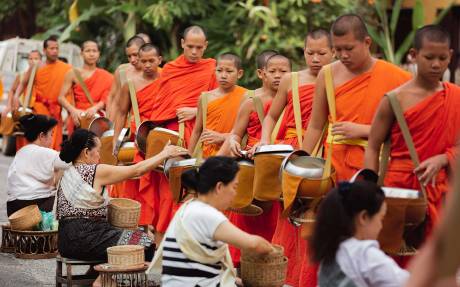
The third and perhaps most critical reason was that although one could be a lay Buddhist, Buddhism also wanted to remove able-bodied men in their prime from society, to turn them into monks who lived on the dole. Who was supposed to do the work, then? Who was left to protect the family? It was dangerous and impractical for society. And so, Buddhism gradually faded in the land of its birth.
Buddhist missionaries learnt from this and softened their approach abroad. They led good, helpful lives and attracted the public by example, which is how Buddhism took root and flourished across Asia. They often combined other faiths with the Dhamma and the Sangha. That’s how our prime minister saw the Ramakien dance and received the Tipitaka in Thailand. – The New Indian Express, 7 April 2025
› Renuka Narayanan is an author and senior journalist in Chennai.
Filed under: india, thailand | Tagged: buddhism in india, buddhist culture, buddhist monks, hindu-buddhist relations, modu in bangkok | Comments Off on Why Buddhism faded in the land of its birth – Renuka Narayanan