










Baburi is not described in terms of lineage, rank or purpose. Instead, he is defined by presence. The boy becomes memorable not because of who he is, but because of what he stirs in Babur. – Kalpana Sharma
While reading Raiders from the North, the first in the six-part Empire of the Moghul series by Diana Preston and Michael Preston, who write as Alex Rutherford, one encounters the many layers of Babur: warrior, poet, exile and empire-builder. The novels trace his journey from a young prince in Ferghana to the founder of one of the subcontinent’s most powerful dynasties. Yet beyond the battles and conquests, there are quieter, deeply human moments. One of the most striking is his account of a boy named Baburi Andijani..
A Chance Encounter
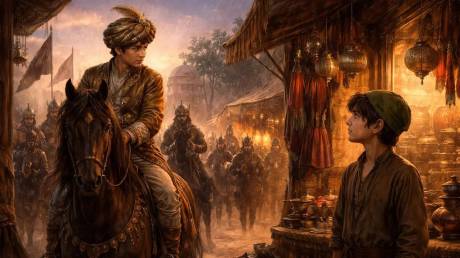
Our most intimate window into Babur’s inner life is the Baburnama. It is here that Baburi appears as a fleeting presence who leaves a lasting impression. Their meeting is neither political nor planned. Babur writes of encountering him in the camp-bazaar, a temporary, restless marketplace that followed military encampments, filled with traders, performers, soldiers and those living on the margins of empire. It is in this ordinary, almost chaotic setting that something shifts.
There is no dramatic introduction. Babur sees him and the moment lingers. What stands out is how he writes about it. Baburi is not described in terms of lineage, rank or purpose. Instead, he is defined by presence. The boy becomes memorable not because of who he is, but because of what he stirs in Babur.
Baburi, by most accounts, was younger than Babur, most likely an adolescent. In the Baburnama, Babur describes a ‘strange inclination’ that took hold of him in his youth, an emotion so consuming that it unsettled him completely. He writes of being unable to meet Baburi’s gaze, unable to speak, unable even to compose himself in his presence.
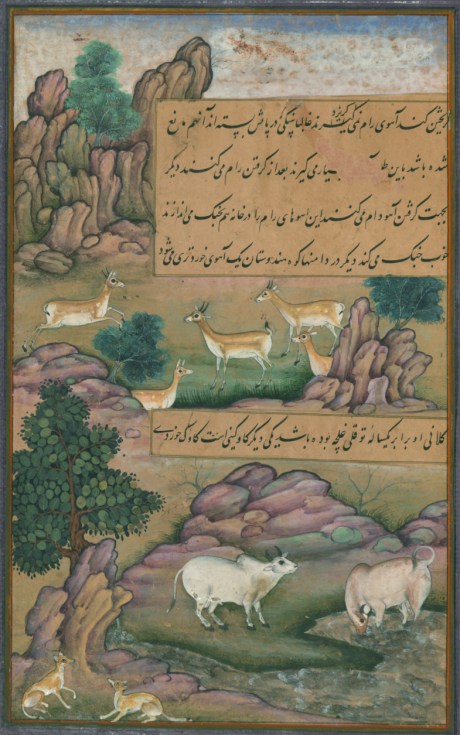
Babur wrote his memoir Baburnama (Archives)
In one vivid passage, Babur recounts unexpectedly coming face to face with him in a narrow lane. The encounter overwhelms him. Words fail, eye contact becomes impossible, and he walks past carrying what feels like a storm of confusion and shame.
In Raiders from the North, Rutherford expands this moment, imagining Baburi as someone drawn into Babur’s inner circle. Their growing closeness, the novel suggests, unsettles those around him, advisors and elders who watch but do not openly object. While this remains a fictional interpretation, it builds on the emotional truth of Babur’s own writing: that this was not a passing glance, but a presence that lingered.
An Emotion Without Ease
Baburi’s appearances in the memoir are brief but charged. Babur notes that the boy would come to his presence from time to time, yet even these moments offer no ease. Authority seems to dissolve; hesitation takes over. Historian Aabhas Maldahiyar, in Babur: The Chessboard King, writes of how Babur turned to Persian poetry to articulate what he could not express directly. He recalls a couplet by Muhammad Salih: “I am abashed with shame when I see my friend; my companions look at me, I look the other way.” The lines mirror Babur’s state, caught between longing and restraint, emotion and silence.
There is no resolution to this story. Baburi does not emerge as a companion in Babur’s later campaigns or court. He does not take on a defined role in the emperor’s life. Instead, he fades from the narrative almost as suddenly as he appears. In The Mughal Throne, Abraham Eraly notes that this remains Babur’s only recorded romantic infatuation.
A Fleeting Presence, A Lasting Trace
In a life defined by relentless movement, lost kingdoms, shifting alliances and hard-won victories, this episode stands apart for its stillness. It captures a young Babur not as a conqueror, but as someone disarmed by feeling, uncertain of how to carry it. The Baburnama is remarkable for many reasons, but passages like these give it a rare intimacy. Babur does not shield himself behind grandeur. He records vulnerability with the same honesty as triumph.
Baburi, then, is less a figure of history and more a fragment of memory, brief, unresolved, yet deeply felt. Through him, we see a different side of Babur: not the founder of an empire, but a young man caught in the quiet intensity of an emotion he could neither name nor navigate. It is perhaps this incompleteness that makes the story endure. Baburi appears, stirs something profound, and disappears. And yet, he remains.
Not in imperial records or grand chronicles like the Akbarnama, but in something far rarer, a private moment, preserved in the words of an emperor. – TimesNow, 17 March 2026
› Kalpana Sharma is a freelance journalist, editor and author in Mumbai.
Filed under: afghanistan, india, uzbekistan | Tagged: babur, baburi, baburnama, homosexuality in islam, same-sex love in india | Comments Off on Babur and his infatuation with Baburi – Kalpana Sharma