






Mohan Bhagwat used an iconic global platform to take Sanatana Dharma’s message of “oneness in different paths” to an international audience. Placed alongside the politics of the American cancel club, the contrast is stark: universal oneness versus selective liberalism; respect for diversity versus cancellation; integration versus confrontation. – Utpal Kumar
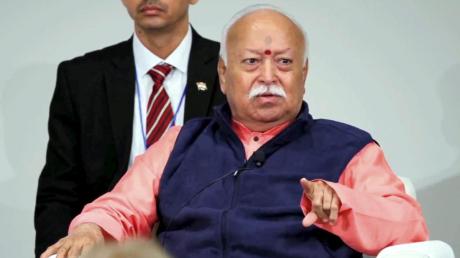
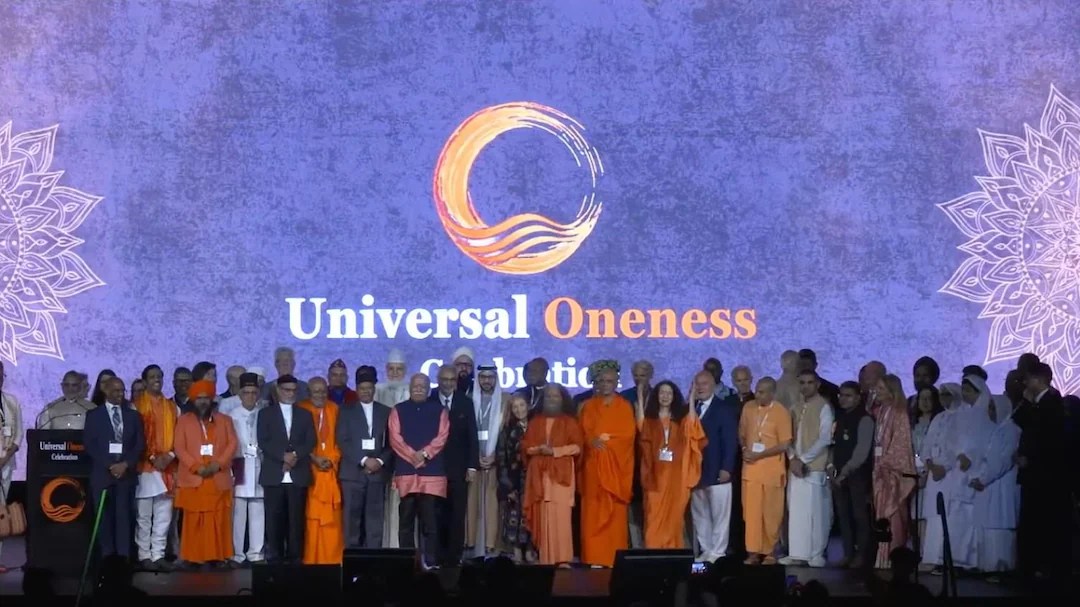
It is rare for both sides of an ideological divide to be unhappy—even outraged—by the same event and, more importantly, by the message emerging from it. Yet, that is precisely what happened after Rashtriya Swayamsevak Sangh (RSS) chief Mohan Bhagwat addressed an event at Madison Square Garden in New York on Saturday.
Let’s consider Bhagwat’s words first: “If you want to call yourself Hindu, you must believe that all paths are leading to the same (goal). And every human has dignity. There is no difference between human beings.” He went further: “If any Hindu thinks that there should be no Muslim in Bharat, he will not remain Hindu.”
To be fair to Bhagwat, it was a mature articulation of the Indian civilisational perspective, while simultaneously providing an effective rebuttal to those who had opposed the RSS chief’s presence in the United States. More significantly, it offered a striking contrast to the US cancel club, which is liberal in vocabulary but increasingly marked by the instincts of exclusion and cancellation.
Incidentally, a section of the Indian Right is unhappy too, though for the opposite reason. It regards the RSS chief as too conciliatory towards hostile strains of Islamism and Leftism. But that criticism misses the occasion. Bhagwat was speaking at an event devoted to interfaith dialogue. For him to launch into an examination of competing religious doctrines, or the differences between exclusivist Abrahamic traditions and Sanatana traditions, would have defeated the purpose. The event was about multi-faith dialogue. To attend a gathering intended to promote religious harmony and dwell primarily on religious conflict would have been a self-goal.
More importantly, Bhagwat articulated the essence of Sanatana Dharma: diversity, dialogue and mutual respect—not merely tolerance. There is an important distinction between respect, accommodation and tolerance. The Sanatana tradition aspires to respect different paths. Modern secularism generally seeks to tolerate them. Exclusivist interpretations of Abrahamic faiths, by contrast, have historically struggled with the proposition that radically different religious paths can possess equal validity.
Bhagwat appeared to have a larger objective: to use an iconic global platform to take Sanatana Dharma’s message of “oneness in different paths” to an international audience. Placed alongside the politics of the American cancel club, the contrast is stark: universal oneness versus selective liberalism; respect for diversity versus cancellation; integration versus confrontation.
Let’s take the case of the current poster boy of American cancel culture, Zohran Mamdani, who had publicly opposed the RSS event in New York, describing its ideology as representing an “exclusionary vision”. Yet, the irony is difficult to miss. A politics that seeks to exclude a speaker because it considers his worldview exclusionary risks reproducing the very instinct it claims to oppose. Moreover, Mamdani, who objected to Bhagwat’s presence, has had no difficulty meeting Imam Siraj Wahhaj, who has publicly expressed opposition to homosexuality and was named as an “unindicted co-conspirator” in connection with the 1993 World Trade Center bombing case. While Mamdani accuses the RSS, and its current leader, Mohan Bhagwat, of “violently” promoting a “supremacist ideology”, he has described Wahhaj as “one of the nation’s foremost Muslim leaders”.
Herein lies a central contradiction in contemporary ‘liberal’ politics, especially in the West. It advertises pluralism as a cardinal virtue but applies it selectively. Tolerance is readily—and almost exclusively—extended to groups and ideologies regarded as allies; ideological opponents are subjected to demands for exclusion, delegitimisation or cancellation.
Bhagwat’s statement also raises a host of other, harder questions: would similar declarations of theological pluralism be expected from leaders of other religious or ideological organisations? Would Christian or Islamic religious leaders affirm that other religious paths possess equal legitimacy? Would they respect the Bhagavad Gita in the same spirit in which they regard their own sacred texts? Would they affirm that multiple religions can lead to God, truth or salvation?
Not necessarily. And that is precisely where the asymmetry becomes difficult to ignore: the RSS and Bhagwat are frequently treated as uniquely suspect, irrespective of what they actually say, while those on the other side of the religio-ideological divide are treated with kid gloves. This suggests that the issue is not merely the RSS or Bhagwat. It points to a deeper discomfort with Bharat and its civilisational conception of itself.
Bharat often finds itself being cancelled by these very ‘liberals’ and the institutions they control. It is publicly called names, and its civilisational and democratic credentials delegitimised. The annual United States Commission on International Religious Freedom (USCIRF) report is a case in point, routinely attempting to delegitimise the democratic credentials of Bharat, invariably clubbing it with communist China, Islamist Pakistan and autocratic North Korea.
The fact of the matter is that the idea of Bharat is rooted in a civilisation that has, over centuries, absorbed and accommodated extraordinary socio-religious diversity. It offered refuge to persecuted communities, including Parsis and Jews, who were able not merely to preserve their identities but to flourish within the Indic civilisational ecosystem. Jain and Buddhist traditions likewise developed distinctive identities while remaining deeply embedded in the broader Indic world.
These examples complicate simplistic attempts to understand Bharat’s minority issue solely through the Islamic prism. Muslims, of course, constitute a religious minority in the constitutional and demographic sense. But their enormous numbers, internal diversity, long history and profound influence on the subcontinent make the Indian experience very different from the conventional Western image of a tiny minority living precariously alongside an overwhelmingly homogeneous majority. Communities such as Parsis and Jews, Jains and Buddhists offer a more realistic perspective from which to analyse Bharat’s record of civilisational pluralism.
Bharat finds itself in a unique situation where even its supposed allies in the West tend to stand opposed to it, largely because of their innate Christian upbringing, which manifests itself in their outlook despite their outwardly atheistic worldview. Richard Dawkins is a case in point. He fights religious fundamentalism unapologetically. But his lack of understanding of the Sanatana tradition makes him equate it with the Abrahamic faiths he opposes.
A few years ago, Dawkins attacked “Modi’s BJP” as “a tragic affront to India’s secular beginnings”. He described Hinduism as “at least as ridiculous as Islam” and accused contemporary India of betraying the ideals associated with Nehru and Gandhi. Interestingly, he passed this sweeping verdict on “Modi’s India” and “Hinduism” on the basis of an editorial in Nature magazine, which claimed that the Periodic Table and Charles Darwin’s Theory of Evolution had been dropped from the school curriculum in Bharat. As it turned out, it was yet another case of fake news, for the topics had not been removed but merely shifted from Class X to Class XI. The verdict, however, had already been delivered: Hinduism itself was “ridiculous”.
Dawkins is a self-proclaimed atheist, but his cultural assumptions occasionally make him behave like a ‘born-again’ Christian. He criticises PM Modi for foregrounding Hindu identity, yet has described Barack Obama as effectively atheist despite the latter’s very public Christianity. As Micklethwait and Wooldridge observe in God Is Back, “one reason why Barack Obama beat Hillary Clinton was that he succeeded in out-Godding her”. Obama himself writes in The Audacity of Hope: “Kneeling beneath that cross on the South Side of Chicago, I felt God’s spirit beckoning me. I submitted myself to His will, and dedicated myself to discovering His truth.”
If this is the case with the likes of Dawkins, the general intellectual milieu in the West is largely anti-Bharat. In fact, even someone like Sheldon Pollock, who is projected as a sobering figure in the American Indology arena, especially in comparison with the likes of Wendy Doniger and Audrey Truschke, describes the Ramayana as a “hegemonic discourse” used to legitimise elite domination—specifically by kings and Brahmins—over the masses. He has also argued that the Ramayana’s portrayal of Ravan and the Rakshasas as “others” helped create an ideological template for later hostility towards Muslims.
It is against this larger socio-political and intellectual background that Bhagwat’s Madison Square Garden remarks should be analysed and understood. First, he was participating in an event centred on “Universal Oneness”. His speech naturally reflected that theme. Expecting him to use such an occasion to catalogue religious conflicts would be like looking for culinary advice in an economics textbook.
Second, he was speaking abroad and presenting a civilisational understanding of Bharat and Hinduism to an international audience. Swami Vivekananda’s Chicago address offers a useful historical parallel. Vivekananda spoke differently before Western audiences than he often did in Bharat because his audience, purpose and historical circumstances were different. Third, and most importantly, Bhagwat projected what he regards as the authentic civilisational ethos of Sanatana Dharma: inclusivity without uniformity, unity without erasure and respect for multiple paths without demanding that they become identical.
For decades, Bharat and its traditions have been filtered abroad through a familiar vocabulary: caste, communalism, majoritarianism and religious nationalism. Bhagwat’s intervention attempted to challenge that jaundiced gaze. It placed before an international audience an innately Indian civilisational proposition in which diversity need not be patronisingly tolerated, but genuinely respected and even cherished.
Mohan Bhagwat—first in New York and then in Toronto a day later—pitched “universal oneness”. Will the critics of the RSS do the same now? – Firstpost, 31 August 2026
› Utpal Kumar is the author of ‘Bharat Rising: Dharma, Democracy, Diplomacy’ and ‘Eminent Distorians: Twists and Truths in Bharat’s History’.
Filed under: india, USA, world | Tagged: cancel culture, hindutva, mohan bhagwat, religious tolerance, unity in diversity |