








A Hindu India in which Bhagwat can publicly declare that the desire to expel Muslims negates a citizen’s claim to Hinduism merits serious debate, not reflexive denunciation. – Ravi Shankar
History is humanity’s perpetual memoir, whose plot carries a subtext of irony. The indignation of New York’s anti-Semitic mayor Zohran Mamdani towards Mohan Madhukar Bhagwat, the sixth and current Sarsanghchalak of the RSS addressing Indian-Americans is imbued with deep irony. This resentment of Mamdani, a practising Muslim, duplicates a profound dislike of the RSS, which the global liberal-Left apparatus casts as the embodiment of exclusion. Bhagwat’s New York script that any Hindu who believes Muslims are not Indians, are not Hindus, is not bound to be accepted by every BJP politician, Hindutva activist, or voices invoking Hindu nationalism. Nor will it convince career wackadoodles that Bhagwat was serious.
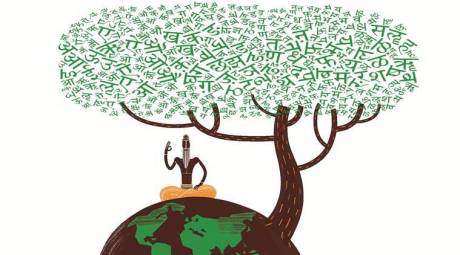
But India persists in its indefinite complexity, as most civilisations tend to. Its tradition carries within itself ideas, practices, and philosophical positions that modern sensibilities find both magnificent and troubling. The correct response to history is not to venerate it uncritically, but also not to expunge it from textbooks—it is to understand its contradictions with mature discernment. When mythos meets politics, the result is debate on truth. Or better, fact. To understand why the RSS describes its annual collections as guru dakshina in the face of intense interrogation by its current tormentor Priyank Kharge, the explanation lies in an ancient concept in Indian civilisation. Long before universities charged fees, political parties raised unaudited funds and companies offered government-monitored CSRs, Indian society had evolved an unique educational mechanism of financial transaction. Students acknowledged their debt to their teachers through guru dakshina. In the epics and Puranas, the value of what disciples offer their teachers lay not in its amount, but in the spirit of gratitude behind it. There is a clear distinction between a fee and a dakshina. A fee is a transaction upon completion of a job or purchase. A dakshina is the distinguished finale of a sacred relationship—a voluntary offering in gratitude, respect and recognition that knowledge is not a commodity purchased in a marketplace. Hence the guru dakshina becomes a sacred covenant between guru and disciple, enacted through trust, discipline, and personal example. Consequently, the relationship between them was moral, spiritual, and civilisational, not transactional. In the Upanishadic tradition, the guru is the force at the centre of intellectual and spiritual life. The Taittiriya Upanishad instructs students to honour their gurus for the knowledge gained through education. However, there is nothing amiss in demanding that an organisation account for its finances. When RSS adopted this metaphor in its guru dakshina tradition, the symbolic guruship it offered to the bhagwa dhwaj rather than to an individual was its cultural motif. Records state that at the first Guru Dakshina Utsav in 1928, RSS collected the princely amount of Rs. 84. Since the RSS is widely regarded as the ideological fountainhead of the broader Sangh Parivar, questions are raised on the scale, accounting, and transparency of the collections. But reducing the debate to a chartered accountant’s domain is to miss an important cultural dimension. The contrary liberal critique is: the RSS is dangerous because it is exclusionary. Bhagwat says exclusion of Muslims contradicts Hindu principle; therefore, Bhagwat harbours exclusionary intent. This is not reasoning but a pre-decided conclusion looking for supporting evidence.
Bhagwat’s compelling message from New York did not imitate BJPs stance of India as the “vishwaguru” in the usual bombastic sense. His proposition suggests India itself can be the guru to the world because it is a civilisation that has spent millennia in conversation with itself by arguing about gods and faiths, truth and identity, caste and philosophy, invasion and coexistence, and the contradictions these generate. If India truly aspires to be a vishwaguru, it must teach through example. A Hindu India in which Bhagwat can publicly declare that the desire to expel Muslims negates a citizen’s claim to Hinduism merits serious debate, not reflexive denunciation. Consider its global implication. If Mamdani’s idea of diversity genuinely aspires to universality, should it not be welcomed rather than be suspect? Hamas is not just another grievance within the political catalogue. The fanatics who chant support for massacres by its idols are not merely dissenters of Israeli policies. Bhagwat’s formulation that human dignity is universal, and requires protection, and that no group possesses the right to declare entire communities beyond the national identity extends far beyond Hindu-Muslim relations.
This column is a neither a tribute to the RSS nor is it a condemnation of the liberal Left. It is a nuanced attempt to reconcile antithetical ideologies of India and Bharat. The significant question is, can India truthfully embody the vishwaguru role it claims for itself? A guru who speaks only to disciples is merely a preacher. A guru who perpetually teaches himself is an altogether different philosopher, acutely moral, and infinitely powerful than the idea itself. – The New Indian Express, 6 August 2026
› Ravi Shankar is a columnist and editor in New Delhi.
Filed under: india, USA | Tagged: hindu-muslim relations, hindutva, mohan bhagwat, religious pluralism, vishwaguru |