














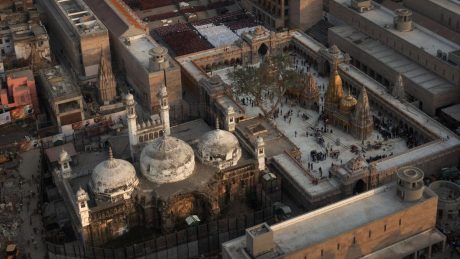
 The Places of Worship (Special Provisions) Act prohibits conversion of any place of worship and provides for the maintenance of the religious character of any place of worship as it existed on the 15th day of August, 1947, and for matters connected therewith or incidental thereto. – Asianet News
The Places of Worship (Special Provisions) Act, 1991 must be repealed in light of recent findings by the Archaeological Survey of India (ASI) within the Gyanvapi Mosque, a noted historian has sought. Historian Vikram Sampath‘s demand comes following court orders for the ASI to conduct excavations at the mosque premises.
In his forthcoming book titled Waiting for Shiva; Unearthing of the Truth of Kashi’s Gyan Vapi, Sampath strongly argues against the 1991 Act, contending that it obstructs Hindus from reclaiming their places of worship in a peaceful and legal manner. He questions the legitimacy of such provisions in a democratic nation, emphasizing the impediment they pose to the pursuit of justice by Hindus.
The Places of Worship (Special Provisions) Act was enacted during the tenure of the Congress-led government under Prime Minister PV Narasimha Rao. This legislation, aimed at maintaining the status quo of religious sites, has remained unchanged despite subsequent changes in government, including the BJP-led administration. Even with the spotlight shifting to Kashi and Mathura following the historic consecration of the Ayodhya Ram Temple, the Act has not been revised.
Sampath drew attention to Turkey’s actions of converting historic churches into mosques to advocate for a review of the 1991 law. He highlighted the stark contrast between this approach and the significance of the Gyanvapi Mosque to Hindus, expressing concern over the restrictions hindering Hindu access to sacred sites.
The historian further underscores the importance of the Gyanvapi Mosque site to Hindus, asserting evidence of a Shiva temple’s existence for thousands of years. With the court’s permission, worship has commenced in the mosque’s basement, signalling a potential shift in the site’s usage in the future.
What the ASI report said
The recent report by the Archaeological Survey of India (ASI) regarding the Gyanvapi mosque complex has unveiled significant historical insights. According to the findings, a structure pre-existing in the mosque was dismantled in the 17th century, with a portion of it repurposed in the mosque’s construction. Scientific studies cited in the report suggest the presence of a substantial Hindu temple before the mosque’s establishment.
The report highlights an Arabic-Persian inscription within the mosque, dating its construction to the 20th regnal year of Aurangzeb (1676-77 CE). This indicates that the pre-existing structure was likely demolished during Aurangzeb’s reign, with some of its components integrated into the mosque.
Furthermore, the ASI identifies the western wall of the mosque as remnants of the former Hindu temple. Elements from the original temple, such as pillars and pilasters, were utilized in the mosque’s expansion and the creation of additional prayer space. Cellars were constructed in the eastern section, utilizing pillars from the previous temple, while a spacious platform was erected to accommodate larger congregations. – Asianet Newsable, 1 March 2024

Filed under: india | Tagged: archaeological survey of india, gyanvapi mosque, kashi viswanath temple, places of worship act, temple-breaking |












LikeLike