












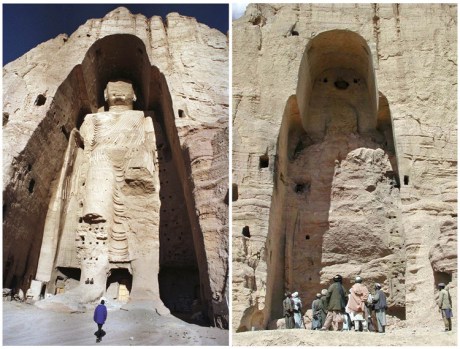
 It was the Buddhist history of the area that the Taliban wanted to erase in the name of Islam, when they blew the statues up in 2001. – AFP
For centuries they stood, two monumental ancient statues of Buddha carved into the cliffs of Bamiyan, loved and revered by generations of Afghans—only to be pulverised by the Taliban in an act of cultural genocide.
It felt like the loss of family for many who live and tend their crops nearby—but some 15 years on they are hopeful these awe-inspiring relics can be reconstructed.
But experts are divided on the value of rebuilding the artefacts, with some insisting it is more important to preserve the remains of the entire crumbling site.
Archaeologists and restorers, mostly Afghan, German, Japanese and French, working in the Bamiyan Valley in central Afghanistan will meet from December 1-3 in Munich, Germany.
There they will try to move forward on the issue, as much a matter of the conservation of the UNESCO World Heritage Site as of the memories and culture of a brutalised community.
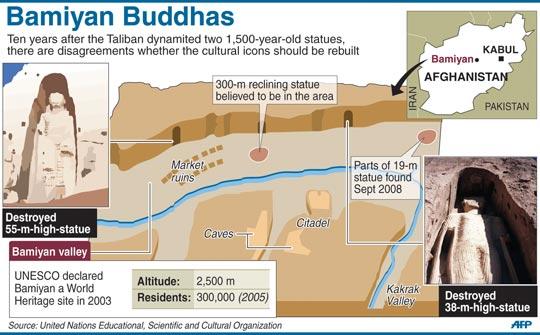
All Afghans, especially the peasants tending potatoes at the front of the cliffs, mourn the loss of the tutelary silhouettes—the largest, the Salsal, was 56 metres high; its feminine version, the Shamama, 38 metres.
They were blasted in April 2001 by the Taliban, who had taken control of the province and killed thousands of Hazara civilians, a Shiite Muslim minority in Bamiyan.
“For us, they were like parents,” said Hakim Safa, the 27-year-old representative from the Afghan culture ministry selling tickets at the site. “I feel as though I had lost family.”
“In the villages local people very much want the Buddhas to be rebuilt…. They are always asking us, when will you be ready to begin?” says Rassoul Chojai, professor of archeology at the University of Bamiyan.
But the statues were so thoroughly destroyed that it is not even clear if they ever could be reconstructed.
UNESCO and the archaeologists have gathered fragments, a clutter of rocks and stones of various sizes. But the bulk of the monuments has simply vanished, reduced to dust.
“The destruction of the great Buddhas is total,” confirms Julio Bendezu-Sarmiento, director of the French Archaeological Delegation in Afghanistan (DAFA) and member of the committee for the preservation of Bamiyan which will meet in Germany.
 The cliff, he says,is “pierced with thousands of decorated caves, connected by stairs, corridors, used in the past by monks and hermits” until the slow arrival of Islam from the 8th to the 11th centuries.
It was the Buddhist history of the area that the Taliban wanted to erase in the name of Islam, when they blew the statues up in 2001.
The explosions left deep cracks along the niches, which over the years have expanded, weathered, the rock crumbling against the elements.
Greatly weakened the cliff threatens collapse, Julio Bendezu-Sarmiento adds.
“The focus for UNESCO is to preserve the remains of the statues,” said Ghula Reza Mohammadi, representative of the UN agency in Bamiyan.
UNESCO has reinforced the niche of the Shamama with the help of Japanese funding, and is now working on that of the Salsal, enmeshed in giant scaffolding.
“Since 2001, German researchers have also worked on protecting the wall murals — there are more than 4,000 caves in Bamiyan and all of them have designs and were painted,” says Ghula Reza.
German restorers, in favour of reconstructing the statues, have already rebuilt the feet of the smaller Buddha, nearly ten metres long.
“We have some fragments of the original Buddhas,” says Bert Praxenthaler, a Bavarian art historian who has worked in Bamiyan since 2003.
“It would be a kind of statue with a lot of gaps and holes of course, but this is the first honourable approach to the history,” he argues. “If we have a really good funding, we could do it in a period of about five years.”
But why bother, wonders Bendezu-Sarmiento: “In history so much has disappeared yet we have still kept the memory, the Buddhas will remain in the collective memory even so,” he says.
“Leaving aside nostalgia, the urgency is rather to prevent it from happening again,” he concluded, citing Palmyra, the Greco-Roman oasis in the Syrian desert devastated in 2015 by the Islamic State group.
The debate surrounding the Buddhas is not only technical, says Masanori Nagaoka, director of cultural heritage at UNESCO in Kabul, arguing that consideration must also be given to ethical, humanitarian and human rights points of view.
“Statues are not just a physical representation … they have meaning for people, to represent their history and their diversity of culture or in depth respect for religious dialogue.
“So if the reconstruction of the Buddha statues would contribute to revitalising such memories or dignity, this has to be (considered),” he added, describing a rebuild as a potential “contribution to a peaceful world.”
The debate will not be decided in Munich, where experts will simply agree on the work to preserve the site — or in Abu Dhabi, where Afghan President Ashraf Ghani will attend a separate conference on safeguarding cultural heritage this weekend.
But the question is already on the agenda of an international conference on Bamiyan next autumn in Tokyo.- The Times of India, 1 December 2016

Filed under: afghanistan | Tagged: bamiyan buddhas, cultural genocide, islamic iconoclasm, taliban, world heritage site |








Leave a Reply