















 The Bamiyan Buddha statues, hewn from sandstone cliffs, are said to have dated back to the 5th century AD, and were once the tallest standing Buddhas in the world. In their Roman draperies and with two different mudras, the statues were great examples of a confluence of Gupta, Sassanian and Hellenistic artistic styles. – The Indian Express
The Taliban regime in Afghanistan has said it would protect the ancient Buddha statues in Mes Aynak, also the site of a copper mine where the Taliban are hoping for Chinese investment.
The Taliban’s position is in marked contrast to the time they ruled Afghanistan earlier, when, in the face of global outrage, they brought down the centuries-old Buddha statues in Bamiyan using artillery, explosives, and rockets.
The apparent change of heart over the Mes Aynak statues seems to be driven by economic interests, with the regime in desperate need of the income Chinese investment in the copper mines could generate.

Hakumullah Mubariz, the Taliban head of security at Mes Aynak, told the Associated Press, “Protecting them is very important to us and the Chinese.”
While the deal with the Chinese is yet to be finalised, the Taliban’s changed stance on the statues has brought back into conversations the tragedy of the razing of the Bamiyan Buddhas in March 2001.

The ancient Bamiyan Buddhas
The Bamiyan valley, in the Hindu Kush mountains and along the river Bamiyan, was a key node of the early Silk Routes, emerging as a hub of both commercial and cultural exchange.
According to UNESCO, the “rise of Bamiyan was closely connected with spread of Buddhism across Central Asia, and that in turn was linked to the political and economic currents of that time. Early in the first century AD, a semi-nomadic tribe called the Kushans swept out of Bactria. … The Kushans made themselves the unavoidable middlemen between China, India and Rome, and prospered on the revenues of the Silk Road. In so doing, they fostered a syncretic culture, in which tribal traditions from Central Asia fused with artistic conventions derived from the Hellenized Mediterranean and with the ideologies coming from Buddhist India, as reflected in the remarkable cultural legacy to be found in Bamiyan.”
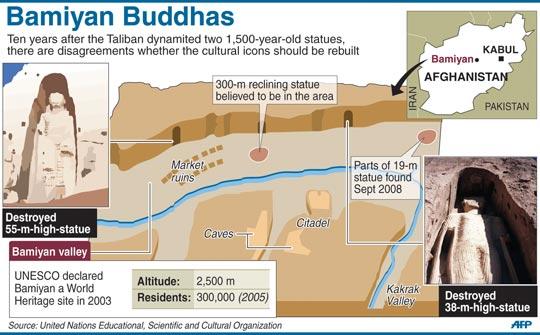
The Bamiyan Buddha statues, hewn from sandstone cliffs, are said to have dated back to the 5th century AD, and were once the tallest standing Buddhas in the world. In their Roman draperies and with two different mudras, the statues were great examples of a confluence of Gupta, Sassanian and Hellenistic artistic styles.
Called Salsal and Shamama by the locals, they rose to heights of 55 and 38 metres respectively. Salsal means “light shines through the universe”, while Shamama is “Queen Mother”.
Their razing by the Taliban
The hardline Islamist Taliban wanted to bring down what they saw as symbols of idol worship. “These idols have been gods of the infidels,” a report in The Atlantic quoted Mullah Muhammad Omar, the founder leader of the Taliban, as having said.
However, the manner in which the statues were demolished—amid protests from several quarters internationally—suggests the Taliban were also interested in making a spectacle of the destruction and sending a message to the world.
The Taliban first announced their intention to destroy the statues on February 27, 2001. The declaration was met with condemnation and outrage, with then Pakistan President Pervez Musharraf among those who voiced concern. India offered to arrange for a transfer and safeguarding of the artefacts.
On March 2, 2001, the destruction started with guns. It took a month for the process to be completed, with the use of weaponry scaled up continuously. According to the report in The Atlantic, “when the Buddhas finally crumbled, Taliban fighters were firing weapons into the air, they were dancing and they brought nine cows to slaughter as a sacrifice.”
Apart from the Taliban, terrorist group ISIS has also destroyed artifacts dating from the pre-Islamic world due to their “idolatrous” links. Most notable of this was the bulldozing of the ancient Assyrian city of Nimrud in 2016.
After the destruction
In 2003, UNESCO included the remains of the Bamiyan Buddhas in its list of world heritage sites. It was proposed that the statues should be reconstructed with the pieces that were still available, and restored in their niches, but it was met with opposition.
While some argued that security concerns would always remain around the newly built statues in the war-torn country, many said the empty niches should be preserved as a testament to the violent fanaticism that destroyed them.
To mark 20 years of their destruction, on March 9, 2021, the statue of Salsal was “recreated”—a 3D projection was beamed at the alcove where it had stood.
“We do not want people to forget what a horrific crime was committed here,” Zahra Hussaini, co-organiser of the “A night with Buddha” event, was then quoted by BBC as saying. – The Indian Express, 31 March 2022

Filed under: afghanistan | Tagged: bamiyan buddhas, buddhism, islamic iconoclasm, taliban, world heritage site | Comments Off on The Bamiyan Buddhas and why the Taliban destroyed them – Indian Express











