














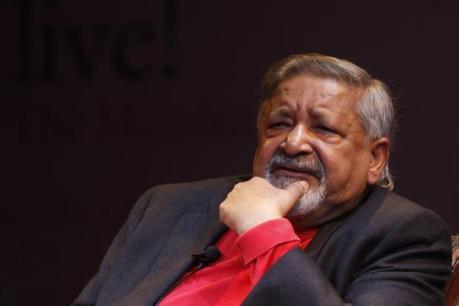
 “Girish presented his theory that V.S. Naipal was awarded the Nobel Prize after years of waiting for it only after the Twin Towers in New York had been demolished by Islamist terrorists. We were supposed to deduce that President Bush had subsequently instructed the Swedish Academy to award the prize to someone whom Girish Karnad could prove was anti-Muslim. I was shocked. That’s idle Internet-monkey talk!” – Farrukh Dhondy
Oliver Stone’s film Alexander was the climactic show at the Goa International Film Festival some years ago. The UK film critic Derek Malcolm and I were standing in front of a wall-sized poster by the beach at the closing party.
Spotting sound bite potential, an enthusiastic young lady presenter/producer led her crew up to us.
“Mr Dhondy, what did you think of the film?” she asked.
“Er… which film?”
“This one”, she said pointing to the poster.
I turned round and back with as much theatrical indignation I could muster.
“You expect me to have seen this film?”
“Why not?” She was genuinely puzzled.
“It’s like asking a Jew if he wants to see a film depicting Hitler as a hero.”
“What? Why?”
“Because this bastard Alexander the Damned tried to wipe out our Zoroastrian civilisation! He set fire to Persepolis, burnt the palace and libraries, raped and enslaved our Parsi women….”
Her jaw dropped to her blouse.
“When did all this happen?” she asked.
“In 326 BC”, I said.
Then, seizing the time I added “This film offends minorities!”
“No, Farrukh”, said Derek attracting the cameras away and stealing the punchline, “It offends majorities — the majority of people who see it!”
My remarks were tongue-slightly-inclined-to-cheek. I do feel that Alexander’s murderous exploits can be looked at from the Persian point of view as not very nice or heroic, but that has never stopped me eating a good moussaka, reading Homer, going for a break on a Greek island or indeed having Greek friends.
I even sympathise with the economic plight of Greece in Europe though I know it’s their own mass fault.
The fact that Europeans and Americans think Alexander should be called The Great is all the more reason for me to apply my casual historical corrective to assert that he and his armies had no business in Zoroastrian Persia.
I rehearse this argument here this week because I have just participated in the Mumbai Literature Live Festival, principally to launch my new book, London Company, to interview Sir V.S. Naipaul and to take in some culture.
With which latter aim I attended a session in which Girish Karnad was to expostulate on his career in theatre. Instead, I witnessed the honourable Girish in full flow stabbing Naipaul’s reputation in the back (Naipaul had left town). Girish had come to bury VS, not to praise him.
 The noble Girish accused VS of being stone-deaf to music. He wasn’t saying that VS didn’t know Mozart from Mozarella, that VS believed that Bach was something his neighbours’ dogs shouldn’t do or even that Sting was a waspish prerogative.
He was saying that VS had made a remark somewhere that the great and ancient tradition of Indian music had been ruined by the Muslim and Mughal conquests.
He went on to accuse Vidia of being blind to architecture because he had somewhere said that the Taj Mahal was a building he couldn’t look at without thinking of the suffering that had gone into its construction — not on the part of the love-struck and vain tyrant Shah Jahan, but that of the workers who built it — a Marxist sentiment if ever I heard one, but then the noble Girish was more appreciative of ethereal floatations of marble, which is an aesthetes opinion and fair enough. Everyone can’t be a Marxist.
Girish then turned to Vidia’s India: A Wounded Civilisation, giving us his own erudite account of the wars of southern India in the 16th and 17th centuries.
The burden of this song, or oratorio since it was keyed in many quoted, syncopated registers and raags (Dekha? I knows my musik!) was that VS was no historian, was against Muslims and even advocated their elimination and the demolition of their disused mosques. It was this that prompted Girish to defend his Muslim friends and their feelings. Truly noble!
Then Girish presented his theory that VS was awarded the Nobel Prize after years of waiting for it only after the Twin Towers in New York had been demolished by Islamist terrorists.
We were supposed to deduce that President Bush had subsequently instructed the Swedish Academy to award the prize to someone whom Girish Karnad could prove was anti-Muslim. I was shocked. That’s idle Internet-monkey talk!
Khair!
I was by now mourning the murder of truth and balance so when they called for comments, I got a microphone and began “Friends, Indians, countrymen…” — (I have a PIO card) — but Brut… I mean Girish cut me off with “Not Farrukh, anyone but Farrukh.” Silenced.
But not here:
If VS did hate Muslims because they follow a particular religion and if he did say the things Girish accused him of, then it would be a grievous fault and grievously must VS answer it.
But of course Vidia doesn’t hate Muslims — he is married into a family of them — appreciates very many buildings with Islamic architectural antecedents, has never claimed to be a historian and has never advocated or approved of the killing of anyone.
What VS has attempted to do in books and interviews is to indict the history of an era in which Hindus and Muslims were demanding freedom from British colonial rule and consequently glossed over the atrocities and slaughter of the Muslim raids, conquests and governance of India.
He didn’t add that Humayun and Sher Shah fighting it out for the possession of Hindustan is as absurd as me and Girish battling it out with Parsi and Kannadiga armies in some field outside Amsterdam to set up as Emperor of Holland.
Yes, the Muslim occupation and settlement brought kebabs and evolved qawwali. Agreed, there is no caste system in Islam, so they brought notions of equality.
Still, isn’t it time to explore history for more truth than the political necessities of nationalism (or of Hindutva) prescribe? – Deccan Chronicle, 10 November 2012
The utter boorishness of Girish Karnad’s secularism – R. Jagannathan
 “Karnad was pulled up by the organisers for meandering off on his hobby-horse. According to the Express, Festival Director Anil Dharker expressed his disappointment thus: ‘We gave you (Karnad) the chance to speak about your life in theatre, but you never spoke about it. Instead, you chose to go on about a writer who has won the Nobel Prize for literature.’ Dharker justified the award to Naipaul saying it was for his entire body of work, and not just one or two books, which Karnad criticised.” – R. Jagannathan
Every now and then, card-carrying secularists have the need to wear their secularism on their sleeves. You may be called to officiate at a municipal tree planting ceremony, but you have to give the audience your robust views on the Ayodhya issue and Sufi music.
On Friday, Girish Karnad managed to do the same at the Tata Literature Live! festival in Mumbai.
He was invited to conduct a one-hour masterclass on his life in theatre. He did nothing of the sort, and abused his hosts’ hospitality. He managed to convert the occasion into a theatre of the absurd and spent 40 minutes of his allotted time castigating V.S. Naipaul, who was honoured earlier with a Lifetime Achievement Award by the festival’s organisers.
From Naipaul’s alleged anti-Muslim bias to his supposed support for the destruction of the Babri Masjid by Hindu militants in 1992 to the lack of authenticity in some of his books (including India: A Wounded Civilisation), Karnad spoke about everything but the topic he was given.
According to a report in Mint, Karnad claimed Naipaul would never have been given a Nobel but for 9/11, which made the West wary about Islam. He said: “Naipaul won the Nobel Prize in 2001. In London in 2000, word was that Naipaul would never get the Nobel because of what he’d written about Indian Muslims.”
Karnad blasted the organisers and said they shouldn’t have honoured Naipaul in the city which saw many Muslims killed in the post-Babri riots.
 The Indian Express quotes Karnad as saying: “Naipaul is a foreigner and he is entitled to his opinion. But why give an award to a man who calls Indian Muslims ‘raiders’ and ‘marauders’? I have Muslim friends and I feel strongly about this.”
Fine, he has Muslim friends, but did he have to make his point in an event unrelated to communalism? And if he had Hindu friends, would he have said the opposite? Aren’t you supposed to be secular regardless of who your friends are?
Karnad was pulled up by the organisers for meandering off on his hobby-horse. According to the Express, Festival Director Anil Dharker expressed his disappointment thus: “We gave you (Karnad) the chance to speak about your life in theatre, but you never spoke about it. Instead, you chose to go on about a writer who has won the Nobel Prize for literature.” Dharker justified the award to Naipaul saying it was for his entire body of work, and not just one or two books, which Karnad criticised.
To writer Farrokh Dhondy, who asked Karnad a question, the latter haughtily refused a reply. An angry Dhondy is supposed to have replied: “This is like a court where the prosecution has been presenting its case without giving any opportunity to the defence.”
The Times of India said Karnad didn’t talk on his given subject — life in theatre — since the subject was “boring”. One wonders why Karnad chose to accept the invitation in that case. Or was it just to demonstrate his boorishness?
There is possibly a simple conclusion one can reach from the unnecessary brouhaha: If you are a professional secularist, you can abuse your host’s hospitality just as easily as if you were a professional communalist. – First Post, 3 November 2012
V. S. Naipaul talks to Farrukh Dhondy – Literary Review
“I remember talking about the Iranian love of blood. When a man fell bleeding in a religious demonstration, people went and dipped their hands and pieces of cloth in his blood. The people I was with [at MIT] refused to believe it. This couldn’t happen. Oh God! How wise they were! There was an American paper which was going to serialise [Among the Believers: An Islamic Journey] in three parts, but they cancelled.” – V.S. Naipaul to Farrukh Dhondy
V.S. Naipaul hasn’t been well. Feeling more comfortable with Indian doctors and medical provision than with the National Health Service, he has been in New Delhi for several months for treatment and recovery. Now he’s back in England and says he’s writing again.
I visit him in his Wiltshire cottage and the following interview is conducted in short periods over two days.
He’d like me, he says, to follow his own method of interviewing, which is to take notes in longhand as the subject speaks: he doesn’t trust tape-recorders. I don’t trust them either, and so have brought two with me, pocket-size, and made sure they have fresh batteries. I place them in the least obtrusive position on the dining table, at which we sit.
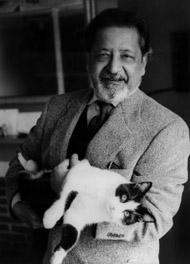
Augustus, the cat, periodically appears outside on the window sill as we speak, and demands to be let in. He is a more than usually imperious fellow and insists on attention from Vidia, who has a way of commanding him to sleep. He surprisingly obeys, curling up at our feet.
This is our second extended interview, again for the Literary Review. The first, in August 2001, was controversial: his comments on E.M. Forster, John Maynard Keynes and James Joyce were considered provocative. As we begin, I suggest that we stay off politics in this interview and he agrees.
Would you say luck has any part to play in the career and success of a writer?
I worked so hard for so many things. The luck came at the beginning when I was trying to get started. That day in the Langham Hotel, the BBC building where I was working, if it hadn’t occurred to me to write about the street in which I grew up in Port of Spain in Trinidad, I might have floundered for many years. If the people in the room — the freelancers’ room in the BBC — hadn’t encouraged me, I might never have got started. I felt I was doing it in my own way. It wasn’t all easy-going — the book I was writing wasn’t published for four years. England had different ideas of writing then — from what I was doing. This has gone on right to this day.
Would you say you were writing outside the tradition of English literature?
That’s Leavis and Cambridge and all that — and it’s not important. What’s important is that England didn’t understand what I was doing. If it were my own territory it would be different, but I have no territory. England has not appreciated or acknowledged the work I have done. My task was to open up a territory of readership. It was very slow — too slow for me.
Were you conscious of trying to open up this territory of readership?
I always wrote for the smallest audience: my wife (Pat, and now Nadira), someone I knew at the BBC, my publishers and my editor at Deutsch.
Surely a book like Among the Believers, which entailed travels through the Muslim world, was written for a universal audience?
 Since writing is a process of learning, writing that book was a process for me. It found a readership after it was published. It got into a lot of trouble in places like Harvard and MIT. There are some very wise people in these places who, in their wisdom, had no need to go to a country to find out what was going on there. They already knew what was to be known. I can’t stress this strongly enough — everything I discovered and wrote was done for myself. I didn’t know what on earth I was doing at MIT, but I had accepted their invitation to speak about the book and I found they were very concerned about Iran. I remember talking about the Iranian love of blood. When a man fell bleeding in a religious demonstration, people went and dipped their hands and pieces of cloth in his blood. The people I was with refused to believe it. This couldn’t happen. Oh God! How wise they were! There was an American paper which was going to serialise the book in three parts, but they cancelled.
Why?
They would have been told by the Wise People that it must be stopped. Twenty years later it may seem that these ideas were to be given to a waiting world — but they still had a hard time.
Even in the first book, Miguel Street, I was experimenting. I wanted it to be simple, new and pictorial — every sentence.
Did your experience of writing change as you went on?
My idea of writing developed as I wrote. I still have no big idea of writing. My only idea is that if you are doing non-fiction it should be truthful. The people about whom you write should themselves be able to see the truth of it. After the book we’ve spoken about, Among the Believers, was published, people wrote from Iran to say I’d missed the point. I had written about driving in Tehran. It’s dangerous and precarious. The car I was in returned from every journey with the scrapings of paint from other cars. And they picked on the same observation when I read extracts to a Harvard audience. They didn’t like that at Harvard at all. Harvard said it was ‘colonial’ to write the truth.
Do you think you met particularly bigoted or silly people at these universities? The Wise Ones?
I don’t think so. I think these universities have passed their peak. The very idea of the university may be finished. In Oxford, for a long time, they were producing divines. Then it took a turn and the University began to produce smart people. The idea of learning came quite late, in the early nineteenth century perhaps, and it went on some way into the twentieth. Now, apart from sciences, there seems to be no purpose to a university education. The Socialists want to send everybody to these places. I feel that these places ought to be wrapped up and people should buy their qualifications at the Post Office.
Not including scientific qualifications?
No, those must remain. But the Humanities — they seem to me to be worthless disciplines.
Read more in the Literary Review here …
See also
Filed under: india | Tagged: civilization, culture, farrukh dhondy, free speech, geopolitics, girish karnad, hindutva, history, india, indian history, indian politics, internet, islam, knowledge, literature, media, multicultural, nehruism, politics, psychological warfare, religion, scholarship, secularism, terrorism, v.s. naipaul, writers |












http://www.outlookindia.com/article.aspx?282986
Who is this Bangalore based writer.
It’s not only Girish Karnad who is taking on luminaries like Rabindranath Tagore and Sir Vidia in public. Another Bangalore-based writer of international acclaim is at war with a foreign author of popular history books. Recently, there was a nasty missive by this writer about this author in a popular website, which was on the verge of growing viral when the website yanked the piece off. The buzz is that the Bangalore writer is too fond of what another famous Bangalore industrialist makes copious amounts of (and which he diluted recently), and that led him to pour venom on this author. To finish the circle, this famous author’s relationship with Sir Vidia goes back a long way too.
LikeLike
Hartosh Bal first wrote a critique in Open magazine about W Darylample and then WD countered it in the UK press. Bal responded with a reply. All the critique and counter to the critique is there.
Very well summarised below.
http://blogs.wsj.com/indiarealtime/2011/01/20/a-literary-spat-starring-william-dalrymple/
LikeLike
James Pattle was known as the greatest liar in India. A man supposed to be so wicked that the Devil wouldn’t let him leave India after he died.
Great-great-grandfather of W Dalrymple and 7 generations from Kolkata. No wonder WDalrymple is continuing the tradtion of James Pattie — lying. In http://en.wikipedia.org/wiki/St._John%27s_Church,_Kolkata
James Achilles Kirkpatrick, popularly known as the White Mughal was the central character of William Dalrymple best selling work of history White Mughals died in Calcutta on 15 October 1805 at the age of 41. He was buried at the North Park Street Cemetery, but neither his grave nor the cemetery exists today. James Achilles Kirkpatrick’s father James Kirkpatrick, popularly known as the Handsome Colonel, along with his brothers erected a memorial in memory of James Achilles Kirkpatrick on the southern wall of the St. John’s Church. The overblown and oddly inappropriate epitaph, erected still stands to this day.
The memorial of James Pattle, the great-great-grandfather of William Dalrymple is also located on the south walls of St. John’s Church.
According to Dalrample “Seven generations of my family were born in Calcutta, there are three Dalrymples sitting inside St John’s graveyard. And a great-great-grandfather’s plaque is on the St John’s Church wall, James Pattle.”
“James Pattle was known as the greatest liar in India. A man supposed to be so wicked that the Devil wouldn’t let him leave India after he died. Pattle left instructions that when he died, his body should be shipped back to Britain. So, after his demise (in 1845) they pickled the body in rum, as was the way of transporting bodies back then. The coffin was placed in the cabin of Pattle’s wife and the ship set sail from Garden Reach. In the middle of the night, the corpse broke through the coffin and sat up. The wife had a heart attack and died.”
“Now both bodies had to be preserved in rum. But the casks reeked of alcohol and the sailors bored holes through the sides of the coffins and drank the rum… and, of course, got drunk and the ship hit a sandbank and the whole thing exploded, cremating Pattle and his wife in the middle of the Hooghly! That’s why you see a plaque on the wall and not a grave in the graveyard of my great-great-grandfather.”
LikeLike
“Dalrymple should also be unequivocally condemned (along with Karnad) for his comments on Naipaul, not because he is a non-Hindu Britisher but because he is a bad scholar who writes with prejudice. Now the Syrian Christians are trying to rope him in to do a historical “proof” that St. Thomas came to India and he appears to be sympathetic to their agenda.”
Dalrymple is son of a baronet and his wife Olivia Fraser is Roman Catholic who also comes to India painting Hindu minaitures. You are right IS, the motive is very clear. If one goes back to History, Bishop Caldwell, another Scotsman did the mischief of Dravidian politics. IS you are intuitive.
LikeLike
V.S. Naipaul is one of the world’s most distinguished writers, and arguably the greatest living master of English prose. His two books on Islam — Among the Believers and Beyond Belief analyze the effect of Islamic conditioning on individuals and societies. While one may disagree with Naipaul’s conclusions and analysis, there is no denying his brilliance as a writer. By no stretch of the imagination can Girish Karnad, at best a fringe figure in Kannada, never mind world literature, be placed anywhere close to Naipaul.
Karnad owes his recognition less to literary skills than government sponsorship. He has displayed much more skill at cultivating the right people than creating literature or drama. His theatrics at the meet were better than anything he has presented on the stage. Karnad used Naipaul’s presence at the event to step out of obscurity and bask in Naipaul’s reflected light by attacking him on non-literary grounds.
His charge that Naipaul is insensitive to Muslim contribution to music is irrelevant. Germans from Johann Sebastian Bach to Richard Strauss have made a stupendous contribution to music, but that cannot be used as a pretext to erase the Nazi record. William Dalrymple, while a more substantial writer and scholar than Karnad, has joined him for reasons thoroughly analyzed by Dr. Vijaya Rajiva in her article here.
LikeLike
RN you are being too kind to this “white dog who barks at the moon” — as SJ calls him — and too hard on the Hindutva ladies. They do very good work for the Hindu Samaj and it should not be discounted. But I agree fully that racial slurs and identifiers should be removed from their discourse. They are a self indulgence and can make a good argument completely invalid. Racial identifiers are also not needed as we know the ethnicity of a foreigner by their name. It is the content of their argument that should be challenged, not their ethnic identity.
I have said many times that the white man is the most destructive creature to have ever walked this earth. But this is a generalisation that is not valid in the particular. It is not directed at any white person and many white people who have read history would agree with the observation. There are as many good white people as there are many bad brown ones. In fact the Hindus worst enemy is not some foreign scholar mouthing off but the alienated born-Hindu-now-secular who operates within Hindu society against Hindu interests. Our political parties and parliament are full of these people and we are governed by them. That is the real problem and the real danger to the Hindu Samaj. That is why a Karnad is far more dangerous to Hindu India than a Dalrymple.
LikeLike
@ Vijaya Rajiva: To clarify I am an Indian Hindu who works for Hindu causes but don’t use labels. I do not know Dalrymple’s work so cannot comment on it. I do know Karnad and he has attacked Hindus and Hindutva for years. My point is that using ethnic and racial labels in a critique diminishes your argument. There is a saying that the race argument is made only when there is no other argument. I agree with this.
I think the way you Hindutva ladies have treated Dr Koenraad Elst and Swami Ishwar Sharan is shameful. I have followed their work for Hindu interest for years. I know what they have given to Dharma and Bharat Mata. You Hindutva ladies will never match them!
LikeLike
Dr. Rajiva, you are being rather disingenuous about your attitude towards Dr. Elst and his work. You led the attack on him by RR and SJ a couple of months ago, and you did focus your attack on the fact that he was a European non-Hindu and therefore not qualified to comment on Hindu issues. Go back and look at some of the comments you made in Oct-Nov.
(By the way Dr. Elst’s new book called The Argumentative Hindu: Essays by a Non-Affiliated Orientalist has just been published by Voice of India.)
Dalrymple should also be unequivocally condemned (along with Karnad) for his comments on Naipaul, not because he is a non-Hindu Britisher but because he is a bad scholar who writes with prejudice. Now the Syrian Christians are trying to rope him in to do a historical “proof” that St. Thomas came to India and he appears to be sympathetic to their agenda.
Taslima Nasrin has also jumped on the bandwagon against Naipaul and declares that he is anti-Muslim. This is the gratitude of a refugee from Bangladesh who is under interdict by the mullahs for her book Lajja!
LikeLike
Correction: completing the sentence: I recommend that since you feel so strongly about Karnad . . . . you should go ahead and write an article about him.
En passant. The Belgian scholar Koenraad Elst is not a Hindu and is not Indian. Neverthless I cite him, with full appreciation, in my article. This is because he is writing in context and not sounding off as Dalrymple does. Elst’s works are clearly pro Hindu and pro Indian, whatever his ethnicity. This refutes your charge against me as being biased against a non Hindu or non Indian.
LikeLike
RN I used the word ‘political stunt’ as an important point. Karnad is planning to join the Third Front and so along with the Congress they are hoping to defeat the BJP. His motives for coming out now are being highlighted by that phrase.
I am not focussing on Karnad because I do not know his work. I do not write about people whose work I am not familiar with. I have read Dalrymple on the other hand, and it was he who came out swinging strongly at the Times Now discussion and called Naipaul a fascist comparable to Ezra Pound. As far as I am aware Karnad has not publicly called Naipaul a fascist. Perhaps he did at the Mumbai Literary Festival.
Frankly, I am not sure why you are defending Dalrymple. My article is quite clear. Naipaul is a Hindu and his observations on Vijayanagar are a crise de coeur (cry from the heart). He is not attacking Dalrymple or his culture such as it is.
There is a vast difference here. Dalrymple is going out of his way to attack a Hindu who is defending his own culture.
I regret that you fail to see the point of my article. I have received many appreciative comments from people who understood what I was doing. I do request that you go back and read my article once more. Most people found it informative because I place my criticism of D. in the context of his misinformation about Indian history and the inadequacy of the actual sources that he cites.
I also recommend that since you feel so strongly about Karnad and are in a position to write about him (presumably you know something about the man’s work also). At any rate he went very public on national television with his criticism of Naipaul and that is sufficient material for now.
And thank you for honouring me with the title ‘Hindutva lady’. Am proud to be considered a Hindutvadin. Presumably you are not.
LikeLike
IS, thanks for adding the interview at the end of the article. It gives some insight into VS Naipaul.
Also read V Rajiva’s article through the link. She excuses the inexcusable in Karnad’s rant against Nailpaul as a political stunt (below), but attacks Dalrymple’s partisanship because he is a foreign non-Hindu. This is the usual ethnic bias Hindutva ladies show in their nationalistic pretend scholarship. If non-Hindus can’t have an opinion on Indian history, then Hindus can’t have an opinion on Islamic history. Karnad should be condemned outright, not explained away. This isn’t his first attack on a Hindu intellectual or Hinduism.
LikeLike
The murder and mayhem of the barbarian invasions and after in India are as Will Durant put it, one of the bloodiest chapters of human history. Reading some of the sources (Babur Nama) is a horrifying experience.
The only reason that Karnad is doing what he is doing is because he has plans to join the Third Front and along with the Congress they hope to defeat the BJP. This is a political stunt by Karnad.
LikeLike
Alexander is a popular name in Christianity which is Sikandar in Islam. Both faiths followed the footsteps of Alexander the damned as Dhondy has rightly written to conquer, pillage and do all that they have done for centuries.
LikeLike