









That the Hindu society at various levels could muster the courage, skills and resources to dislodge the demonic regime personified by Mamata Banerjee shows that nothing can stop the juggernaut of Hindu renaissance. India is firmly set on the road to become a Hindu Rashtra. – Virendra Parekh
The Hindus of Bengal have spoken. And how! Overcoming institutionalized intimidation and lure of freebies, they have pulled their land back from the brink of descent into an Islamic state. What took place in Bengal was not merely an assembly election. It was a decisive battle to determine the future trajectory of the birthplace of Indian renaissance: an ascent to self-renewal, prosperity and a return to the leadership of national resurgence or a continued decline into cultural obliteration, poverty and stigma of being a perpetual laggard among Indian states.
It is a momentous verdict, a mandate not just for a change of the ruling party, but a wholesale transformation. Bengal since independence has witnessed a multi-faceted downfall (shatamukha vinipata). Between 1947 and 2024, its per capita income declined from 127.5 per cent of the national average to 83.7 per cent, pulling down its rank from the third among states to 24th. Its contribution to national GDP halved from 10.5 per cent in 1960-61 to 5.6 per cent in 2023-24. Once an industrial powerhouse, its industrial contribution fell from 27–30 per cent in 1947 to around 3–3.5 per cent in 2025.
Cultural and demographic reverses have been even more severe and more damaging than the economic ones. Over the decades, every ruling party in the state has been actively encouraging infiltration of Bangladeshi Muslims in an effort to create a large and dependable vote bank. The chickens are now coming home to roost. Muslim population in the state had shot up from around 10 per cent at the time of independence to 27 per cent in 2011 census and is probably over 30 per cent now. Several districts bordering Bangladesh have become Muslim majority areas.
More ominously, the relentless demographic change has interchanged the roles of the puppets and the puppet master. Those who came as asylum seekers have now become masters. They lord over the locals, rape their womenfolk, disrupt celebration of Hindu festivals and generally remain above law. They make no secret of their objective of converting Bengal into an Islamic state. The ruling party dared not touch them for it depended on these very people for muscle power and votes. The Hindu identity of even the truncated Bengal was increasingly being eclipsed by Jihadi Islam. The Hindus lived in perpetual fear of their peace-loving neighbours, knowing fully well that the state government would never come to their aid, whatever the provocation.
The downtrend was continuous and cumulative, unbroken even by a brief reversal. One may ask how, with such a dismal record, ruling parties manage to win election after election for so long. The answer lies in the election machine perfected over decades by the leftist parties over the decades which was adopted wholesale by the TMC. It takes care of everything from the broad narrative to the booth level management. For decades, state leaders have portrayed the central government as hegemonic and inimical to the interests of Bengal, and leaders from national parties (whether Congress or BJP) as outsiders out to subjugate Bengal’s pride and erase its distinct identity. In this narrative, people shouting Jay Sri Ram are uncouth bhaiayajis (‘chhoto lok’) undeserving of any attention.
Moreover, first the Marxists and then Mamata Banerjee systematically obliterated the distinction between the party and the government. Every government service would be mediated through the party. If you wanted a government job, ration card or BPL card, file a police complain, claim a subsidy or benefit under a government scheme, register yourself under MNREGA—the nod from the local party functionary was essential. This iron grip on government patronage and even basic services gives the ruling party a powerful leverage on the life of the people. Add to this the power of Muslim vote bank. Prashant Kishore boasted that TMC’s tally started at 30 per cent, while BJP had to start from the scratch. This was the formidable machinery that Bengal’s public was up against. It must be dismantled now so that Bengal can breathe freely.
This election has thrown up a couple of heartening trends. For one, constitutional bodies like the Election Commission and the Supreme Court have rejected false narratives of victimhood and served the cause of national interest and justice. Kudos to Gyanesh Kumar, the chief election commissioner who has displayed rare commitment, courage and efficiency in dissipating the suffocating atmosphere by deconstructing the poll rigging machinery. He cleansed the electoral rolls of 91 lakh bogus names through SIR (special intensive revision). He managed to learn all the tricks and tactics of voter intimidating and booth capturing and foiled them by boldly exercising his wide administrative powers. He courageously stood against political blackmailing and mudslinging to ensure free and fair elections. The Supreme Court (as also Calcutta High Court) remained unimpressed by the numerous petitions by the wrong doers and refused to grant them any relief. Thanks to them, Bengal had free and fair elections for the first time in decades. The results are before us.
For another, the BJP seems to have realised that while economic issues (growth, jobs, prices et al) are important in themselves, they need to be accompanied by a muscular and assertive Hindutva. Its call for Hindu unity was disguised thinly, if at all. Hindutva entered Amit Shah’s cold calculations as the essential counter to the TMC’s bid to divide or hoodwink the Hindus. One hopes BJP will not fight shy of its nourishing its core constituency more openly in future.
True to type, the old regime fought back fiercely. TMC goons tried to repeat their time-tested tricks of intimidation and booth capturing, but discovered that the game had changed. The central forces, given a free hand and full political backing, easily overpowered the pampered goons long used to deal with defenceless people and pliant officers.
Even after declaration of results, the battle is not over. There will be efforts to contest the legitimacy of elections, with the allegations of massive disenfranchising, intimidation by central forces and EVM tempering. We should be ready for renewed violence. Nothing can alter the new reality, however. The reconstruction will necessitate much time and effort. Restoring Bengal’s civilizational identity as also investor confidence will have to be a patient exercise. But the reward will be worth the pain.
That the Hindu society at various levels could muster the courage, skills and resources to dislodge the demonic regime personified by Mamata Banerjee shows that nothing can stop the juggernaut of Hindu renaissance. India is firmly set on the road to become a Hindu Rashtra. The recovery of Bengal will help fortify Assam and other north eastern states against Islamic depredations.
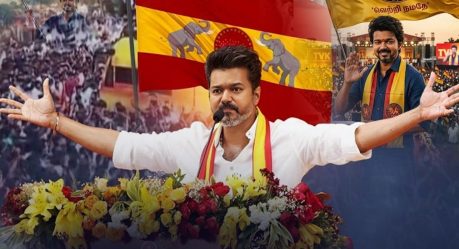
The next frontier for Hindu Rashtra will be South India. While this article has focused on Bengal, the real surprise has been delivered by Tamil Nadu, where the defeat of both the Dravidian parties at the hands of a political novice opens up vast but uncertain possibilities. Hindu awakening and concerns in Tamil Nadu and Keralam are reflected in the steady increase in the BJP’s vote share, though it is not reflected in the number of seats it wins. Here it will have to fight not the openly hostile jihadi Islam, but the subtle poison spread by the Church over decades in the form of false narratives. Bengal gives us the hope that Hindus will be able to overcome that challenge also, before it is too late.
› Virendra Parekh writes on economics and politics, also on issues related to Indian civilization, history and cultural nationalism.
Filed under: india, tamil nadu, west bengal | Tagged: BJP vs TMC, BJP wins, indian politics, state elections, TVK wins |