










 The impact of colonialist thinking was deep-rooted. But the New India is drawing confidence from its philosophy, traditional knowledge and culture. – Vinay Sahasrabuddhe
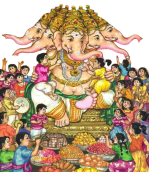
Like most festivals in India, Diwali celebrations too have a deeper philosophical meaning. What are generally referred to as rituals also have a deeper insightful message inherent to them. However, the quintessential symbol of Diwali is the traditional earthen lamp. And the lamp is all about enlightenment. It is the light of knowledge that ends the darkness of ignorance and tells us how to move ahead, which path to take and the direction.
Interestingly, this lamp has acquired such a prominent position in our imagery that several government and non-government organisations have used it as an icon and made it a part of their emblem. In the context of how India is often perceived globally, a lamp that ends the darkness of ignorance has some special significance as we are one of the countries difficult to understand. In the past, our governments, intelligentsia, media and even civil society allowed several misunderstandings about India to persist. Our collective inertia and at times ignorance about our own culture are to blame for this. Many intellectuals, while participating in activities abroad, take pleasure in assailing their own country simply to showcase their so-called objectivity. This habit of criticising Indian culture and traditions was encouraged by many global think tanks and internationally renowned universities to a great extent. Scores of examples could be given as to how only so-called ‘progressives’ were chosen for many established international laurels. Juries of international film festivals too fell into this trap and decorated mostly those interested in showing only misery and poverty in India.
Sadly, the impact of colonialist thinking is so deep-rooted that we downgrade our own selves and as Ananda Coomaraswamy once said, many of us have become strangers in our land. As early as in the beginning of the 20th century, Coomaraswamy wrote, “Speak to the ordinary graduate of an Indian university … of the ideals of the Mahabharata, he will hasten to display his knowledge of Shakespeare; talk to him of religious philosophy, you find that he is an atheist of the crude type common in Europe a generation ago, and that not only he has no religion but is as lacking in philosophy as the average Englishman; talk to him of Indian music—he will produce a gramophone or a harmonium and inflict upon you one or both; talk to him of Indian dress or jewellery, he will tell you that they are uncivilised and barbaric; talk to him of Indian art, it is news to him that such a thing exists; ask him to translate for you a letter in his own mother-tongue, he does not know it. He is indeed a stranger in his own land!” (Modern Review, Calcutta, October 1908).
Unfortunately, we haven’t been able to free ourselves from this perverse habit of self-denigration, but today things are changing for the better. We are confidently talking of atmanirbhar bharat and the nation is made to realise its own innate strength, the strength of atma or self. Indigenous knowledge and traditional wisdom are now getting due prominence. Be it COP26 or the UN General Assembly, the prime minister himself is speaking in Hindi and giving the message to not get enamoured by the ability to talk in English. Like our mother, we have to respect mother tongues too. Yoga and ayurveda are now being officially recognised globally. With the model of Ram Mandir getting a place of prominence at the India pavilion of Dubai Expo 2020, the legacy of uncalled-for hesitancy about our cultural identity is now being laid to rest.
It is noteworthy that the PM too has been vigorously bringing our cultural icons to the fore. His efforts have ensured ghar wapasi of several artifacts of historical importance. Unapologetic in presenting a copy of Bhagwad-Gita to foreign dignitaries, it was only after 2014 that the nation witnessed international Ramayana festivals happening regularly with enthusiastic participation of countries—some of them avowedly Islamic. Like the Mahabharata and Ramayana, the global influence of Indian festivals like Diwali, Holi, Ganesh Chaturthi and [Devi] Puja are now fast spreading across the globe. Prime ministers and heads of states are now competing with each other in wishing Indians a Happy Diwali.
In keeping with these changing winds, the PM was right in underscoring the relevance of Indian philosophy while speaking at the COP26. Quoting from the Surya Upanishad, he pointed out: “Ever since life originated on Earth, the life cycle of all living beings, and their routine, has been linked to the sunrise and sunset. As long as this natural connect has continued, our planet remained healthy. But in the modern era, man in the race to overtake the cycle set by the sun disturbed the natural balance and caused great damage to his environment. If we are to re-establish a balanced life with nature, the path of this will be illuminated by our sun. We have to walk along with the sun again to save the future of humanity.” His idea of ‘One Sun, One World, One Grid’ was also welcomed by all as he advocated that it is the solution to the challenge of solar energy being available only during the day and also weather-dependent. His concern reflected the quintessential Indian world view of Vasudhaiva Kutumbakam. The address and forceful assertion while providing a practical solution has opened a new chapter in our history of soft power. This New India, drawing confidence through its philosophy, traditional knowledge and culture, is now asserting its position as “part of solution”. Indeed, this is real soft-power Diwali! – The New Indian Express, 10 November 2021
› Vinay Sahasrabuddhe is President of the Indian Council for Cultural Relations and a BJP Rajya Sabha MP.

Filed under: india, world | Tagged: hindu culture, indian soft power, NDA government, soft power, vasudhaiva kutumbakam | Comments Off on India has started to assert its soft power – Vinay Sahasrabuddhe