









 “Mr Bhagwat wasn’t suggesting that rape was not prevalent in the geographical zones we choose to call Bharat. His intervention was based on the belief that traditional Bharatiya values deified women while cosmopolitan India, nurtured on an overdose of consumerism and moral relativism, was inclined to see females as mere commodities.” – Swapan Dasguta
 The social divide that is said to exist between Bharat and India has often been used to score debating points. Rashtriya Swayamsevak Sangh chief Mohan Bhagwat was, arguably, guilty of this needless game of one-upmanship when, in response to a question, he told a gathering in Silchar (Assam) that rape was essentially India’s problem and not a Bharatiya problem.
If the issue hadn’t been so emotive and the media not in constant search of a whipping boy, it is likely that the comment wouldn’t have attracted so much attention. Mr Bhagwat wasn’t suggesting that rape was not prevalent in the geographical zones we choose to call Bharat. His intervention was based on the belief that traditional Bharatiya values deified women while cosmopolitan India, nurtured on an overdose of consumerism and moral relativism, was inclined to see females as mere commodities.
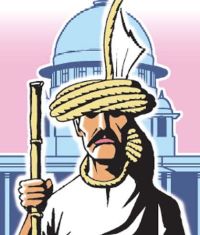 Without imputing motives to the RSS chief or charging him with antediluvian proclivities, it is necessary to emphasise that the idealisation of a pristine, pure and noble Bharatiya ethos is certain to be challenged. Regardless of what may have existed in a distant Golden Age, the fact is that there are many features of actually existing Bharat (presuming it exists both apart from and in opposition to India) that would seem repugnant to many, not least women. What often passes off as “custom” and “tradition” by the likes of the high-handed khap panchayats are, to say the least, reprehensible. Indeed, these bodies are the 21st-century versions of those who so resolutely defended the right of some Hindu communities to practise sati till as late as the mid-19th century. And yet who can deny that these upholders of inherited values aren’t more Bharat than India? Just as everything modern doesn’t always constitute enlightenment, everything traditional isn’t the filtered repository of good practices.
 That the deracinated India, unsure of its self-identity that we often experience today is very troubling is undeniable. Over the past two decades or so, India has witnessed more cumulative economic growth than took place in the past 100 years. This remarkable transformation within a relatively short time has had both beneficial and negative consequences. The rapid growth of urbanisation and the detachment of large numbers of people from their traditional moorings have, for example, led to a spate of social problems, including the harassment and molestation of women. Likewise, the huge enlargement of the role of the state has eroded the role of the community and produced a huge mass of atomised individuals who are partially aware of their rights but unmindful of their corresponding obligations to society. In recent years there has emerged a body of well-meaning individuals who profess to represent “civil society”. But to what extent are these bodies more representative than the “vote banks” of political parties?
 The social map of India is in the process of transition. There is undoubtedly a “new” India and an older Bharat but the lines of separation have been blurred to such an extent that we can no longer talk meaningfully of two autonomous and self-contained categories. This is not something unique. The tiny island of Britain, for example, experienced a remarkable transformation with the onset of the Industrial Revolution in the early 19th century. At that time, concerned citizens despaired of the emergence of “two nations”. There was a rural Britain that appeared to be hierarchical and unchanging; and there was an urban Britain that appeared to many to be the Devil’s workshop.
Curiously, the Bharat-India divide that Mr Bhagwat alluded to, is not new. Throughout the late-19th and early-20th centuries, British administrators spoke incessantly about a “real” India that existed in the countryside and a new, insolent India that was proving to be a headache for the sarkar in the towns and cities. Fiercely imbued with the idea that the British Empire was a sacred mission, British administrators were conscious of the need to get their priorities right. “While I have sought to understand the needs and to espouse the interests of each of India’s various races and creeds,” said Lord Curzon, the Viceroy who had the most pronounced sense of India’s “sacredness” to the Empire, “my eye has always rested on a larger canvas crowded with untold numbers, the real people of India.”
 A similar sense of the “real” India which existed outside the cantonments, Civil Lines and the law courts full of “seditious” babus also moved Rudyard Kipling, arguably the finest chronicler of British India. “Underneath our excellent administrative system; under piles of reports and statistics; the thousands of troops…” he wrote, “runs wholly untouched and unaffected the lives of the people of the land — a life full of impossibilities and wonders as the Arabian nights … immediately outside of our own English life, is the dark and crooked and fantastic, and wicked, and awe-inspiring life of the native.” For Kipling, there seemed to be three Indias: the India of Mahbub Ali the horse trader, the widowed rani of Kulu and the restless Kim; the India of the British conquerors which was predictable and often vacuous; and the hybrid India of “our progressive Aryan brother, the Oxford B.A. who will eat with you, ride with you and talk to your wife (but) won’t dare to fly in the face of his ‘custom’.”
In a strange sort of way, the Bharat-India divide replicates this romantic but condescending view of India. – The Asian Age, 11 January 2013
» Swapan Dasgupta is a senior journalist who has held editorial posts with The Statesman, The Daily Telegraph, The Times of India, The Indian Express and most recently India Today, where he was Managing Editor till 2003. He has been published in The Pioneer, The Telegraph, Dainik Jagran, The Times of India, The New Indian Express, Outlook, The Free Press Journal and several other newspapers and magazines. Along with Arun Shourie and Ashok Malik he is widely credited for breaking the left liberal stagnation in the Indian intellectual establishment.
Filed under: india | Tagged: bharatiya, culture, ethics, eve teasing, globalisation, hindu, hindu values, hindutva, history, indian history, lifestyle, mohan bhagwat, nehruism, nehruvian secularism, politics, population displacement, psychological warfare, psychology, rape, RSS, sanskritisation, secularism, society, urbanisation, values | 5 Comments »