












Knowledge makes one humble, humility begets worthiness, worthiness creates wealth and enrichment, enrichment leads to right conduct, and right conduct brings contentment. – Anon
Quantum physics and Vedic philosophy, particularly the teachings in the Upanishads, explore the nature of reality, consciousness, and the deep interconnectedness of all things. Despite emerging from different eras and cultures, key concepts in modern science align closely with the ancient wisdom found in the Vedas.
Modern quantum gravity and quantum field theory share interesting similarities with ancient Vedic philosophy. Despite their different approaches, both explore deep questions about reality, time, and consciousness. Quantum mechanics is based on two important concepts: superposition and entanglement.
Superposition means that tiny particles, like electrons, can exist in multiple states at the same time. Entanglement happens when two particles become linked so that a change in one instantly affects the other, no matter how far apart they are. These ideas challenge the way we normally think about space, time, and how objects are separate from each other.
Vedas describe the universe as deeply interconnected. Vedic philosophy teaches that the entire universe is connected through a fundamental essence called Brahman, which is eternal, infinite, and present everywhere. This is similar to the idea of a “unified field” in quantum physics, where all particles and forces come from a single source. Both views suggest that everything we see as separate is part of one unified whole.
The Observer’s Influence
In quantum mechanics, the observer plays a key role in how reality unfolds. A well-known example is the double-slit experiment, where tiny particles like electrons act like waves when no one is watching, spreading out in different directions. However, when they are observed, they behave like solid particles, taking a single, definite path.
This experiment suggests that simply watching something can change how it behaves, raising interesting questions about the connection between observation, reality, and even consciousness. This connects to the Vedic concept of maya, which refers to the illusion of being the doer in the material world.
The Vedas teach that what we experience through our senses isn’t the ultimate reality—it’s shaped by our perceptions. Similarly, in quantum mechanics, the way particles behave depends on whether they are observed. Both perspectives suggest that the physical world isn’t a fixed, separate reality but rather a fluid and interconnected process influenced by consciousness and observation.
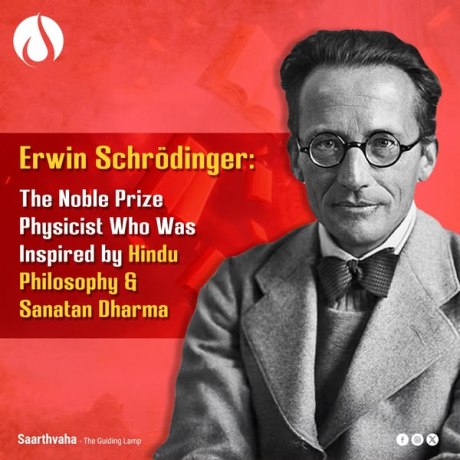
Erwin Schrödinger, one of the founding fathers of quantum mechanics adopted the concept of atma (the individual soul) and brahman (the cause of atma and the universal consciousness). In his book What is Life, Schrödinger proposed that consciousness is one and universal, arguing that the perception of multiple individual consciousnesses is merely an illusion. This idea parallels quantum mechanics, which shows that particles are fundamentally interconnected rather than separate.
This idea aligns with the Vedic philosophies of Achintya Bhed Abheda and Vishishtadvaita, which suggest that reality is both one and many at the same time. While everything is inherently connected as part of a unified whole, our perception tends to see it as separate and distinct.
Quantum Entanglement & Non-Duality: A Holistic Perspective on Reality
Quantum entanglement is a fascinating effect where two or more particles become so closely linked that any change in one instantly affects the other, no matter how far apart they are. This challenges the traditional idea that objects are separate and independent, offering new insights into the nature of reality.
In Advaita Vedanta, non-duality means that the true nature of reality goes beyond all differences, like self and others or subject and object. It teaches that everything is connected as one consciousness, and the idea of separateness is just an illusion (maya). This idea is similar to quantum entanglement, where two particles stay linked no matter how far apart they are. Changing one instantly affects the other, showing a hidden unity that challenges our usual understanding of space and time.
The connection between quantum entanglement and non-duality presents a holistic view of reality, encouraging us to rethink the nature of existence. It invites us to move past a divided perspective and embrace the idea of deep interconnectedness. Recognizing the significance of entanglement within a non-dual framework allows for new insights into consciousness and reality, helping us gain a deeper understanding of our role in the universe.
Quantum Gravity & Time: A Vedic Philosophical Approach
Quantum gravity is an area of research that seeks to merge quantum mechanics with Einstein’s general theory of relativity. While general relativity describes space and time as interconnected and flexible, responding to the presence of matter and energy, quantum mechanics governs the behavior of particles on a tiny scale. Bringing these two theories together offers fresh insights into the nature of time.
One approach, Loop Quantum Gravity (LQG), proposes that space and time are not smooth and continuous but instead made up of tiny, discrete units or “quanta.” This suggests that time itself may not flow smoothly but could emerge from fundamental quantum interactions, much like matter is composed of individual atoms.
This non-linear perspective on time aligns with ancient Vedic philosophy. In Vedic tradition, kala (time) is viewed as cyclical and eternal, not merely a linear sequence from past to future. Instead, it unfolds in repeating cycles of creation, preservation, and dissolution, as represented by the yugas. This concept parallels modern quantum physics, which suggests that time is not a fixed, one-way progression but a more intricate and fluid phenomenon.
Studying quantum gravity and string theory alongside Vedic concepts like Brahman and maya provides a profound, integrated perspective on reality. Both quantum physics and Vedic philosophy question conventional ideas of separateness and time, suggesting instead a universe that is deeply interconnected and governed by fundamental vibrations. – News18, 5 March 2025
› Dr. Atul Tripathi is Quantum Technologist & Data Scientist, Honorary Adjunct Fellow at the National Maritime Foundation and former AI Consultant Prime Minister’s Office (NSCS).
MORE SCIENTISTS QUOTES ON HINDU PHILOSOPHY HERE
Filed under: india, world | Tagged: erwin schrodinger, hindu philosophy, quantum physics, science and religion, universal conciousness | Comments Off on Quantum Physics & Vedic Philosophy: Where science meets spirituality – Atul Tripathi