







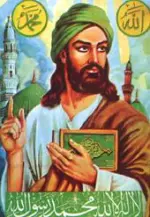



 “There is compelling reason to conclude that Muhammad, the messenger of Allah came into existence only after the Arab Empire was firmly entrenched and casting about for a political theology to anchor and unify it. Muhammad and the Qur’an cemented the power of the Umayyad caliphate and then that of the Abbasid caliphate.” – Robert Spencer
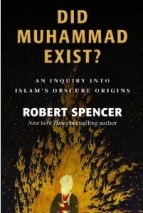 Why would it matter if Muhammad never existed? Certainly the accepted story of Islam’s origins is taken for granted as historically accurate; while many don’t accept Muhammad’s claim to have been a prophet, few doubt that there was a man named Muhammad who in the early seventh century began to claim that he was receiving messages from Allah through the angel Gabriel. Many who hear about my new book Did Muhammad Exist? An Inquiry Into Islam’s Obscure Origins ask why it would matter whether or not Muhammad existed — after all, a billion Muslims believe he did, and they are not going to stop doing so because of some historical investigations. Yet the numerous indications that the standard account of Muhammad’s life is more legend than fact actually have considerable implications for the contemporary political scene.
These are just a few of the weaknesses in the traditional account of Muhammad’s life and the early days of Islam:
- No record of Muhammad’s reported death in 632 appears until more than a century after that date.
- The early accounts written by the people the Arabs conquered never mention Islam, Muhammad, or the Qur’an. They call the conquerors “Ishmaelites,” “Saracens,” “Muhajirun,” and “Hagarians,” but never “Muslims.”
- The Arab conquerors, in their coins and inscriptions, don’t mention Islam or the Qur’an for the first six decades of their conquests. Mentions of “Muhammad” are non-specific and on at least two occasions are accompanied by a cross. The word can be used not only as a proper name, but also as an honorific.
- The Qur’an, even by the canonical Muslim account, was not distributed in its present form until the 650s. Casting into serious doubt that standard account is the fact that neither the Arabians nor the Christians and Jews in the region mention its existence until the early eighth century.
- We don’t begin to hear about Muhammad, the prophet of Islam, and about Islam itself until the 690s, during the reign of the caliph Abd al-Malik. Coins and inscriptions reflecting Islamic beliefs begin to appear at this time also.
- In the middle of the eighth century, the Abbasid dynasty supplanted the Umayyad line of Abd al-Malik. In the Abbasid period, biographical material about Muhammad began to proliferate. The first complete biography of the prophet of Islam finally appeared during this era-at least 125 years after the traditional date of his death.
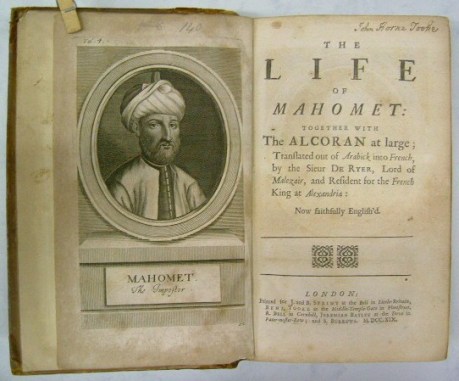
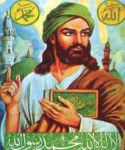 The lack of confirming detail in the historical record, the late development of biographical material about the Islamic prophet, the atmosphere of political and religious factionalism in which that material developed, and much more, suggest that the Muhammad of Islamic tradition did not exist, or if he did, he was substantially different from how that tradition portrays him.
How to make sense of all this? If the Arab forces that conquered so much territory beginning in the 630s were not energised by the teachings of a new prophet and the divine word he delivered, how did the Islamic character of their empire arise at all? If Muhammad did not exist, why was it ever considered necessary to invent him?
Every empire of the day had a civic religion. The Eastern Roman (Byzantine) Empire was Christian. Its rival Persia, meanwhile, was Zoroastrian. The Arab Empire quickly controlled and needed to unify huge expanses of territory where different religions predominated. The empire was growing quickly, soon rivalling the Byzantine and Persian Empires in size and power. But at first, it did not have a compelling political theology to compete with those it supplanted and to solidify its conquests. It needed a common religion — a political theology that would provide the foundation for the empire’s unity and secure allegiance to the state.
Toward the end of the seventh century and the beginning of the eighth, the leaders of the Muslim world began to speak specifically about Islam, its prophet, and eventually its book. Stories about Muhammad began to circulate. A warrior-prophet would justify the new empire’s aggressive expansionism. To give those conquests a theological justification — as Muhammad’s teachings and example do — would place them beyond criticism.
This is why Islam developed as such a profoundly political religion. Islam is a political faith: the divine kingdom is very much of this world, with God’s wrath and judgement to be expected not only in the next life, but also in this one, to be delivered by believers. Allah says in the Qur’an: “As for those disbelieving infidels, I will punish them with a terrible agony in this world and the next. They have no one to help or save them” (3:56). Allah also exhorts Muslims to wage war against those infidels, apostates, and polytheists (2:191, 4:89, 9:5, 9:29).
 There is compelling reason to conclude that Muhammad, the messenger of Allah came into existence only after the Arab Empire was firmly entrenched and casting about for a political theology to anchor and unify it. Muhammad and the Qur’an cemented the power of the Umayyad caliphate and then that of the Abbasid caliphate.
This is not just academic speculation. The non-Muslim world can be aided significantly in its understanding of the global jihad threat — an understanding that has been notably lacking even at the highest levels since September 11, 2001 — by a careful, unbiased examination of the origins of Islam. There is a great deal of debate today in the United States and Western Europe about the nature of Islamic law; anti-sharia measures have been proposed in at least twenty states, and one state — Oklahoma — voted to ban sharia in November 2010, although that law was quickly overturned as an infringement upon Muslims’ religious freedom. Others have been successfully resisted on the same grounds.
If it is understood that the political aspect of Islam preceded the religious aspect, that might change. But that will happen only if a sufficient number of people are willing to go wherever the truth may take them.
» Robert Spencer is the director of Jihad Watch and author of the New York Times best-sellers The Politically Incorrect Guide to Islam (and the Crusades) and The Truth About Muhammad. His latest book, Did Muhammad Exist?, is now available. – American Thinker, 23 April 2012
Filed under: west asia | middle east | Tagged: abbasid caliphate, abbasid dynasty, allah, biography, gabriel, history, islam, koran, mohammed, muhammad, mythology, political religion, prophet, prophet muhammad, umayyad caliphate, umayyad dynasty, west asia | middle east | 6 Comments »