











Once upon a time, Indians were very willing to forsake all outward symbols of both their faith and culture in order to assimilate or appear modern and progressive. But not anymore. Now Indians are far less squeamish about themselves and less likely to accept unreasonable restrictions on their cultural and religious freedom in the name of company policy. – Reshmi Dasgupta
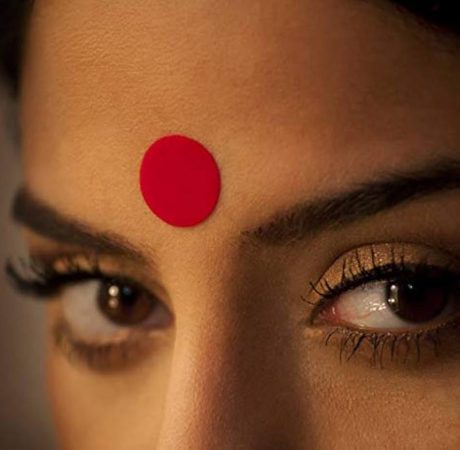
When our office caricaturist was asked to draw me for a logo some years ago—perhaps to illustrate an article—he drew on (pun intended) two immutable facets of my personality: a big red bindi and a large green handbag. No matter what colours the rest of my ensemble may have been on any given day (unless it was a rare recourse to western wear), these two never changed. Though I hardly ever carry a handbag now, that red bindi remains, even bigger than before.
Me without a bindi would not be me, and that has less to do with my devotion to my faith and more to do with culture as it is also part of India’s traditional ‘solah shringar’ or 16 adornments. So I was naturally depressed by the news that a large Indian company—whose products now increasingly repose on my nose—had an earlier policy (post-facto called a mere ‘internal memo’) that prohibited employees wearing bindis, tilaks, and kalavas in all their stores and premises.
Bindis, like many aspects of Indian culture, straddle a space between faith and style. When faith is an all-encompassing way of life rather than just a communion with the Almighty, such overlaps are natural. Much depends not only on personal perception but also regional practices. In southern India, many devout Hindu girls wear bindis or pottus from a very young age; but many communities in the north believe that they should be worn only after puberty or even after marriage.
The cultural or non-denominational aspect of it is still visible in some parts of the subcontinent, notably Bangladesh, many of whose Muslim women wear bindis too, belying the belief that it is only a Hindu religious symbol. Why they do so despite Islamic taboos is worth considering. While some cultures think of it as a ‘third eye’, it is actually a clever make-up hack to draw attention to the eyes, long regarded as the most sensual and expressive part of a female South Asian face.
Focusing attention, in fact, is a prime function of a bindi or bindu. The late artist S.H. Raza made it his leitmotif and traced his obsession with it to a teacher who drew a dot on his classroom wall and asked that restless artistic child to focus on it to calm down and become more reflective! It worked so well that he drew on that bindi’s concentration for the rest of his life. Affixing a bindi on my own rather generous expanse of forehead may well have made me far less fidgety too.
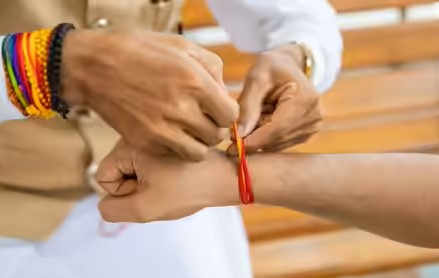
The usual justification for companies to prohibit open displays of “religious symbols” is to foster uniformity and obviate any chance of offending or discomfiting anyone. But why or how do “symbols” like bindis or even red strings on wrists offend per se? Or indeed why would hijabs or skullcap/kippahs do so either? Surely body language and actions are more intimidating than clothing, accessories, or cosmetics? Shouldn’t HR departments monitor those instead?
In India, where the religious and the personal are so deeply enmeshed, it is very tough to enforce non-denominational outward appearances with just concessions for western-style wedding rings, Sikh turbans, and Muslim hijabs. After all, kadas for both male and female Sikhs, sindoor, mangalsutras, shell ‘shakha-pola’ bangles, and gold-bound ‘loha’ bangles are very revered symbols, and forbidding them offends religious beliefs and smacks of tactlessness or plain derision.
Back in the 1980s, bindis or ‘dotheads’ became the shorthand for Indians—read Hindus—immigrants in the US, and the people behind racist attacks on them at that time earned the sobriquet ‘dotbusters’.
The victims were mostly bindi-less Indian men, many of them not even Hindus, but the word stuck. Could that have triggered a trend in western workplaces (and companies) to regard ‘dots’ on foreheads as inherently provocative and therefore better off prohibited?
And did that mindless ban just continue for the next 40 years, unquestioned even by new Indian companies that sought to implement “international” norms? There is a sneaking suspicion that the dress policy of the eyewear company in question was broadly drafted by copy-pasting existing codes of multinationals, with its HR department and higher-ups too lazy or cocooned to consider local differences while formulating it. Or perhaps they took Indian attunement for granted?
More Muslim women wear hijabs now than before, and like most ‘international’ uniform/dress codes, companies in India accommodate that. But why do many or even most managements not make the same concession for Hindu women who may also be more observant now than before? The same goes for men, who are probably as likely to have beards and skullcaps now as they are to wear, say, kadas and ear-rings/studs. None of these need be regarded as offensive or distracting.
Once upon a time, Indians were very willing to forsake all outward symbols of both their faith and culture in order to assimilate or appear modern and progressive. Now Indians are far less squeamish about themselves and less likely to accept unreasonable restrictions on their cultural and religious freedom in the name of company policy. The expose of one company’s seemingly discriminatory policy on wearing bindi, tilaks, and kalevas has brought that point to the fore.
A big red bindi has become my trademark, and the idea of being barred from wearing it in a workplace simply because a corporation thinks that it may offend someone, offends me first of all! Unless something puts their health or physical safety in danger while at work or impedes their ability to function efficiently, no organisation should prohibit what people wear for their faith or culture within reasonable limits. Managements must set judicious and relevant boundaries.
Assimilation was once a prerequisite, but now is more often a negotiation. Identity has become important even as people migrate more than ever before. Faith symbols and customs are markers of identity in an increasingly homogenous corporate culture and civic life. How much are people willing to ‘accommodate’ without sacrificing or diluting their identity? – News18, 21 April 2026
› Reshmi Dasgupta is a freelance writer.
Filed under: india, world | Tagged: articles of faith, bindis, company policy, secular dress, tilaks | Comments Off on Asymmetry on articles of faith is bad business – Reshmi Dasgupta