














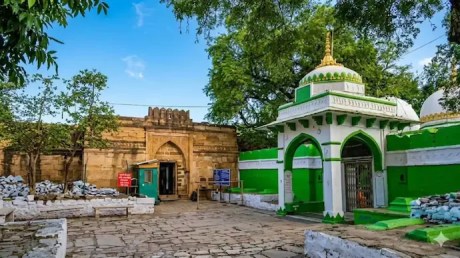
The MP High Court declared that the Bhojshala complex in Dhar is a temple of goddess Vagdevi (Saraswati), therefore allowing the Hindu community to worship at the site, while dismissing the Muslim community’s claim. – Mehul Malpani
The Madhya Pradesh High Court on Friday (May 15, 2026) declared that the long-disputed site of Bhojshala complex and Kamal Maula Mosque in Dhar is a temple of goddess Vagdevi (Saraswati), therefore allowing the Hindu community to worship at the site, while dismissing the Muslim community’s claim.
In a 242-page order, a Division Bench of Justices Vinay Kumar Shukla and Alok Awasthi in Indore dismissed the petitions of the Muslim and Jain communities, filed recently, while saying that the Muslim representatives can seek an alternate piece of land in Dhar district from the Madhya Pradesh Government.
The court quashed a 2003 order of the Archaeology Survey of India (ASI) that allowed the Muslim community to offer Friday prayers at the site, while restricting the right of Hindus to worship within the Bhojshala complex on Tuesday and Basant Panchami. The court took inspiration from the Ram Janmabhoomi-Babri mosque verdict from the Ayodhya dispute in 10 principles.
“The disputed area of Bhojshala and Kamal Maula Mosque is held to be a protected monument under the Ancient Monuments and Archaeological Sites and Remains (AMASR) Act, 1958, with effect from March 18, 1904. The religious character of disputed area is held to be a Bhojshala with a temple of goddess Vagdevi (Saraswati),” the court order said.
While the Hindu side has welcomed the decision terming it a “historic verdict”, the representatives of the Muslim community said that they will review the order and challenge it in the Supreme Court.
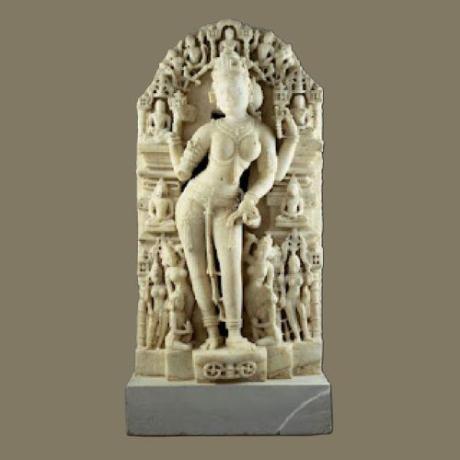
The court also directed the Union Government to make efforts to bring back an idol of goddess Saraswati from the London Museum as it had been taken to the United Kingdom in the late 1800s and reestablish in the Bhojshala complex.
The court rejected the Muslim side’s argument that an August, 1935 Ailan (official proclamation) by the then princely State of Dhar declared the site as a mosque under provisions of the Government of India Act, 1935. The court noted that the Act was only enforced in April, 1937 while rejecting the validity of the Ailan.
“In order to secure the religious rights of the Muslim community and to ensure complete justice between the parties, in case if the respondent No. 8 submits an application for allotment of a suitable land within the Dhar district for the construction of a Mosque or a place for prayer, the State Government may consider the said application in accordance with law…,” it said.
It also directed the Union Government and the ASI to take a decision on the administration and management regarding the affairs of the Bhojshala temple and Sanskrit learning at the site, while granting the ASI management and administration control of the property.
“The ASI shall have full supervisory control over the preservation, conservation and regulation of religious access,” it said.
During the hearings, the Muslim side had alleged that the ASI survey report was “biased” and prepared to back the Hindu side’s claims. Claiming that the ASI ignored historical texts and its own records, the Muslim side had said that the survey findings “have no legal basis”.
While the ASI rejected the charges as “baseless”, the court noted, “We find that the survey was conducted by adopting scientific method in a fair and impartial manner. The presence of representatives of the petitioners and the respondent can be very well seen in the videography.”
The court also said that the ASI has used scientific methods in its survey, including carbon dating and palaeography to determine the age and historical period of the structure, and XRF spot analysis and compositional testing to examine the construction material.
“The findings scientifically supported the conclusions recorded in the report,” it said.
The court order has come following the recent daily hearings, that concluded on May 12, based on a report of a court-ordered scientific survey conducted by the ASI. The court also watched the videography of the survey.
The disputed site has long been an issue of contention between the Hindu and Muslim communities of the region while the petition from a Jain community representative was filed in March this year. The Hindu side was represented by the Hindu Front For Justice among others, Maulana Kamaluddin Welfare Society of Dhar was leading the Muslim representation.
The site is an ASI-protected, 11th century monument. Under an agreement with the ASI in 2003, now impinged by the court, Hindus were allowed to perform puja at the complex every Tuesday, while Muslims offered namaz every Friday. – The Hindu, 15 May 2026
› Mehul Malpani is the chief correspondent for The Hindu in Delhi.
Filed under: india, madhya pradesh | Tagged: bhojshala complex, high court order, hindu temple, kamal maula mosque, vagdevi temple |










 BHARATA BHARATI