














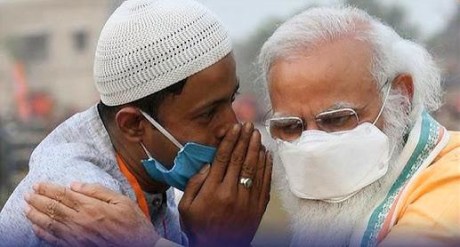
Indian Muslims are at a crossroads. They can stop being vote banks of selfish politicians who have given them nothing but poverty, fear and isolation, and become responsible citizens of a modern prosperous democratic India participating in its progress. – Virendra Parekh
Muslim politics is at a crucial point. Despite being more than 12 per cent of the population, Muslims’ representation in the parliament and the state assemblies is not just much lower, but declining. The recent assembly elections have brought a sharp reminder of this reality. In West Bengal and Assam, where Muslims constitute over 30 per cent of the population, the BJP won landslide victories (102/126 in Assam and 207/294 in West Bengal) without fielding a single Muslim candidate.
Data shows that the number of Muslim MLAs in the country has fallen from 339 in 2013 to 282 now. More tellingly, the decline has been steepest in the states which are most significant electorally. Uttar Pradesh, where Muslims account for around 19 per cent of the population, now has 31 Muslim MLAs in a house of 403, down from 63. West Bengal has seen the number drop from 59 to 37, Bihar from 19 to 11 and Rajasthan from 11 to 6. Indeed, BJP has just two Muslim MLAs nationally, Achab Uddin in Manipur and Tafajjal Hossain in Tripura.
In several states, the proportion of Muslim MLAs is much lower than their share in the population. In Bengal, Muslims were 27 per cent of the population in 2011, but now account for only 12.6 per cent of the MLAs. In Bihar, they are nearly 17 per cent of the population, but hold about 4.5 per cent of assembly seats. In Assam, their share in the population is over a third, but in the assembly it is about 17 per cent.
The situation is no different at the national level. The current Lok Sabha has 24 Muslim MPs, down from 27 in the previous one. However, this is not a recent trend. In fact, except in 1980 and 1984 when Muslims won 49 and 45 seats accounting for 9 and 8.3 percent of the house respectively, the percentage of Muslim MPs in the Lok Sabha has stayed around the 5 per cent mark.
In good old days, however, Muslims exercised an influence far disproportionate to their numbers. The first BJP-headed government at the centre under Atal Behari Vajpayee lasted only 13 days since no party which counted on Muslim vote was prepared to support it. The next one lasted a little over a year, but only after the BJP agreed to shelve its core agenda (Article 370, Ayodhya and uniform civil code) despite being the largest party in the coalition. This was the veto that Muslims enjoyed over who would rule over India and who would not.
Narendra Modi has put paid to all that. He has demonstrated that it is possible to win election after election in the states as well as at the centre with a thumping majority without fielding a single Muslim candidate. Muslims in the past have occupied high constitutional offices such as the President, Vice President, Chief Justice of India as also heads of armed forces and intelligence agencies. At present, there is just one Muslim judge in the Supreme Court out of 32 and just one secretary in the union government out of around one hundred.
Hindu awareness has changed political calculations across the board. Earlier, secularist parties would appease Muslims with all sorts of concessions while dividing the Hindus along caste, language and region and ride to power. They kept Muslims fearful and isolated. Even now, Muslims continue to vote strategically for the candidate best suited to defeat the BJP in their constituency. But the secularist parties (barring, probably, Congress) have realised the perils of pandering to the Muslim vote bank.
In Assam, 18 out of 19 Congress MLAs are Muslims; In Bengal, All MLAs of Congress, CPM and AJUP are Muslims (two each), while TMC has 31 Muslim MLAs in a total of 80. The impression of being a ‘Muslim’ party puts them at a disadvantage among the Hindus, affecting their overall performance. This is exactly where BJP would like the opposition parties to be, for any Hindu versus the rest equation is loaded 80:20 in its favour. In Kerala, of the UDF’s 102 newly elected MLAs 30 are Muslims and 29 Christians. But the secularist glee at these numbers will be short-lived: it will only consolidate the Hindu sentiment in a state where BJP is still just a marginal player.
The Hindus are convinced that they are under assault from several sides. Their share of the population is falling steadily, their sacred places are encroached upon, their women are systematically targeted, and law bars them from reclaiming their holiest shrines. It is no use telling them that raising such issues is ‘communalism’. They are convinced that unless they stand together, they will be slaughtered separately. In the telling phrase of Yogi Aditynath, Hindu bantega toh Hindu katenga.
This new normal places Muslims in an unenviable position. If they continue to be courted by the secularist parties and vote en bloc to defeat BJP, they risk further diminution of their thin representation. A seemingly attractive option is to form a pan-Indian Muslim party of their own, as Asaduddin Owaisi has suggested. However, the whole of India is not old Hyderabad. Indeed, the idea is fraught with serious dangers of dividing the country once again along communal lines. The very formation of an all-India Muslim party will harden attitudes among the Hindus. There is no British government now to tilt the scales in favour of Muslims nor any Nehru-Gandhis to rein in Hindus. Moreover, an all-India party is no guarantee of proportionate representation in parliament or state assemblies, as examples of UP, Bengal and Bihar show. In a polarised polity, Muslims can determine the outcome only where they are around half the electorate.
A more promising alternative for all is for Muslims to shed their hatred of Hindus and join the national mainstream as a large and powerful component. They must show the same non-harm, tolerance and respect to the Hindus that they expect from the latter. There is no need for ghar wapsi, an acknowledgment of their Hindu roots would suffice. Then they would realise that their qaum (community) is not global ummah, but the rest of India. Those Muslims who undertake this endeavour would soon discover that any positive gesture towards the Hindus would be more than reciprocated. If this happens, then there is a chance that we may have genuine politics where communities work towards their collective good through dialogue and compromise. Ideally, Muslims should be able to win in a Hindu-majority constituency and vice versa as a matter of routine.
Indian Muslims are at a crossroads. They can stop being vote banks of selfish politicians who have given them nothing but poverty, fear and isolation, and become responsible citizens of a modern prosperous democratic India participating in its progress. India, driven by the Hindu renaissance will continue to march on regardless of what Muslims do or don’t do. At best, they can slow down its progress and prevent it from realising its full potential. But they will be worse off for it, not better off.
› Virendra Parekh writes on economics and politics, also on issues related to Indian civilization, history and cultural nationalism.
Filed under: india | Tagged: BJP wins, muslim political integration, muslim vote banks, muslims in india, west bengal elections |











