














The positives of SIR are far too many without an iota of doubt—an electoral roll that more closely matches the living, resident, non-duplicate citizen population makes the act of voting a clearer expression of the eligible electorate rather than an artefact of two decades of unremoved entries. – Sanju Verma
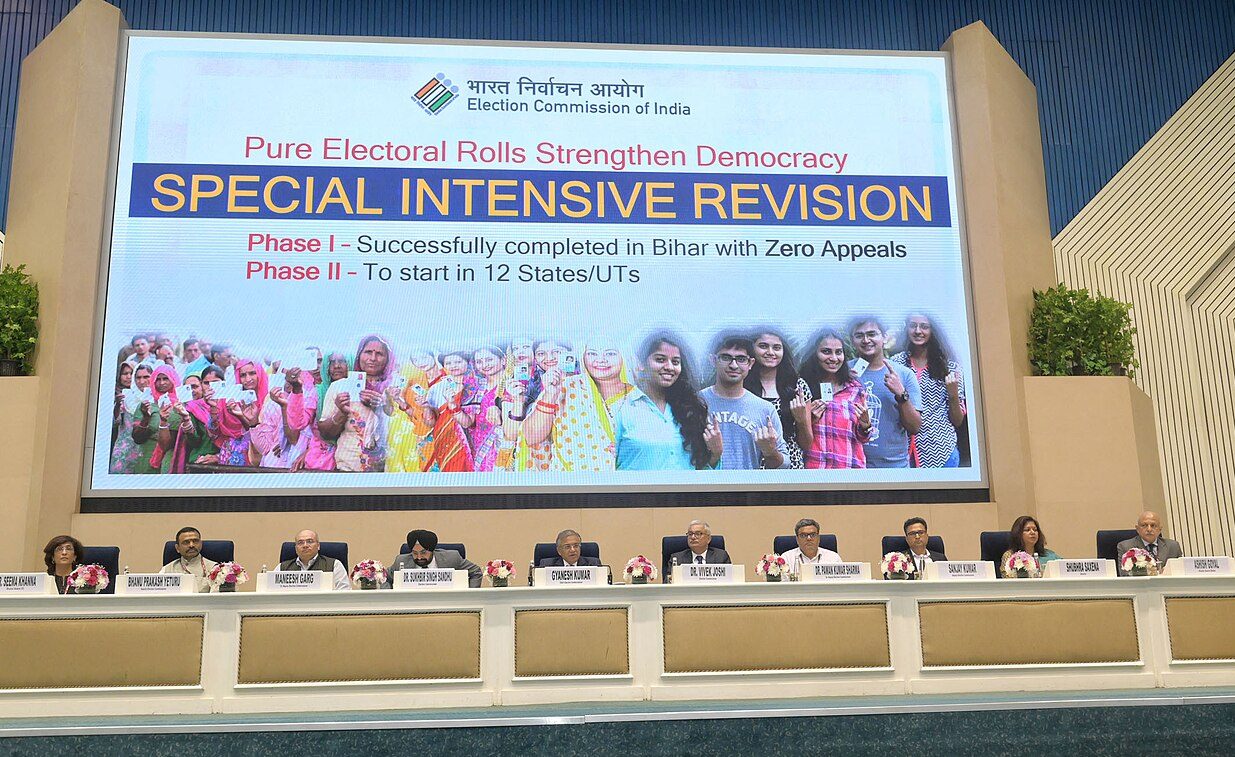
The Special Intensive Revision of electoral rolls is a house-to-house verification ordered by the Election Commission of India (ECI). In Bihar, it began on June 24, 2025, the first stage of a wider national exercise.
The ECI’s stated test is straightforward—every eligible citizen should be on the roll and no ineligible person should remain on it.
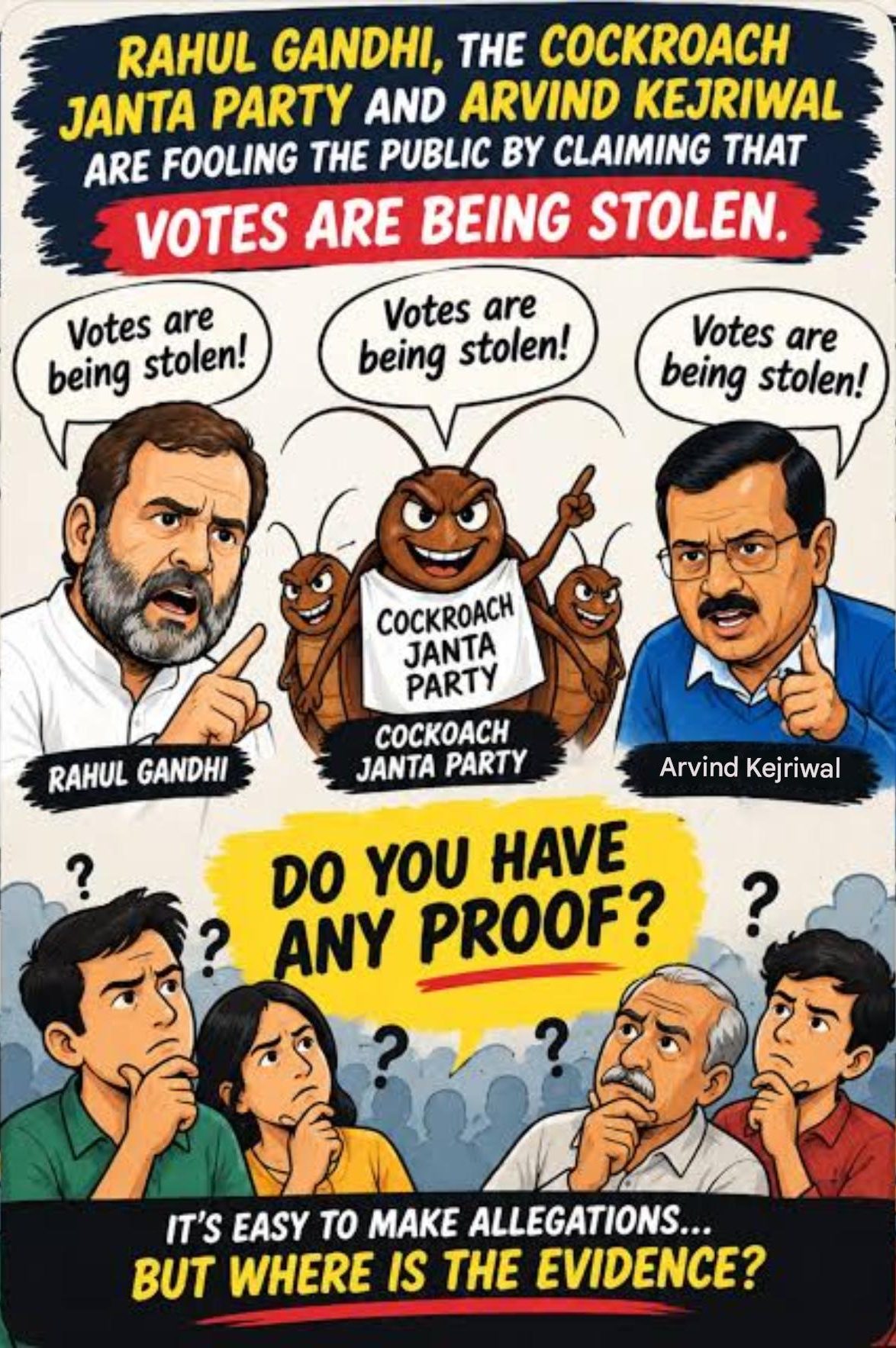
The nefarious political campaign against the SIR by India’s morally decrepit Opposition has treated the same exercise as proof of a plot to steal votes and discredit the Modi government.
The truth is, intensive revision is not a new invention. Article 324 gives the Election Commission the power to superintend elections and the preparation of electoral rolls. Section 21 of the Representation of the People Act, 1951, allows the ECI to order a special revision of a roll. Rule 25 of the Registration of Electors Rules, 1960, contemplates intensive, summary, or mixed revision. The ECI’s June 2025 order listed earlier intensive revisions across the country, from the 1950s through 2004.
Bihar’s previous intensive revision was in 2003. The voter identity card system itself grew out of intensive revisions in the early 1990s, under successive governments that were not led by the BJP. A gap of twenty-two years in a high-migration State is a solid reason to clean the roll and certainly not any evidence that the cleaning is unprecedented or unlawful.
The Bihar numbers, for example, are public. On June 24, 2025, the roll contained 7.89 crore electors. Booth-level officers, roughly one lakh of them, distributed pre-filled enumeration forms and made repeated house visits. By the draft roll of August 1, 65 lakh names were absent. The Commission’s breakdown of that draft-stage removal was approximately 22 lakh deceased, 36 lakh permanently migrated or not traceable at the recorded address, and 7 lakh already enrolled elsewhere. The claims and objections period then added 21.53 lakh electors through Form 6 and removed a further 3.66 lakh. The final roll published on September 30, 2025 stood at about 7.42 crore. Net reduction was roughly 47 lakh, or barely 6%. Electors still left out could apply for inclusion up to ten days before the last date for filing nominations, with the addition going into a supplementary list. Appeals under Section 24 lay to the District Magistrate and then to the Chief Electoral Officer.
Political parties were always seized of the modalities of the SIR process right from day one, and to therefore make spurious allegations after facing an electoral loss is simply the handiwork of sore losers. Indeed, the Opposition has been a bad case of “sour grapes”.
Physical and digital copies of all relevant documents were shared with all stakeholders during the SIR exercise in various poll-bound States in 2025 and 2026. Booth-level officers, numbering over one lakh, conducted repeated house visits. More than 1.6 lakh booth-level agents appointed by the twelve major parties, including the RJD, Congress, JD(U) and BJP, were given lists of probable deletions so they could locate eligible voters before the draft window closed.
The ECI later stated that the Bihar exercise concluded with zero appeals against the final roll and that the subsequent assembly election saw a record turnout. Zero re-polls were recommended after scrutiny. If political parties thought the SIR process was unfair, why were there zero appeals? Why did BLAs not complain?
The moot point is there were no appeals because there was no wrongdoing. The Opposition is lazy and wants to hold ECI to ransom, but does not want to go to Courts with any valid grievances, because they know if they go to Courts, their bluff will be called out.
The Congress and RJD alone had a total of over 64,000 BLAs on the ground during last year’s Bihar elections. Similarly, Mamata Banerjee’s party had an army of BLAs in Bengal. If indeed there were illegal additions or deletions of voters as claimed, why did the BLAs affiliated to the TMC and Congress not raise a hue and cry when it mattered? How is it that after the RJD was reduced to a measly 25 seats and the Congress to a humiliating 6 seats, these Opposition parties suddenly realised that “Vote Chori” happened in Bihar?
Mamata Banerjee started crying foul against SIR after her party was wiped out, securing barely 80 seats. In fact, seats with maximum SIR deletions saw the TMC winning, so the flimsy argument that SIR deletions helped the BJP is absolute balderdash.
Let us cut to the chase—each time the Opposition is vanquished at the hustings, it cries foul, but people can now see through the antics of these parties and how they are trying to delegitimise the electoral process.
Elections in India are free and fair. If a criminally lethargic and reckless Rahul Gandhi has failed to dent Narendra Modi’s massive popularity that shows no signs of waning, the problem is with Rahul, not Modi.
The Supreme Court, in Association for Democratic Reforms vs. Election Commission of India (May 2026), upheld the ECI’s authority to conduct the revision and to prescribe a documentation framework, while reiterating the safeguards of notice, hearing and appeal. The Court noted that the exercise advances the constitutional requirement of free and fair elections; inquiries into eligibility for the roll do not themselves amount to a determination of citizenship. These mechanics explain the principal positives. Electoral rolls that have not been intensively verified for two decades accumulate dead voters, duplicate entries and permanently shifted persons, and therefore need to be sanitised.
Inflated rolls depress reported turnout percentages, complicate logistics and create opportunities for impersonation. Removing the deceased and the long-migrated restores the principle of one person, one vote without requiring any new legislation. In both Bengal and Bihar, the categories were published and shared with parties before the draft stage. Analyses of constituency-level data after the 2025 and 2026 assembly elections in roughly 11 States found no simple correlation between high deletion rates and NDA victories; several high-deletion and high-addition seats went both ways. So a debilitated Rahul Gandhi & a vanquished Mamata Banerjee’s baseless allegations that SIR deletions have helped the Modi government are a bunch of malicious lies.
Foreign-national removals, the category most often invoked by the Opposition in political rhetoric, proved negligible. Independent examination of the final Bihar rolls, for example, found roughly 9,500 entries marked ineligible for reasons that include foreign nationality, unsound mind or corrupt practices—about 0.012% of the electorate. Is the Opposition saying the Bihar outcome was engineered in favour of the NDA simply because 0.012% illegal foreigners were removed by the ECI? Should illegal aliens be allowed to vote in India? No. The Opposition is simply crying wolf because it refuses to introspect and refuses to learn from its defeats. It chooses to malign the BJP, as that is the easiest thing to do.
The Opposition narrative has treated SIR deletions as evidence of deliberate disenfranchisement. Protest marches and public statements framed the Election Commission as an instrument of the ruling party. But these wild claims do not survive the rigour of published records.
First, intensive revision is not novel. The Commission’s June 2025 order itself listed earlier exercises under governments of different parties; the voter-identity card system itself emerged from intensive revisions in the early 1990s. A 22-year gap since Bihar’s previous intensive revision is long for a high-migration State, not evidence of sudden partisanship.
Second, the bulk of Bihar deletions fell into these categories—(1) death, permanent migration, (2) duplication—that every previous revision has addressed. Political parties were supplied the lists and appointed agents in large numbers; the volume of formal claims for restoration filed through parties was modest relative to the deletions. The Opposition fails to realise a basic fact—draft-stage omissions are not final exclusions. Also, demographic patterns cut against a simple targeting story. In Bihar, male out-migration for work is long-established; higher removal of younger women recorded as “permanently shifted” tracks that pattern more closely than partisan lists. Seemanchal districts with large Muslim populations did not show uniformly exceptional deletion rates once migration and death were accounted for. Constituency-wise analysis after the assembly elections results in the last one year found the relationship between SIR changes and seat outcomes scattered rather than systematic.
Moreover, the institutional actor is the Election Commission, whose members are appointed under constitutional procedure. Attributing every operational shortcoming—residual duplicate entries that investigative reports still found, spelling variances flagged as “logical discrepancies,” or slow disposal of appeals in later states—to a Central government conspiracy requires evidence. And Rahul Gandhi has not been able to provide even a shred of credible evidence. Assumptions and conjectures are not akin to proof of wrongdoing. And besides flying imaginary kites in the air, the Congress scion has no hard evidence to offer. Allegations cannot be a substitute for hard facts.
Transparency on the precise software rules used for “logical discrepancy” flagging has been limited. These are arguments for tighter field protocols, fuller publication of deletion reasons at booth level, and faster tribunals—not for the claim that the entire exercise was engineered to steal an election. The political incentive to call every cleaning exercise fraudulent is obvious once results disappoint the Opposition. The positives of SIR are far too many without an iota of doubt—an electoral roll that more closely matches the living, resident, non-duplicate citizen population makes the act of voting a clearer expression of the eligible electorate rather than an artefact of two decades of unremoved entries. Opposition parties retain every legal avenue—booth agents, claims, appeals and further litigation—to protect any eligible elector who was wrongly omitted. Instead of using these avenues, describing the existence of the avenues themselves as proof of malice is the narrative that the Opposition has been peddling with brazen impunity.
Transparency exists in India, but via lawful channels, not press conferences and baseless claims. ECI procedures exist to protect electoral integrity. Duplicate names do not mean duplicate votes. Urban migration is not akin to vote fraud. Allegations need evidence and process, not noise. Rahul Gandhi does not even have a shred of evidence in his possession, barring obnoxiously hollow claims of wrongdoing. He has not been able to digest one electoral defeat after another in the face of the unrelenting Modi juggernaut. And yes, no fundamental right is absolute.
Every fundamental right, including the right to a peaceful protest under Article 19 of the Constitution, is subject to reasonable restrictions pertaining to public order, morality and health. Street-style thuggery can never be and will never be an alternative to the popular mandate of the electorate. – News18, 12 October 2026
› Sanju Verma is an economist, national spokesperson of the BJP and the bestselling author of ‘The Modi Gambit’.
Filed under: india | Tagged: arvind kejriwal, cockroach janata party, rahul gandhi, SIR, special intensive revision | Comments Off on SIR: Facts vs. Falsehoods – Sanju Verma











