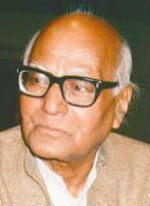








 Yogacharya B.K.S. Iyengar, the last of the legendary yoga gurus, passed into the ages on August 20, 2014. He would have turned 96 on December 14.
In an interview he had granted Rediff.com in September 2000, he had said, “The practice of yoga fulfils the need for enjoyment just as it provides enlightenment.” – Ronjita Das
The Interview
For Yogacharya B. K. S. Iyengar, winning the Lifetime Achievement Award at the Priyadarshini Awards ceremony for service rendered to humanity in the field of yoga, is just another accolade in a rich lifetime. Born in a poor family in Bellur, Karnataka, in 1918, he has come a long way from being a weak and sickly child to becoming one of India’s greatest yoga teachers.
He has received many prestigious awards like the Rajyotsava Award, 1988; the Patanjali Award, 1990; the Padma Shri in 1991; the Punya Bhushan Award, 1995; Health Care for 1996 Award; Swami Vivekanand Puraskar, 1999; and the Best Citizen of India Award, 2000, to name a few. Many international awards have come his way too, like the Man of the Year 1998, awarded by the American Biographical Institute; the International Man of the Year, 1998, awarded by the International Biographical Centre, Cambridge; and the Twentieth Century Award for Achievement.
His name has been included in many national, Asian and international lists of Who’s Who, men of achievement and prominent personalities of India. Titles like Yogi Ratna and Yoganga Shikshaka Chakravarti have also been conferred upon him.
The Film and Television Institute of India produced a film on Iyengar called Samadhi, which won the Silver Lotus Award. He was invited in 1985 to the Festival of India in France, where the film Guruji depicted his heroic struggle from poverty to prosperity.
♦ You have won the Lifetime Achievement Award for service rendered to humanity in the field of yoga. How do you rate this achievement?
♦ Yoga was a very dry subject 40 years ago. There were hardly three or four people learning yoga then, but now there are millions of people who learn yoga. The subject was not treated with respect in the early years, but I changed the whole scene. I brought life into yoga. I made it very lively.
♦ How did yoga become an important part of your life?
♦ I was suffering from tuberculosis, malaria and typhoid as a child. In those days, there was no treatment for these ailments. So I turned to yoga.
♦ How do you account for its popularity today?
♦ It spread by word of mouth. I have not made any conscious effort to promote yoga. No newspaper in Pune has ever given publicity to either my institute or to what is taught there. It became popular because of my dedication. When I was in England, I used to walk from Highgate to Hampstead, a distance of six miles, because I could not afford the bus. I used to send all the money I earned to my family in India. But I did not want to give up learning yoga. I was so dedicated!
♦ How receptive is the West to yoga?
♦ There are 180 Iyengar institutes in the world. There are 5,000 teachers abroad. In 1968, the educational department in London asked me if I could teach yoga in London without using Sanskrit words. I trained some teachers for 15 to 20 days before I too started teaching in London.
♦ Is your wife interested in yoga as well?
♦ Yes, very much. She used to teach yoga to women. In the early days, we were not really well off. But my wife encouraged me to learn yoga despite the financial hardships we were facing. Which is why I have named the Ramamani Iyengar Memorial Yoga Institute in Pune after her. My children also teach yoga. And now I have started training my grandchildren too.
♦ Is it an expensive way of keeping fit?
♦ Not at all. The Ramamani Iyengar Memorial Yoga Institute charges Rs 50 for four classes.
♦ You have devised several props with the help of which even a disabled person can perform various yoga postures. What made you think of this?
♦ Disabled people cannot perform yoga without help. So I had to think of a support system with which I could help such people do yoga. It is with this in mind that I devised some props. There are now 600 asanas which can be performed with props.
♦ Do you follow any special diet?
♦ No. I eat like any ordinary, middle-class Hindu man.
♦ Muscle vs meditation. Gymnasiums vs yoga. What are your views on these forms of exercise?
♦ The practice of yoga fulfills the need for enjoyment just as it provides enlightenment. A person should not be caught in the pursuit of enjoyment alone, he should experience enlightenment too. I mean, there should be action and motion. We must enjoy the action, not the motion. – Rediff, 20 August 2014

BERLIN, GERMANY: US-born Russian Jewish violinist Yehudi Menuhin, one of the most brilliant and celebrated violinists of the century and a yoga student of B.K.S. Iyengar, stands on his head in a yoga position as he conducts with his feet the Berlin Philharmonic Orchestra, which was playing the 5th symphony of Beethoven. Menuhin died 12 March 1999 in Berlin after a heart attack at the age of 82. (Photo credit AFP/Getty Images)
A Guru and a Maestro’s ‘Best Violin Teacher’ – TNIE Edit
Yoga guru B. K. S. Iyengar, who helped popularise yoga worldwide, died on Wednesday at the age of 95. Born in a poor family at Bellur village in Karnataka, Iyengar was a sickly child who suffered multiple illnesses including typhoid and tuberculosis. When he was 15, a relative introduced him to yoga in an attempt to build his resistance to disease. By the time he was 18, he moved to Pune to practise yoga and to teach its techniques. Iyengar created his own brand of yoga called “Iyengar yoga” and established studios in 72 countries where practitioners are taught ways to improve breathing, concentration and meditation. Despite suffering severe heart attacks in 1996 and 1998, the guru kept up an active schedule in recent years that included tours to China and Russia. Among his disciples were celebrated philosopher J Krishnamurti, Queen Elisabeth of Belgium, violinist Yehudi Menuhin, writer Aldous Huxley and cricketer Sachin Tendulkar.
Menuhin called Iyengar his “best violin teacher” for he made the aches and pains disappear and enabled him to conduct the opening movements of Beethoven’s fifth symphony for the Berlin Philharmonic Orchestra at its 100th jubilee celebrations standing on his head and conducting with his feet. Iyengar also helped the Belgian queen to recover partially from her stroke in 1965.
As Nehru wrote, there’s something quintessentially Indian about yoga, for it entails performing an “exercise” sitting motionless while in the West, exercising means running about till one is out of breath. Yet, in yoga, the body can be toned up without undertaking any violent exertions. Moreover, along with the body, the mind, too, can become alert and fresh. These are the reasons why many in the enervated West whose minds and bodies have become jaded because of the competitive lifestyle turn to yoga. There is a lesson in this for Indians, too. – The New Indian Express, 22 August 2014

Filed under: india | Tagged: b.k.s. iyengar, hatha yoga, hinduism, sanskrit literature, yoga, yoga postures, yogacharya | 2 Comments »