












“This is my own and that a stranger” is the calculation of the narrow-minded;
For the magnanimous-hearts however, the entire earth is but a family.
If we study the original sources for the shloka ‘vasdhaiva kutumbakam’, it becomes amazingly apparent that its popular understanding is simply flawed, and its application in matters of policy is the height of ignorance. The Vedas did not propagate vasudhaiva kutumbakam, nor does this shloka really mean what is commonly understood. In general, surprising as it might seem, Sanskrit sources—not Vedas—that presented vasudhaiva kutumbakam are actually warning AGAINST the tendency to preach universal brotherhood! – Sarvesh K. Tiwari
If a survey of the saMskR^ita verses most quoted in the modern times were undertaken, the above would certainly secure the top rank. Along with its short form ‘vasudhaiva kuTumbakam’, this shloka somehow finds a massive popularity among the modern Hindus. Of late though, the secular variety seems to have developed quite a fetish for it and the verse has gained a rhetorical note. Apparently it offers them an aesthetic emblem of multiculturalism and universalism, as well as an authority of yore to denounce the nationalistic thought as narrow-minded. Even the most saMskR^ita-phobic ones therefore can be seen reciting this shloka on every sundry occasion.
While we can site several examples of its interesting usage, we shall limit to the following few:
“… India that once, 2000 years ago, had proclaimed vasudeva (sic) kutumbakam—the world is one family, …” — Ms. Sonia Gandhi in her acceptance speech on occasion of being conferred the “Grand Officer of the Order of Leopold” by Belgian government for her “constructive nationalism and efforts to foster a multicultural, tolerant society in India”, on November 11, 2006 at Centre for Fine Arts, Brussels.
And:
“In ancient India the liberal perspective was defined by the concept of Vasudhaiva Kutumbakam … in contradiction to the ‘Clash of Civilizations’… the theory I don’t agree with. We have to reclaim that liberal space.” — Dr. Manmohan Singh, the Prime Minister of India, address to the Harvard Alumni Association, March 25, 2006 at New Delhi.
The shloka of vasudhaiva kuTumbakam being sited to propose it as a contrasting paradigm to the Samuel Huntington’s theory of Clash of Civilizations, is both iconic and profound. The shloka is invoked by the speakers to show their liberalist Nehruvian internationalism to be a continuity of the ancient Hindu paradigm; the appeal is made to the Hindu past for approval and attestation of their ideology; and claim is laid to be the legitimate heir of the continuity of the ancient thought process and legacy.
Had it been limited to the shloka’s popularity among the speech-writers to add some aesthetic value to the speeches, not much harm done. But what is much more profound comes in the following:
Speaking in Rajya Sabha on December 5, 2007, the Union Minister for External Affaires Mr. Pranab Mukherjee made it very unambiguous when he jubilantly declared:
“Vasudhaiva Kutumbakam is our foreign policy.”
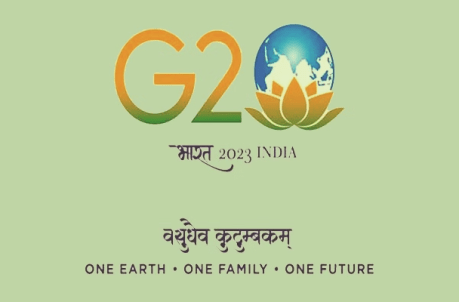
Indeed, Vasudhaiva Kutumbakam has also become an unchallenged cornerstone of India’s official policy-making since independence, as has been officially proclaimed so on several occasions. No wonder that as a symbolic reflection, Vasudhaiva Kutumbakam has been literally inscribed in stone, on the walls of the India’s Parliament House.
Now, thanks to the continuous rhetoric, traditional Hindus too seem to have taken to this shloka like a duck to the water. Vasudhaiva Kutumbakam is often cited by them as an evidence of how the ancient sages had set for themselves, and for generations thereafter, the principles of an unconditional universal brotherhood. It has been generally taken for granted that Vasudhaiva Kutumbakam is of unquestionable value, a traditional nIti recommended by wise ancestors of how to deal with the world. We can notice the shloka being quoted uncritically not only by Hindutva ideologues in their writings and speeches but also popular religious leaders in their discourses without getting tired.
However, this prominence of Vasudhaiva Kutumbakam in the modern public discourse springs from a superficial or even a perverted understanding. If we study the original sources which recited it in the first place, it becomes amazingly apparent that its popular understanding is simply blundered, and its application in the matters of policy is a height of ignorance and squarely flawed.
Links to all Tiwari’s Vasudhaiva Kutumbakam articles:
1 – The Hoax Called Vasudhaiva Kutumbakam (Hitopadesha)
2 – The Hoax Called Vasudhaiva Kutumbakam (Panchatantra & Kautilya)
3 – The Hoax Called Vasudhaiva Kutumbakam (Vikrama, Poetics & Upanishada)
Filed under: india | Tagged: indian politics, nehruvian secularism, sanskrit literature, self-deception, vasudhaiva kutumbakam | 4 Comments »