










 Indian diplomats and foreign policy consultants well versed in Hindu studies will increase their strategic value for India and, in turn, the soft power of India in the global corridors of power by bringing an “Indic perspective” inspired by Hindu thought into discussions worldwide, which is highly essential when India aspires to become a “world power.” – Arunansh B. Goswami & Sumit Kaushik
Throughout the annals of time, ancient seers and saints, dwelling serenely along the banks of the Sapt Sindhu (Seven Rivers), embarked on a profound journey of intuitive realization. In their contemplative moments, they unravelled the eternal spiritual truths (satya) and envisioned the foundational principles orchestrating the universe—principles known as dharma. This enduring and fundamental essence, encapsulated within the term Sanatana Dharma, stands as the majestic cornerstone of Indian civilisation, conveyed through a myriad of oral traditions and textual legacies. Hindu studies, therefore, becomes the soulful exploration of these opulent oral and textual traditions—an endeavour akin to unravelling the intricate branches of a vibrant, living tree that embodies Indian culture, philosophy, rituals and spirituality.
Akhand Bharat and “Farther India,” as mentioned by French scholar George Coedes, are two different geo-political concepts, united by the influence of Indian culture (including Hindu Dharma); while the former is substantially coterminous with what we call South Asia, the latter includes what is called the “Indosphere” in Asia, which geographically consists of Vietnam, excluding Northern Vietnam, Cambodia, Laos, Thailand, Myanmar and the Malay states. Hindu settlements existed in Armenia, which became the first country in the world to declare Christianity as its state religion, as mentioned by Indo-Armenian historian Mesrovb Jacob Seth, and in a 3,300-year-old inscription of a treaty between Hittite King Suppiluliuma I and Mittanni King Shattiwaza, found in Bogazköy Türkiye, deities Indra and Varuna are invoked as divine witnesses. Hindus worshipped in the Ateshgah of Baku in Azerbaijan with Sikhs and Zoroastrians. Hindu heritage is found in different parts of the world. Through the discipline of Hindu Studies, students will learn about this heritage and hopefully work for its preservation.
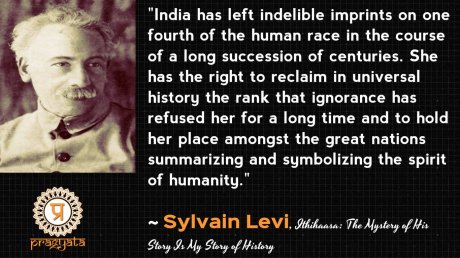
French Orientalist Sylvain Levi wrote in his book L’lnde civilisatrice: Apergu historique (Paris, 1938) that “India gave her mythology to her neighbours who went to teach it to the whole world. Mother of law and philosophy, she gave to three-quarters of Asia a god, a religion, a doctrine, and an art. She carried her sacred language, her literature, and her institutions into Indonesia, to the limits of the known world, and from there they spread back to Madagascar and perhaps to the coast of Africa, where the present flow of Indian immigrants seems to follow the faint traces of the past.” Indian diplomats and foreign policy consultants well versed in Hindu studies will increase their strategic value for India and, in turn, the soft power of India in the global corridors of power by bringing an “Indic perspective” inspired by Hindu thought into discussions worldwide, which is highly essential when India aspires to become a “world power.”
Among the rich tapestry of worldviews, Hindu studies emerge as a beacon, offering intense insights that resonate across time and space. The relevance of Hindu studies for today’s youth lies not only in preserving cultural heritage but also in fostering wisdom, compassion, and a holistic understanding of life. Tolerance and coexistence are important parts of the wider Hindu worldview. Adherents of this religion, which is internally so diverse with a spectrum of views from theistic (Bhakti) to atheistic (Lokayata) within its ambit, have readily accepted diversity outside of it too. In India, the birthplace of Hindu civilization, Jews did not and still do not face anti-Semitism; Zoroastrians found refuge after their once-mighty empire was obliterated by the Arabs; and several sects of Islam found a peaceful home. Hindu studies will help the younger generation of Indians learn about the culture that promoted such a tolerant worldview and help them fulfil their fundamental duties mentioned in Article 51A (e) and Article 51A (f) which will promote communal harmony in a country as diverse as India.
Several prestigious Western institutions, such as Oxford University, the University of Cambridge, the Massachusetts Institute of Technology and Harvard University, have long incorporated courses focused on Hindu studies. While Bharat, with its Hindu majority, has introduced the subject relatively late in educational institutions. Today, the subject aligns with the progressive provisions of the National Education Policy (NEP) 2020. Under the NEP, students can explore Hindu studies alongside contemporary subjects like computer science, data analytics, commerce, and political science as minors. There is a need to frame a comprehensive programme that aims to elucidate Hinduism through the exploration of ancient Indian literary references, delving into subjects like Gyan Mimamsa, Tatva Mimamsa, Dharma-karma, art skills, society, culture, and more.
Hinduism is a way of life; introducing the youth to Hindu studies provides them with a unique lens to explore universal themes such as the nature of existence, the pursuit of knowledge, and the interconnectedness of all living beings. It was this way of life that attracted the Greek Heliodoros ambassador of King Antialcidas Nikephoros to describe himself as a Bhagavata of Vishnu Vasudeva and for participants from different parts of the world in the first Parliament of the World’s Religions in Chicago on 11 September, 1893, to give a standing ovation for two minutes after Swami Vivekananda had completed his speech. These teachings go beyond religious boundaries, offering a timeless perspective that transcends cultural contexts.
The study of Hinduism serves as a gateway to appreciating Bharat’s rich cultural and historical tapestry. As the world increasingly looks towards Bharat for its economic, scientific, and cultural contributions, a nuanced understanding of Hinduism becomes pivotal for fostering cross-cultural collaborations and partnerships. In the pursuit of encouraging Hindu studies, the aim is to delve into the reservoir of wisdom surrounding Hindu Dharma and its spiritual heritage. This endeavour seeks to unveil the essence of spiritual Hindu literature, unravelling its foundational tenets. The exploration encompasses both prominent and lesser-known texts, accompanied by pivotal commentaries. Furthermore, it accentuates the pertinence of Hindu studies in the dynamic tapestry of the modern world, acknowledging its relevance in the evolving global paradigm. – Firstpost, 19 February 2024
› Arunansh B Goswami is an advocate in Supreme Court of India and a historian. Sumit Kaushik is a PhD candidate at OP Jindal Global University and a social impact consultant.

Filed under: india, world | Tagged: hindu civilisation, hindu studies, indian history, indic perspective, sanatana dharma | Comments Off on Nurturing Hindu wisdom in the 21st century – Arunansh B. Goswami & Sumit Kaushik