











 Up until recent years, the fast unto death process has been celebrated with newspaper announcements that laud the monks, nuns, laymen and laywomen who undergo this vow. But of late, questions are being raised whether it can result in coercion and cruelty. – Prof. Christopher Key Chapple
On June 9, 2016 a law allowing patients with terminal illnesses to end their lives with help from a physician came into effect in California, opening conversations about whether human life should be prolonged against the desire to die peacefully and with dignity.
A similar yet different conversation has been taking place in India for the past several years, but in reverse.
In one of India’s religious traditions, Jainism, those at the end of life can choose to embrace a final fast transition from one body to another. However, a recent court case has challenged the constitutionality of this practice. As an expert in the religions of India and a frequent visitor, I have been following this issue with keen interest.
A rite to final passage
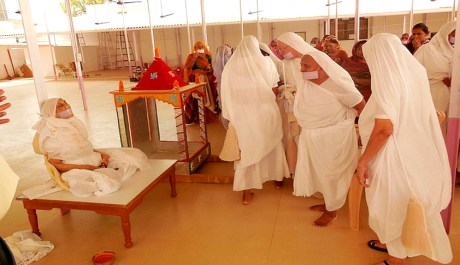
While on a visit to a Jain university in Ladnun, Rajasthan in western India in 1989, I had an opportunity to observe the practice of “Sallekhana” or “Santhara,” a somber rite through which one fasts to death.
A group of enthusiastic nuns rushed me in for a blessing being imparted to an octogenarian nun, Sadhvi Kesharji, who had taken this vow 28 days earlier. The nun had been diagnosed with a fatal kidney disease and been treated, but to no avail.
It was an auspicious moment. Her spiritual preceptor, Acharya Tulsi, praised her six decades as a nun and noted the lightness of her spirit and the strength of her resolve which guaranteed safe passage into her next incarnation.
She passed away 12 days later, in a prayerful state.
This is not the only such case. It is estimated that some 200 Jains, both lay and monastic, complete the final fast each year. Jains living elsewhere in the world observe the practice as well.
For example, two Jain women who were born in India but spent most of their adult lives in the United States chose to fast in the last days prior to death. Vijay Bhade, a Jain woman from West Virginia, entered a fast unto death in 1997. A more recent case was Bhagwati Gada, from Texas, who suffered from advanced stage cancer and decided to fast unto death in 2013, after going through multiple rounds of chemotherapy.
Who are the Jains?
Jainism arose more than 2,800 years ago in northeast India. It teaches a doctrine proclaiming the existence of countless eternal souls who, due to their actions or karma, bind themselves to repeated lifetimes.
These souls could manifest as elemental beings in the earth or water or fire or air. They could evolve to become micro-organisms and plants or eventually take forms as worms, insects, birds, reptiles or mammals.
By committing acts of goodness, they might take human form and ascend to a place of everlasting freedom at the highest limits of the universe, from which they continue to observe forever the repeated rounds of existence experienced by the many souls below.
Jains do not believe in a creator God or an external controller. All experiences, good and bad, are due to one’s own exertions. The key to spiritual ascent resides in the performance of five vows also shared by Yogis and Buddhists in India: nonviolence, truthfulness, not stealing, celibacy and nonpossession.
Jains believe the practice of these vows helps release fettering karmas that impede the energy, consciousness and bliss of the soul. Every ethical success lightens the soul of its karmic burden. Mohandas Gandhi, the well-known leader of India’s independence, who grew up in the company of Jains, employed these vows personally and as a collective strategy of nonviolence to help India overcome the shackles of British colonization.
Freedom yes, but can there be coercion?
Up until recent years, the fast unto death process has been celebrated with newspaper announcements that laud the monks, nuns, laymen and laywomen who undergo this vow. But of late, questions are being raised whether it can result in coercion and cruelty.
In 2006, a young lawyer in Rajasthan, Nikhil Soni, challenged the constitutionality of this act, stating that it violates the anti-suicide laws that had been in put place by the British to stop the immolation of widows on their husband’s funeral pyre. The [very rare] practice of widow burning has endured, despite many efforts to abolish the practice.
The high court of Rajasthan ruled in favor of Soni in 2015, effectively making the practice of fasting to death punishable by law. However, some weeks later, the Supreme Court of India placed a stay on this ruling. The case is still awaiting its final verdict. Observant Jains claim this is an important part of their faith.
Entering the fast requires counsel and permission from one’s spiritual advisor. And the process of rejection of food is gradual. First, one takes some yogurt, then only milk, then only juice, eventually moving from water to total rejection of any nutrition or hydration.
Physicians state that this is not death by starvation but by dehydration. The body automatically goes into a state of ketosis (when the body starts to break down stored fat for energy), often accompanied by a peaceful state.
Rights versus rites approach
What can we learn from such spiritual practices?
Debates on end of life focus on the “rights” approach, thus appealing to the rational mind. Spiritual traditions on the other hand assert that it makes no sense to prolong suffering. They use a “rites” approach to the inevitable passing of the human body.
Jains believe that the soul has always been here, that the soul cannot be destroyed and that through the process of death, one transitions to a new body.
The Jain tradition shows how we can move without attachment into death rather than clinging to life. In their acceptance of the inevitable, they set an example that death is not an evil but an opportunity to reflect on a life well-lived and look forward to what lies ahead. – The Conversation, 10 June 2016
› Prof. Christopher Key Chapple is an Indologist and scholar of the renouncing religions of India, namely Yoga, Jainism, and Buddhism.
Filed under: india | Tagged: jainism, right to die, sallekhana, santhara | Comments Off on What Jainism teaches us about dying – Christopher Key Chapple