






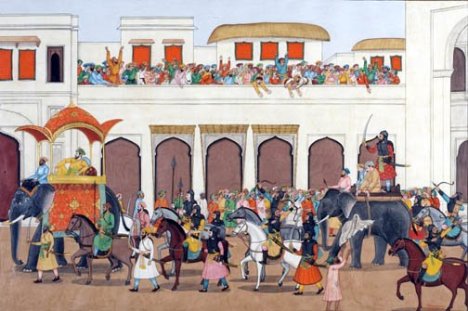
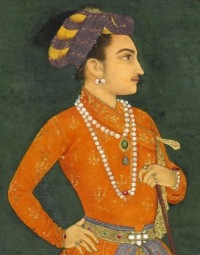
 “We’ve a road named after a religious bigot and tyrannical ruler Aurangzeb, but not after his brother Dara Shikoh, who staked his very life to Indianise Islam. These are of no less significance to understand the psyche of misguided post-independent social philosophy. Secularists have imposed certain figures on our popular mind, who are injurious to our inclusive social and intellectual life, and philosophy.” – Prof Rakesh Sinha
 Indian politics and history may now witness a war of sorts between national heroes and other icons. Post-independent India has witnessed systematic efforts to iconise certain figures as the only ‘true heroes’ of the national movement and political life, while banishing and suppressing others. There are innumerable institutions, projects and roads named after the Nehru-Gandhi dynasty. But the Lal-Bal-Pal trio, Subhash Chandra Bose, Bhagat Singh, Sukhdev and leaders and thinkers associated with the RSS and the socialist movement were denied legitimate space.
This year has witnessed the ascendency of a different politico-ideological consanguinity (gotra). Intellectual and popular discourse, therefore, will also witness iconisation as well as de-iconisation of historical figures. Interestingly, the debate on non-Hindu figures is all the more important for strengthening secularism and nationalism in India.
We’ve a road named after a religious bigot and tyrannical ruler Aurangzeb, but not after his brother Dara Shikoh, who staked his very life to Indianise Islam. These are of no less significance to understand the psyche of misguided post-independent social philosophy. Secularists have imposed certain figures on our popular mind, who are injurious to our inclusive social and intellectual life, and philosophy.
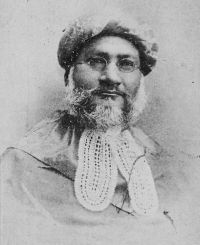 The most glaring instance is of Sir Syed Ahmed Khan, the founder of Aligarh Muslim University, who introduced modern education among Muslims. Does this alone merit his status of a modern leader and icon worthy of celebration? There are two fundamental criteria to judge any social reformer and thinker. First, inclusive politics and social philosophy, and second, egalitarian thought. Khan was one of the first Muslim elites to systematically campaign against the Indian National Congress (INC) and left no stone unturned to alienate it from India’s Muslims. He condemned the INC as “civil war without arms” and wasn’t inconsistent in his approach to the national movement till his last breath. India’s non-Muslims didn’t care who was at the helm of the Congress as they folked together to strengthen the national outfit increasingly evolving as a platform against imperialism.
Congress’ first president W. C. Banerjee was a Christian, the second in 1886 was Dadabhai Naoroji, a Parsi, the third in 1887 was Badruddin Tyabji, a Muslim. The fourth and fifth were Europeans—Yule and Wedderburn—and the sixth president in 1890 was Pherozeshah Mehta, a Parsi. This did not deter Hindu participation in the Congress. While in 1885, the number of Hindu delegates was 55, and Muslims had only two, the Parsis who formed a microscopic part of the total population and stood nowhere in comparison to Muslims, had nine delegates. At the Bombay session of 1904, the Parsis with 65 delegates were 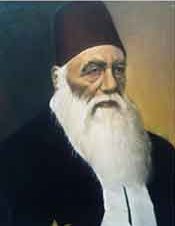 almost double that of the Muslims (35 delegates). In the 1908 Madras session, Muslims had 10 delegates to the Parsis’ 20. What led Parsis to participate way beyond the proportion of their population, while Muslims had mental reservation? Tyabji was ineffective before the Aligarh clique.
Khan justified the need for separate educational institutions for Muslims. The reason he put forth has tragically continued to influence Muslim elites long after Independence. He said the education of Muslims suffer by studying amid other religious communities, particularly Hindus. He believed both had their different needs and modes of life. Khan cautioned Muslims against mutual sympathy and national feeling, which were born due to common schooling and education, as it would dilute Muslims’ religious identity. Is it a secular and democratic proposition?
Last but not the least, Khan was opposed to competitive examinations, as according to him, it would bring feudal lords and fiefs to the level of the commoner. Yet, history books eulogise Khan more but not Tyabji. De-iconisation must proceed, though backed by strong intellectual arguments and empiricism. – The New Indian Express, 19 October 2014
» Sinha is Hony. Director of India Policy Foundation. Email him at rakeshsinha46@gmail.com
Filed under: india | Tagged: aligarh muslim university, aurangzeb road, congress party president, dara shikoh, india, indian history, indian national congress, indianise islam, moghuls, mughal dynasty, national culture, national identity, politics, psychological warfare, RSS, RSS, secularism-nehruism, syed ahmad khan | 3 Comments »