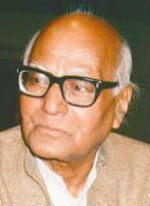










 Even a hundred years ago, Sri Aurobindo had a better understanding of the challenge that modernity posed to India. … Sri Aurobindo envisaged and fought not only for the complete independence of India, but also showed the way for an Indian renaissance. – Prof. Makarand R. Paranjape
As we celebrate India@75, Azadi ka Amrit Mahotsav, we would do well also to remember Sri Aurobindo, whose 150th birth anniversary coincides with this important and auspicious date. In this regard it would be worthwhile to recall his letter from August 30, 1905, originally written in Bangla, to his wife, Mrinalini. Sri Aurobindo tries to prepare her for a difficult life ahead because he, self-confessedly, suffers from “three madnesses”. What are these madnesses?
The first one is: “The accomplishments, genius, higher education and learning and wealth that God has given me are His.” Sri Aurobindo’s life will be one of renunciation, not catering to the pleasures and luxuries of himself and his family. He wants to help all of his countrymen and women: “In these dark days the whole country is seeking refuge at my door. I have three hundred million brothers and sisters in this country. Many of them are dying of starvation and the majority just manage to live, racked by sorrow and suffering. They too must be helped.”
Sri Aurobindo wants his wife to share his ideal: “We will eat and dress like ordinary men, buying only what is truly needed and offering the rest to God.” India is more prosperous than ever in living memory, but so much still needs to be done to alleviate basic poverty, undernourishment, and deprivation.
What can we as ordinary Indians do to alleviate this? If we follow the drift of Sri Aurobindo’s “madness”, we must—especially those of us who are privileged and better off—find ways and means of sharing our wealth and expertise with those who need it the most.
Sri Aurobindo’s second madness is: “By whatever means I must have the direct vision of God.” He wants little to do with conventional religion, like “praying in public, showing off how pious one is”. Instead, he says, “If God exists, there must be some way to experience His existence, to meet Him face to face.” He adds: “The Hindu religion declares that the way lies in one’s own body, in one’s own mind.”
Though he began as a rabid atheist and agnostic as a Cambridge undergraduate, he is now convinced of the truth of the Hindu religion: “Within a month I have realised that what the Hindu religion says is not false. I am experiencing in myself the signs of which it speaks.” Again, he asks his wife to join him in the quest.
Can we, in present-day India, also have a similar passion to experience the Divine first-hand rather than falling prey to the increasingly raucous religiosity that surrounds us?
But it is his third madness which is most pertinent to our understanding of the spirit of the nation: “My third madness is that while others look upon their country as an inert piece of matter—a few meadows and fields, forests and hills and rivers—I look upon my country as the Mother. I adore Her, I worship Her as the Mother.” Furthermore, “What would a son do if a demon sat on his mother’s breast and started sucking her blood? Would he quietly sit down to his dinner, amuse himself with his wife and children, or would he rush out to deliver his mother?”
After this comes the astonishing declaration of the 35-year-old Sri Aurobindo, then in the service of Sayajirao Gaekwad III, the Maharaja of Baroda: “I know I have the strength to deliver this fallen race. It is not physical strength,—I am not going to fight with sword or gun,—but the strength of knowledge. … This feeling is not new in me, it is not of today. I was born with it, it is in my very marrow. God sent me to earth to accomplish this great mission.”
What is more, Sri Aurobindo says he will yet bring thousands and thousands of others onto that same path. He adds: “I do not say that the work will be accomplished during my lifetime, but it certainly will be done.”
Now that India has attained not just political independence, but a considerable measure of economic self-reliance and military strength, what can we learn from Sri Aurobindo about how to make India great once again?
Our Prime Minister, Narendra Modi, said in his Independence Day address on August 15 earlier this year that 25 years from now, when India reaches the centenary celebrations of its independence, it will be an “amrit kaal”—an ambrosial epoch for our nation.
But the question remains—how? More specifically, what can we, the ordinary citizens and common folk of India, do?
How can we contribute to the great task of bringing to fruition India’s unfinished renaissance?
It seems to me that the first order of day is to participate in a collective yajna—a consecration—which is what we can call national yoga. National yoga, it is obvious, is very different from national ego. The latter is only a glorified version of an individual and tribal ego, leading to narrow-minded chauvinism, not a broadening of our horizons.
Even a hundred years ago, Sri Aurobindo had a better understanding of the challenge that modernity posed to India. For India was at once an ancient civilisation and a modern nation in the making. Sri Aurobindo envisaged and fought not only for purna swaraj or the complete independence of India, but also showed the way for an Indian renaissance.
Such a renaissance would not imply mere glorification of the Hindu past or attempts to go back to it or reconnect with it after the devastating attack and destruction during the interregnum of Islamic rule. Rather, a true renaissance implied a new creation—a fresh impetus with innovative ideas—through the proper understanding of both the Indian past and of Western modernity.
What can we learn from Sri Aurobindo’s thought that will take us forward as ordinary citizens and co-creators of our own Swaraj? The next part of this essay will address this question. – The New Indian Express, 12 Septemeber 2022

Filed under: india | Tagged: hindu nationalism, indian renaissance, modernity, nationalism, sri aurobindo | Comments Off on Sri Aurobindo’s ‘three madnesses’ – Makarand R. Paranjape