














 “Then there was 19-year old Sithi Farouq, a Sri Lankan housemaid accused of killing her employer’s four-year-old daughter in 1994. She claimed her employer’s aunt had accidentally killed the girl. On 13 April, 1995, she was led from her prison cell in the United Arab Emirates to stand in a courtyard in a white abaya gown, crying uncontrollably, before a nine-man firing squad which shot her down. It was her 20th birthday. God’s mercy, enshrined in the first words of the Koran, could not be extended to her, it seems, in her hour of need.” – Robert Fisk
 How many tracts, books, documentaries, speeches and doctoral theses have been written and produced about Islamophobia? How many denunciations have been made against the Sarkozys and the Le Pens and the Wilders for their anti-immigration (for which, read largely anti-Muslim) policies or – let us go down far darker paths – against the plague of Breivik-style racism?
The problem with all this is that Muslim societies – or shall we whittle this down to Middle Eastern societies? – are allowed to appear squeaky-clean in the face of such trash, and innocent of any racism themselves.
A health warning, therefore, to all Arab readers of this column: you may not like this week’s rant from yours truly. Because I fear very much that the video of Alem Dechasa’s recent torment in Beirut is all too typical of the treatment meted out to foreign domestic workers across the Arab world (there are 200,000 in Lebanon alone).
 Many hundreds of thousands have now seen the footage of 33-year-old Ms Dechasa being abused and humiliated and pushed into a taxi by Ali Mahfouz, the Lebanese agent who brought her to Lebanon as a domestic worker. Ms Dechasa was transported to hospital where she was placed in the psychiatric wing and where, on 14 March, she hanged herself. She was a mother of two and could not stand the thought of being deported back to her native Ethiopia. That may not have been the only reason for her mental agony.
Lebanese women protested in the centre of Beirut, the UN protested, everyone protested. Ali Mahfouz has been formally accused of contributing to her death. But that’s it.
The Syrian revolt, the Bahraini revolution, the Arab Awakening, have simply washed Alem Dechasa’s tragedy out of the news. How many readers know – for example – that not long before Ms Dechasa’s death, a Bengali domestic worker was raped by a policeman guarding her at a courthouse in the south Lebanese town of Nabatieh, after she had been caught fleeing an allegedly abusive employer?
As the Lebanese journalist Anne-Marie El-Hage has eloquently written, Ms Dechasa belonged to “those who submit in silence to the injustice of a Lebanese system that ignores their human rights, a system which literally closes its eyes to conditions of hiring and work often close to slavery”. All too true.
 How well I recall the Sri Lankan girl who turned up in Commodore Street at the height of the Israeli siege and shelling of West Beirut in 1982, pleading for help and protection. Like tens of thousands of other domestic workers from the sub-continent, her passport had been taken from her the moment she began her work as a domestic “slave” in the city; and her employers had then fled abroad to safety – taking the girl’s passport with them so she could not leave herself. She was rescued by a hotel proprietor when he discovered that local taxi drivers were offering her a “bed” in their vehicles in return for sex.
Everyone who lives in Lebanon or Jordan or Egypt or Syria, for that matter, or – especially – the Gulf, is well aware of this outrage, albeit cloaked in a pious silence by the politicians and prelates and businessmen of these societies.
In Cairo, I once remarked to the Egyptian hosts at a dinner on the awful scars on the face of the young woman serving food to us. I was ostracised for the rest of the meal and – thankfully – never invited again.
Arab societies are dependent on servants. Twenty-five per cent of Lebanese families have a live-in migrant worker, according to Professor Ray Jureidini of the Lebanese American University in Beirut. They are essential not only for the social lives of their employers (housework and caring for children) but for the broader Lebanese economy.
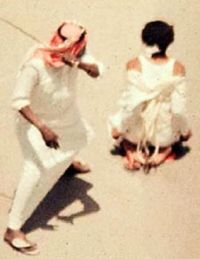 Yet in the Arab Gulf, the treatment of migrant labour – male as well as female – has long been a scandal. Men from the subcontinent often live eight to a room in slums – even in the billionaires’ paradise of Kuwait – and are consistently harassed, treated as third-class citizens, and arrested on the meanest of charges.
Saudi Arabia long ago fell into the habit of chopping off the heads of migrant workers who were accused of assault or murder or drug-running, after trials that bore no relation to international justice. In 1993, for example, a Christian Filipino woman accused of killing her employer and his family was dragged into a public square in Dammam and forced to kneel on the ground where her executioner pulled her scarf from her head before decapitating her with a sword.
Then there was 19-year old Sithi Farouq, a Sri Lankan housemaid accused of killing her employer’s four-year-old daughter in 1994. She claimed her employer’s aunt had accidentally killed the girl. On 13 April, 1995, she was led from her prison cell in the United Arab Emirates to stand in a courtyard in a white abaya gown, crying uncontrollably, before a nine-man firing squad which shot her down. It was her 20th birthday. God’s mercy, enshrined in the first words of the Koran, could not be extended to her, it seems, in her hour of need. – The Independent, London, 7 May 2012

Filed under: india, west asia | middle east | Tagged: anti-semitism, arabia, communalism, culture, globalisation, human rights, india, islam, islamic racism, libya, middle-east, migrant workers, multicultural, muslim racism, racism, religion, slave labour, united arab emirates, west asia, west asia | middle east | 6 Comments »











