







 “Attaining a least worst solution, in other words, requires that both sides be prepared to live with less than they ideally want; if one side feels it’s getting both the least and the worst, there’s no point in even playing. Any monkey could tell us that.” – Prof. K.C. Cole
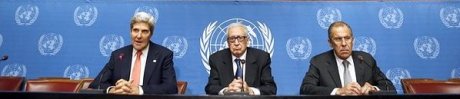
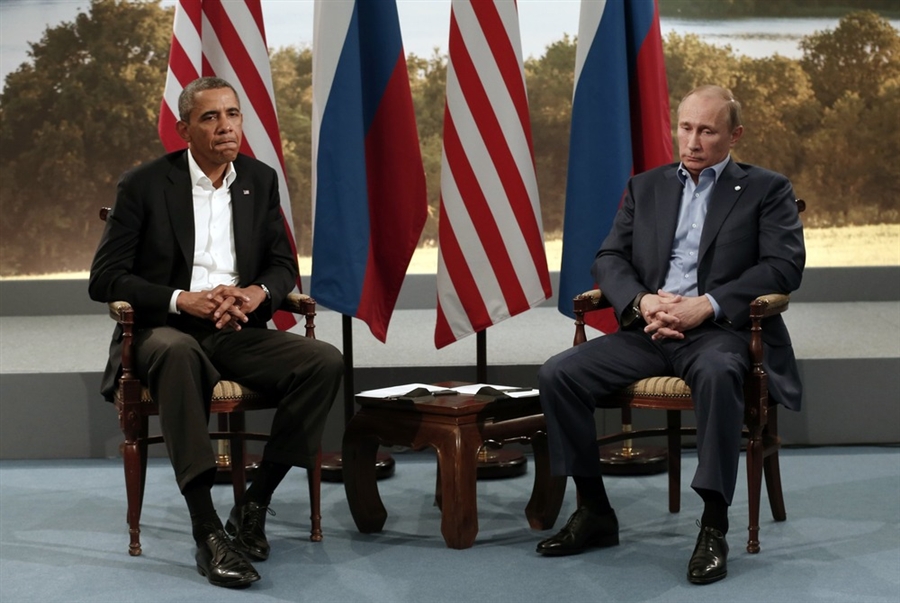 A mathematical solution in Syria? That’s not as crazy as it sounds. In fact, the working compromise is a classic case of the power of game theory, a branch of mathematics that analyzes the best possible outcomes in conflicts where neither side knows what the other will do. It’s not about winning as much as it is finding the least worst option, which is precisely what Presidents Obama, Vladimir Putin, Bashar Assad and company have done.
No one gets exactly what he wants. But no one loses everything either.
In its simplest form, the Syrian standoff was a classic game of “chicken,” the game played by James Dean in “Rebel Without a Cause” when he was challenged by a bully named Buzz to race stolen cars to the edge of a cliff. Whoever bails first becomes the “chickie” and loses face. Dean’s character, Jim, jumps at the last minute, but Buzz’s jacket gets snagged on the door and he plunges to his death. Game over.
The least worst solution would have been for both players to swallow their pride and jump early. The winner gets to gloat. But even the loser gets to play another day.
Over the long term, a willingness to take less than everything is a winning strategy.
One reason is that winner-take-all (a zero-sum game) results in unstable situations, dangerous even for the winner. The losing side has little reason to cooperate and every reason to retaliate in kind, or worse. (In “Rebel,” Buzz’s gang blames Jim for their buddy’s death and hound him until a predictably tragic ending is the only one possible.)
Lasting solutions require coming to an equilibrium in which all players feel they did well enough, given the circumstances. And game theory is all about finding equilibriums.
Such calculations apply to much more than Syria. We do the same sort of mental math when we stop at red lights instead of barreling through at our pleasure (road rage is the primitive brain’s business). Whether we’re paying taxes or tipping waiters, we 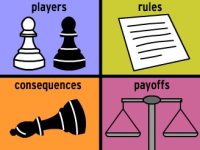 often do things that are not, from a selfish point of view, ideal — but that we know are necessary to keep society going. In other words, the least worst option.
When we insist on winner-take-all, nobody wins in the end. If the big fish gobble up all the little fish, even the big guys starve. It’s the argument I most often hear from the business community for economic policies that promote an equitable distribution of wealth. It doesn’t take a lot of calculation to see that when most people don’t have enough money to buy products, profits eventually dry up.
Stability requires not just a measure of fairness but also the perception of fairness. Even a monkey will turn down a treat if it sees its neighbour get something far more delicious. (In fact, the monkey feeling cheated will throw the second-rate treat back in the experimenter’s face.) When people feel their society doesn’t distribute treats equally — be they tax breaks, voting rights or political power — the resulting instability threatens everyone.
Attaining a least worst solution, in other words, requires that both sides be prepared to live with less than they ideally want; if one side feels it’s getting both the least and the worst, there’s no point in even playing. Any monkey could tell us that.
The situation in Syria, of course, is horrendously complicated, with multiple players with unknown aims and abilities, and multiple options and possible outcomes.
Whether or not turning over Syria’s chemical weapons to the United Nations works, the present pause in the stalemate gives everyone time to think things through. Losing some face is worth it if you can return to play another day — perhaps at a game that plays more to your strengths. – Los Angeles Times, 23 September 2015
» Prof. K.C. Cole, a journalism professor at USC and a former science writer for The Times, is the author of Something Incredibly Wonderful Happens: Frank Oppenheimer and His Astonishing Exploratorium.
Filed under: russia, syria, USA | Tagged: game theory, middle-east, national disaster, politics, psychological warfare, russia, syria, syrian civil war, syrian standoff, US politics, USA, vladimir putin, war | Leave a comment »




 BHARATA BHARATI