















 I suspect the always au courant Scandinavians will now award the Nobel Prize in Literature to Rushdie as a knee-jerk reaction to the stabbing, as they awarded the Peace Prize to Barack Obama because he was, well … black. – Prof. Rajeev Srinivasan
It is a bit of a coincidence that, just around the 75th anniversary of India gaining Independence from the British, Salman Rushdie should be in the news again, because he was stabbed in Chautauqua, a literary watering-hole in upstate New York. His book Midnight’s Children was, as is well known, a sensation when it first came out some forty years ago, in 1981.
The central concept in the book is that 100,000 children born all over India on or around midnight on 15 August 1947, are endowed with magical powers. Their lives are an allegory for India’s progress. It is a picaresque romp centred around the protagonist, Saleem Sinai, who can telepathically connect with and organise them.
When I first read the book, I was impressed by the verbal pyrotechnics, and more so the clever interweaving of contemporary events into the magical realism of the ‘children’s’ lives. The great human tragedies and triumphs of Bharat, that is India, are a rich mother-lode to mine for fiction, and another example is the re-telling of the Mahabharata by Shashi Tharoor in The Great Indian Novel.
But over time, the book’s impact faded for me. Even though I didn’t pay attention to it on first reading it, now I see it as significant that Saleem Sinai’s principal rivals among the children are ‘Shiva’ and ‘Parvati-the-witch’. Interesting choice of names, wouldn’t you say? A bit like Deepa Mehta’s choice of Radha and Sita for Fire, which I criticised as dog-whistle Hindu-hatred at the time in The problem with Fire.
Nevertheless, Rushdie’s and the book’s charm obviously did not fade for the Anglosphere, because it fit into their world-view of India, as an exotic, barbaric country where bizarre things happen. They awarded it a Booker Prize, and later a Booker of Bookers, basically dubbing it the best book to have been written in English in decades.
Rushdie rode his new-found stardom to riches and influence, and became a sort of seer on all things related not only to India, but also literature in general. And he physically moved to the Anglosphere, all the better to suit his new status as an oracle. In this he trod a well-trodden path which, for example, Amartya Sen and V.S. Naipaul also followed. More on that by and by.
If I am not mistaken, Rushdie’s output after Midnight’s Children is hit-and-miss. His only other work that gained fame (notoriety?) was The Satanic Verses, but that was for other reasons, not literary merit. Since I haven’t read that book, I have no particular opinion on it, and the politics is anyway complicated because of Shia-Sunni issues and internal Muslim issues of blasphemy.
But I am now beginning to wonder if Rushdie is also a one-horse wonder, like Arundhati Roy. I have not read her The God of Small Things, but her trajectory has been similar to Rushdie’s: one hit, instant elevation to global stardom and a bully pulpit from which to spout all sorts of radical ideas. A pliant Anglo media piled on and lionised both, regardless of actual merit.
Furthermore, I am struck by the parallels with Amartya Sen, who also parlayed fame from early works into global demi-god status, marriage into the Rothschild empire, and a Nobel Prize (although technically it is only the Swedish bank’s prize for economics). His theories about the ‘Kerala model’ of development turn out to be pure bunkum, but then who’s counting?
Which reminds me, I suspect the always au courant Scandinavians will now award the Nobel Prize in Literature to Rushdie as a knee-jerk reaction to the stabbing, as they awarded the Peace Prize to Barack Obama basically because he was, well…. black. Well, bully for Rushdie!
That, of course, is pure speculation. But the comparison with Naipaul is interesting. Both made Britain their home, and both commented on India in less-than-flattering terms. Naipaul’s An Area of Darkness was fierce, disappointing, and condemnatory. But the difference is that Naipaul, over time, became convinced that India was on the rise. Rushdie, so far as I can tell, does not see any future for India, nor anything worth celebrating.
Maybe that’s why I like Naipaul, because he agrees with my prejudices; but objectively speaking his writing has greater insight. Here’s an excerpt from his India Today article on the occasion of the 50th Independence Day.
“I think that within every kind of disorder now in India there is a larger positive movement. But the future will be fairly chaotic. Politics will have to be at the level of the people now. People like Nehru were colonial-style politicians. They were to a large extent created and protected by the colonial order. They did not begin with the people. Politicians now have to begin with the people. They cannot be too far above the level of the people. They are very much part of the people. The Nehrus of the world have to give way now to the men of the people…
It is important, in this apparent mess, for two things not to be interfered with. One is economic growth. I would like to see that encouraged in every way. It is the most important news coming out of India, more important than the politics. I would like to see education extended and extended. If this were to happen, and I feel it might, gradually, the actual level of politics will reflect both the economic life and higher level of education.”
Rushdie doesn’t have that sympathy, nor the realization that there is something behind the chaos. Fair enough, he is entitled to his opinion. But the point at which I personally became annoyed with Rushdie was when he proclaimed—like Macaulay before him—that there is nothing worthwhile in modern Indian-language literature.
I knew this to be false because there is proof of existence: I had read O.V. Vijayan, Thakazhi, S.K. Pottekkat, Basheer, Anand, and M. Mukundan in Malayalam; Ashapurna Devi and Tarasankar Banerjee in translation from Bengali; S.L. Bhyrappa in Kannada and a host of other world-class writers. For Rushdie to blithely denigrate them all showed both arrogance and ignorance, typical of India’s ‘liberals’.
In fact, it is India’s English-language output that is inferior and derivative. With the exception of a few tour-de-force works such as Vikram Seth’s Golden Gate and Amitav Ghosh’s The Shadow Lines, there’s nothing unique or noteworthy that will stand the test of time. Even Rushdie’s magical realism, I found out, pales before Vijayan’s 1950’s The Epic of Khasak with its shape-shifting odiyans and the disembodied flying oracular head of the ancient magician Kandath Nair; not to mention Gabriel Garcia Marquez’ 1970s English publication of One Hundred Years of Solitude.
It also turns out that Naipaul was right: 25 years later India is finally on an upward trajectory (that graphic from the FT is interesting, although it misrepresents India’s external boundaries). The colonialists are dead and buried, and ordinary men are now taking India forward. With economic growth, everything comes your way; and yes, the education system still sucks, as it’s infested with English and anti-national woke leftism—alas, also derivative and unoriginal.
A Rushdie, steeped in the groupthink of Lutyens and Khan Market, has simply failed to see this, which may mean he lacks the empathy, understanding, and feelings the greatest writers possess.
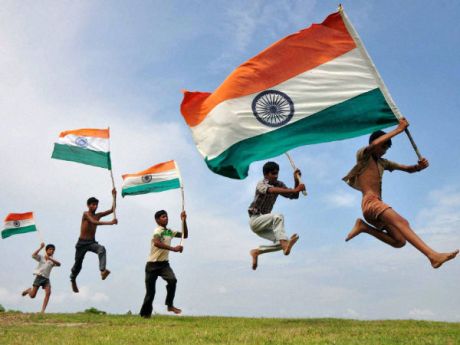
The children and grandchildren of ‘midnight’s children’, however, see this. And what of the real midnight’s children? Hat tip to @NAN_DINI: they are honouring the flag. They believe.
Now personally, I am a little ambivalent about the ‘fly the flag in every house’ request by Prime Minister Narendra Modi. Of course, in my neighborhood in leftist paradise Thiruvananthapuram, hardly anybody took up his clarion call. Besides, I feel a little queasy about the American kitsch of flag-waving jingoism. In addition, flying the national flag from temples bothers me. I believe in the separation of ‘church’ and state; and I honestly think the interference of politicians in temples is an abomination.
But I guess this Magnificent Generation that suffered through fifty years of kakistocratic dynasty misgovernance (see my earlier piece The Nehruvian Penalty: 50 wasted years) deserves to be applauded because they still believe. I do, too, but maybe I am an old cynic.
I am not as old as them, but I remember suffering through those awful years of PL-480 and war and shortages of everything. I left, but then I returned because I, too, do believe.
Giving credit where it’s due, I applaud Rushdie for coming up with the vanity of ‘midnight’s children’ and giving it a lot of airplay. But I’m afraid they, and their children and grandchildren, have left Rushdie behind. They have moved on. He hasn’t, like the rest of the Anglo-Mughlai elite. Rushdie, midnight’s child himself, stayed stuck in the past while the others moved ahead. And that can become an avalanche, an irresistible force, if all goes well. – Firstpost, 22 August 2022
› Prof. Rajeev Srinivasan has been a conservative columnist for over 25 years. His academic interest is innovation.
Filed under: india, iran, sweden, UK, USA | Tagged: assassination attempt, indian english-language literature, literary controversy, midnight's children, salman rushdie | Comments Off on Have Midnight’s Children come of age? – Rajeev Srinivasan











