















 What’s more unsettling, however, is the absolute cluelessness of the non-Islamic world, including India, to deal with the Islamist riddle. – Utpal Kumar
When Hadi Matar repeatedly stabbed Salman Rushdie in New York on 12 August 2022—and whenever a Muslim settled in the West takes up a jihadi cause—one is invariably reminded of Feri, the protagonist of Foreigner, an Iranian novel written in 1978, when the Shah still ruled Tehran. V.S. Naipaul, in his book Among the Believers: An Islamic Journey, writes in detail about this book, which was believed to be the first novel in English by an Iranian author, Nahid Rachlin.
Feri is a 32-year-old Iranian woman living in Boston. She has studied in the United States, is married to an American university teacher, and works as a biologist in a research institute. She goes back to Tehran for a two-week holiday. Initially, she doesn’t like her stay in Iran; she falls ill and is taken to a local hospital. She is nervous about treatment in an Iranian hospital, but the doctor in charge reassures her. He claims he was trained in the US but left to work in Iran. At the hospital, she begins to reflect on her life in the US and question the relevance of her stay there. In America, she suddenly finds herself to be “a stranger, solitary in spite of husband and friends, always at a loss sexually and socially”. The doctor tells Feri that the pain in her stomach is due to an old ulcer, brought with her from the foreign land: “What you have is a Western disease.”
When Feri’s American husband arrives to take her back, she finds him to be a stranger. It is impossible for her to go back with someone so remote to the “American emptiness”. She doesn’t mind—or even care—losing her job. Feri resolves to stay back in Iran and do what the doctor does: Visit mosques and adopt puritan Islam. She feels she has never been so happy.
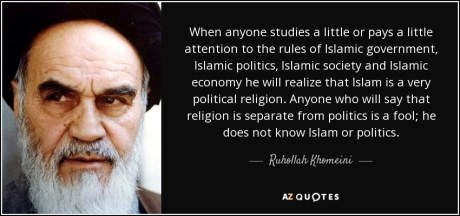
It’s an interesting phenomenon. When a person is poor, wretched, all he wants is food, house, and some basic dignity. He migrates to the better part of the world, gains livelihood. But by the time the next generation comes up, a sense of ‘rootlessness’ gains ground; then begins a renewed search for one’s identity, tracing the very roots his father or grandfather ignominiously left behind in Syria, Iran, Afghanistan or even in Pakistan. Ayatollah Khomeini and his ilk become his idols. And he aspires to be part of the ummah!
Foreigner was written in 1978, a year before the cataclysmic Islamic revolution in Iran and almost a decade before the defeat of the erstwhile Soviet Union at the hands of the US-backed Mujahideen in Afghanistan. From today’s perspective, Nahid Rachlin’s novel would therefore look incomplete. For Islam before 1979 and Islam after these two momentous events are two different phenomena. By the late 1980s, the Islamists were unstoppable. The world was at their feet; at least they thought so, after giving the Americans a bloody nose in Iran and then defeating the Russians in Afghanistan. Aided and abetted by petrodollar, this saw the rise of an assertive and aggressive Islam; it no longer was just about going back to the roots. For, the initial bliss that Feri encountered in Iran after visiting mosques would have been followed by frustration and anger at the American world order. Feri and the doctor would have gone back to America—this time as Trojan Horses—with the objective of destroying it from within and without. Mosques, after all, are politically one the most active and volatile spaces in the Islamic world.
This may explain why 24-year-old Hadi Matar went to Lebanon in 2018—in search of his identity—and then came back to the US with renewed anger and vengeance. If his mother, Silvana Fardos, is to be believed, her “outgoing son” turned into a moody and introvert person following a visit to see his Lebanese father. “I was expecting him to come back motivated, to complete school, to get his degree and a job. But instead he locked himself in the basement. He had changed a lot; he didn’t say anything to me or his sisters for months” she was quoted as saying by Daily Mail. “One time he argued with me, asking why I encouraged him to get an education instead of focusing on religion. He was angry that I did not introduce him to Islam from a young age,” she said.
Hadi Matar was angry with Salman Rushdie for “insulting” Islam. “I saw a lot of lectures. I don’t like people who are disingenuous like that”, he was quoted as saying. The fakeness of his rage, however, can be gauged from the fact that the act for which he tried to kill Rushdie had taken place much before he was born. But then, in Islam, nothing is forgotten or forgiven—at least that’s what Islamists believe. Thus, Rushdie had to be punished, and he was on that fateful August day.
In his book, Schmoozing with Terrorists, Aaron Klein interviewed terrorist leaders and suicide bombers to understand why they take such extreme steps. While our so-called liberal interpreters would come up with several root cause explanations—ranging from Israeli occupation of Palestine and the US’s eternal thirst of Arab oil to the Kashmir issue and Gujarat 2002—to interpret the Islamist anger, Klein was told in no uncertain terms that these were never the primary reasons. As one of the recruited bombers told Klein, “The will to sacrifice myself for Allah is the first and most major reason. It is true that the Zionists are occupying our lands and that it is our religious duty to fight them, including through suicide attacks. The goal is not the killing of the Jews, but that this is the way to reach Allah. … Martyrs have special status in the next world and have bigger chances to watch Allah’s face and enjoy the magnificent pleasures he offers us.”
This may explain Hadi Matar’s temptation to kill Rushdie. But then that’s the distressing part of the story: To invent the root cause for the Islamist ire even when there is none! What’s even more unsettling, however, is the absolute cluelessness of the non-Islamic world, including India, to deal with the Islamist riddle. Brigitte Gabriel writes in her book, They Must Be Stopped: Why We Must Defeat Radical Islam and How We Can Do It, “The West is still seeking the answer to radical Islam’s three riddles: What can we do so that they will not hate us? So that they will stop attacking us? So that they will not want to destroy us? If we grant concessions, will radical Islam forgo the opportunity to kill us?”
She continues, “Radical Islam understands its adversary well. It knows that the West hungers for harmony, for resolution, for approval. It also understands our humanistic impulses—our tendency to employ reason and logic in the quest for solutions to thorny issues—and that we unwisely attribute those same impulses to our enemy. It also understands that we prefer to appease an intractable foe rather than to confront it—a weakness that radical Islam exploits without mercy.”
What Gabriel writes for the West stands true for India as well. The dominant Indian intelligentsia, which swears by liberalism, consistently advocates greater concession for radical Islam, citing historical grievances and injustices, little realising that similar concessions in the past only aroused their appetite for more.
The problem gets compounded by the ‘liberal’ propensity not to debate Islam and Islamism, for the fear of offending the faithful. Those few who dare to initiate a discussion are invariably abused and called names—from being termed racist and ethno-centrist to outright Islamophobic—primarily by mainstream liberals.
This explain why Barbie, “once a beacon of femininity and feminism in the West”, happily dons a hijab today, without much protest in the liberal circle, and Marks & Spencer sells hijabs for girls without facing any feminist ire. “In Saudi Arabia, women are burning their niqabs. In Iran, women tie their hijabs on sticks and sway them silently, defiantly in the streets as they are arrested in droves,” Yasmine Mohammed writes in her book Unveiled: How Western Liberals Empower Radical Islam, “In the West, we put a Nike swoosh on hijabs.”
The Western liberals may have reasons to be apologetic, thanks to their oppressive and exploitative colonial past. But what about Indian liberals? They don’t even have that excuse. They belong to a country that has no colonial/imperial past and is historically a shining example of liberal, secular values, where people of all faiths flourished, and where every persecuted community found a refuge. They should have stood for Muslim women during the recent Karnataka hijab controversy. They should have openly debated and discussed the killing of a Hindu tailor in Rajasthan just for defending the view of a suspended BJP spokesperson. When they invoke Gujarat 2002, which they have every right to do, they should also talk about Kashmir 1990 and Delhi 1984 with same intensity and fervour.
India’s so-called liberals can take a cue from Dr. Khaleel Mohammed, a professor at San Diego State University who is also an imam who studied at Muhammad bin Saud University in Riyadh (Sunni) and the Zeinabiyya in Damascus (Shia). In his foreword to Irshad Manji’s much controversial book, The Trouble With Islam Today, he writes matter of factly that he should hate Manji because “if Muslims listen to her, they will stop listening to people like me, an imam who spent years at a traditional Islamic university. She threatens my male authority and says things about Islam that I wish were not true. … She is a lesbian, and my madrassa training has instilled, almost into my DNA, that Allah hates gays and lesbians.” Yet, the imam supports Manji, howsoever discomforting her views might be. “Irshad is telling the truth. And my God commands me to uphold the truth,” he says.
One hopes the liberals in India stand up and uphold the truth, too. It, however, seems to be big ask, given their dubious track record and mischievous doublespeak: For, they would largely support a ban on The Satanic Verses while opposing the pulping of Wendy Doniger’s overwhelmingly erotic interpretation of the sacred Hindu texts; they would stand in support of an illustrious Muslim painter as he drew nude paintings of Hindu goddesses, but maintained a stony silence when a Hindu made certain inconvenient comments regarding Islam citing their own sacred texts; they supported the Hindu Code Bill while resisting any attempt to reform Islamic practices. For all their liberal pretensions, they would support Article 370 in Kashmir and, worse, question the need for the Universal Civil Code in the country.
It’s time for those who swear by liberalism in India to learn from the American imam. If he can support the “much reviled” Irshad Manji, it should not be too difficult for Indian liberals to stand up and be counted. But then the question is: Do they have the will and the appetite to do so? Given the current scenario in the country, this seems to be a difficult proposition. – Firstpost, 1 September 2022
› Utpal Kumar is the opinion editor at Firstpost and News18.
Filed under: india, USA | Tagged: indian liberals, islamism, leftist loonies, liberalism, salman rushdie | Comments Off on Islamists find a steadfast ally in liberals – Utpal Kumar











