






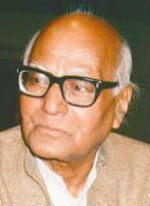
 “We must insist that within a given time-frame Sri Lanka, though a unitary country, introduces strong elements of federalism and devolves power to the provinces in terms of the Thirteenth Amendment of the Constitution. We should strongly counter Chinese influence and make it clear that if Sri Lanka fails to rehabilitate the Tamils, implement a scheme of devolution and ensure that all sections of society become part of the Sri Lanka mainstream India may be forced to intervene. We have proven capacity in this behalf. At the same time let us evolve our own foreign policy towards Sri Lanka without being dictated to by domestic compulsions of what the DMK wants.’ – M.N. Buch
 The United States brought a resolution before the United Nations Human Rights Commission [now the United Nations Human Rights Council]. India voted for the resolution in which Sri Lanka was called upon to make a credible and independent probe into the killings and human rights violations in that country in the context of the war against terrorism. Under pressure from DMK India was in favour of a stronger resolution, but ultimately we accepted the United States’ draft. As a direct reaction to this, the Sri Lankan government has decided to seize part of the Indian public sector-run oil depot in Trincomalee. This despite the fact that the Indian Oil Corporation has recently spent $17 million on refurbishing the depot. All this seems to be a part of the pro-China shift in Sri Lankan foreign policy under the stewardship of President Mahinda Rajapakse. China voted against the resolution as did Pakistan. Part of the shift is because of India’s tardy response to the Sri Lankan call for assistance. For example, the Sri Lankans wanted our help in developing the port of Hambantota in south Sri Lanka. It is only when India failed to respond favourably and quickly that Sri Lanka turned to China, whose rapid response was in sharp contrast to our tardiness.
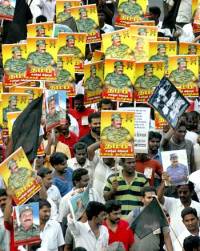 Sri Lanka faced two major threats to its existence. The first was through the extreme left-wing JVP, a Sinhala outfit which waged war with the Sri Lankan government. At the invitation of that government we sent in units of CRPF which helped in restoring order in Colombo, but a much greater threat came from the Liberation Tigers of Tamil Eelam (LTTE), created by and composed of the Jaffna Tamils who had migrated to Sri Lanka centuries ago. Even the Sri Lankans recognised them as citizens of the country. The problem did not end there because when rubber and tea were introduced by the British to Sri Lanka as plantation crops, large numbers of Tamils were brought in as indentured labour. They were not treated as citizens by the Sri Lankans and it needed firm intervention by India to sort out their citizenship status. Even the Jaffna Tamils treat them as a different people. In 1956 the Sri Lankan government removed Tamil as one of the State languages of Sri Lanka and replaced it wholly by Sinhalese.
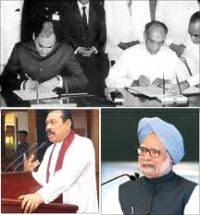 This was reversed in 1978 and Tamil was reintroduced as state language. The middle and higher ranks of the civil services and the armed forces were manned by a large number of Tamils and this parochial move of the Sri Lanka government severely jeopardised their position in government service. Resistance against this move started to polarise. In 1978 LTTE was born. When Indira Gandhi was the prime minister large numbers of LTTE cadres were trained in India and much of the armament of LTTE came from weapons surrendered by Pakistan to us in 1971 and subsequently passed on by us to LTTE. In 1983 there was a general massacre of Tamils by the Sinhalese, especially in and around Colombo. This hardened attitudes and LTTE not only came out with an open declaration of independence but it virtually declared war on Sri Lanka. Sinhala Tamils living outside the country started sending funds and purchasing weapons for LTTE and soon that organisation became the deadliest guerilla outfit in the world.The Sri Lankan Army also responded with great violence. Ultimately India stepped in with humanitarian aid for
 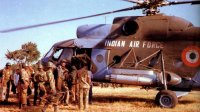 the Tamils, a pact was signed between Rajiv Gandhi and J.R. Jayawardene, the Indian Army sent a peace keeping force. LTTE attacked it and soon we were involved in a full-fledged war with LTTE.
The Indian Army established complete control over North and North East Sri Lanka and a semblance of civil administration was re-established. At this stage Premadasa became President of Sri Lanka. He was upto playing his own games and entered into a secret pact with LTTE. The Indian Army was forced to withdraw, leaving its work not fully done. LTTE reneged on its agreement and in sixteen police stations of the North more than 450 policemen were murdered. The uneasy peace ended. Ultimately Mahenda Rajapakse became President, a re-energised Sri Lankan Army declared all out war and the LTTE was crushed. It was a murderous organisation and perhaps there were cases where the Sri Lankan Army caused civilian casualties and there were a few cases of atrocities. That happens in a war and India was ill-advised to immediately adopt an anti-Sri Lanka government stance.
 This has annoyed Sri Lanka, brought no relief to the Tamils, moved Sri Lanka towards China and the loser in all this is India. What we forget is that LTTE caused about 1,500 deaths of our soldiers and another 5,000 or so were wounded. Masters of ambush, of improvised explosive devices, expert in defensive warfare, so highly motivated that the LTTE cadres preferred suicide by the cyanide pill rather than surrender, there is no way in which LTTE could be handled with kid gloves. An enemy who fights to the last bullet and then commits suicide cannot be defeated; he has to be annihilated. A guerilla fighter mingles with civilians and killing him may hurt civilians. To judge the Sri Lankan Army harshly on this account is unfair.
How should we deal with Sri Lanka? Geographically, ethnically, religiously and strategically it is part of India, though a separate nation. It has to remain in the Indian fold. We should generously open our markets to Sri Lankan tea, gems and other products. We should make heavy investment in infrastructure, including rebuilding the ravaged North and North East and Indian businessmen must help Sri Lankan 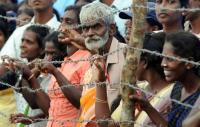 industry to grow. We should gift one IIM and an IIT level institution and we should provide about 500 offshore fishing vessels to Sri Lanka to build a prosperous fishing industry.
At the same time we must insist that within a given time-frame Sri Lanka, though a unitary country, introduces strong elements of federalism and devolves power to the provinces in terms of the Thirteenth Amendment of the Constitution. We should strongly counter Chinese influence and make it clear that if Sri Lanka fails to rehabilitate the Tamils, implement a scheme of devolution and ensure that all sections of society become part of the Sri Lanka mainstream India may be forced to intervene. We have proven capacity in this behalf. At the same time let us evolve our own foreign policy towards Sri Lanka without being dictated to by domestic compulsions of what the DMK wants. – The New Indian Express, 1 April 2013
» M N Buch, a former civil servant, is Chairman of the National Centre for Human Settlements and Environment, Bhopal. E-mail: buchnchse@yahoo.com
Filed under: india, sri lanka | Tagged: AIADMK, chinese, church support for LTTE, civil rights, democracy, DMK, ethnic cleansing, geopolitics, government of tamil nadu, history, human rights, india, indian army, indian catholics, indian politics, jaffna, LTTE, nationalism, politics, psychological warfare, refugees, religion, roman catholic church, sri lanka, sri lanka army, sri lankan tamils, tamil nadu, tamils, terrorism, UN, US politics | 1 Comment »



 BHARATA BHARATI