






 Both the pro- and anti-Ram temple parties have failed to grasp the issue at stake. The fight has never been for a piece of land or against a mosque. … The Babri structure was brought down because a Ram temple could not be built at that very spot without doing so. What the agitated karsevaks demolished was not a mosque, but a symbol of humiliation forced by a ruthless foreign victor over the vanquished. – Babir Punj
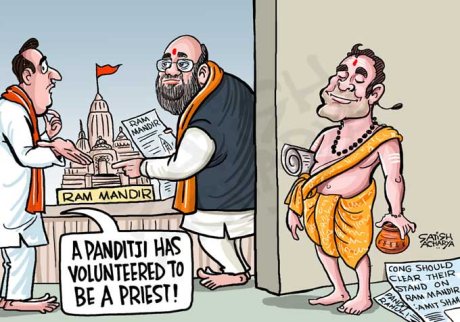
While Congress President-designate Rahul Gandhi was making a desperate bid to pose as a practicing janeu-dhari Brahmin in the wake of elections to the Gujarat Assembly, another top leader of his party and noted lawyer Kapil Sibal was arguing against an early hearing of the Ram Janmabhoomi-Babri Masjid case in the Supreme Court, a move clearly aimed at cultivating the Muslim vote bank. Running with the hare and hunting with the hounds?
Appearing for the Uttar Pradesh Sunni Central Wakf Board, Sibal asked the Supreme Court to postpone the hearing of the case to July 2019. An absurd request considering the fact that appeals against the Allahabad High Court verdict in the case have been pending for the last seven years!
In fact, litigation on the vexed Ayodhya issue is over a century old. On January 29 next, it will compete 133 years! Still, Sibal questioned the court about the “hurry” to hear the matter now and pleaded for the hearing to be postponed to July 2019. This is ‘secularism’ in action. Keep such emotive issues alive to infinity and the communal cauldron boiling.
A flashback: On 29 January 1885, Raghubar Das, Mahant of the Janmasthan, filed a civil suit seeking permission to construct a temple over the Ram Chabutra spot. The Mahant’s plea was opposed by Mohammed Asghar, mutawalli (guardian) of the Babri Mosque.
The Faizabad sub judge dismissed the suit on 24 December 1885. On 23 December 1949, idols of Hindu Gods were installed in the “disputed structure” and puja was started. Meanwhile, the Faizabad civil judge, on 1 January 1950, passed an ad-interim injunction restraining the removal of the idols. The puja continued. The public was allowed darshan from beyond the brick-grill wall.
In 1985 came the Shah Bano judgment and the then Prime Minister Rajiv Gandhi gave in to the Muslim fundamentalist pressure, overruling a secular court’s decision that the divorced Bano was entitled to alimony from her ex-husband. Rajiv enacted a law abolishing the alimony provision in conformity with the sharia.
Within months, Rajiv tried to restore the balance. In 1986, the Faizabad district judge, on an appeal by advocate Umesh Pandey, allowed the public to have the darshan from inside and ordered the respondents to remove the locks on the brick-grill wall. Rajiv Gandhi’s hand was clearly seen behind the court order.
However, mere unlocking was not good enough for the Hindus, who have been aspiring and struggling for centuries to build a grand temple at the Janmabhoomi site, befitting the stature of Lord Rama in Hindu tradition. So the agitation for the temple continued.
On the fateful day of 6 December 1992, a frenzied mob tore down the Babri edifice and hurriedly put a temporary-tented structure on the demolition site under which an idol of Ramlalla sits till this day.
There are irrefutable historical records that the Hindus had repeatedly attempted to recover the Janmabhoomi—in 1735, 1751, 1756 and so on. In 1767, Austrian Jesuit traveller Joseph Tiefenthaler noted that in spite of the Mughal king’s efforts to prevent them, the Hindus were worshipping and celebrating Rama Navami under the Babri structure.
Why has the issue remained unresolved for so long, even after the departure of the British? One, the “secularists” of various hues, who have been in power for most of the time in post-independent India, have a vested interest in keeping the dispute alive. And both, the pro- and anti-Ram temple parties, too have failed to grasp the issue at stake. The fight has never been for a piece of land or against a mosque. Twenty-five years ago, on December 6, the mob which demolished Babri, did not touch any other mosque either in Ayodhya or neighbouring Faizabad.
The Babri structure was brought down because a Ram temple could not be built at that very spot without doing so. What the agitated karsevaks demolished was not a mosque, but a symbol of humiliation forced by a ruthless foreign victor over the vanquished.
Demolishing a temple, highly revered by the locals and replacing it with a mosque on that very site was a political statement by the barbarous invader. The response to this historical injustice too should have been political and not legal—a la reconstruction of the Somnath temple, undertaken at the initiative of Sardar Patel after Independence.
Courts are a poor mechanism to deal with issues which carry long-standing historical baggage concerning faith and have political underpinnings. Reservations for Scheduled Castes and Tribes, and later for OBCs, was a political decision to undo the injustice of the past. Can you expect a court to decide whether reservations are needed or not?
The pre-Independence leadership gave into the Muslim League’s blackmailing and agreed for the partition of the country. Did any court decide if Muslims needed a separate country to feel safe?
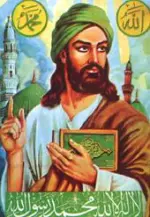
In January 2015, Shireen Dalvi, editor of Awadhnama, was arrested for reprinting a controversial cartoon of Prophet Mohammed. The works of noted authors such as Taslima Nasreen and Salman Rushdie were banned in India, even before anyone in India had even read them. Non-Muslims, who constitute roughly 85 per cent of the population, were denied their right to read these works in deference to the sensitivities of Muslims.
In none of these cases, the executive or the affected parties waited for a judicial intervention or sought the opinion of the courts. In the Ramjanmabhoomi case, the legislature and executive should have taken the call. But with the likes of Kapil Sibal deeply embedded in the system, obviously it is not that easy. – The New Indian Express, 9 December 2017
» Balbir Punj is a former Rajya Sabha member and Delhi-based commentator on social and political issues.
Filed under: india | Tagged: ayodhya, babri masjid, india, kapil sibal, rahul gandhi, ram lalla virajman, rama, ramjanmabhumi, ramjanmabhumi dispute | Leave a comment »