










 It will remain a matter of enduring shame that the Anglophile elite that inherited the country treated the INA and military mutineers as traitors and refused to integrate them with the Indian Army and give them their richly-deserved wartime pensions. Far more scandalous is the recently revealed fact that independent India collaborated with British Intelligence and kept tabs on Netaji’s family and the released INA personnel, till the early 1970s. – Sandhya Jain
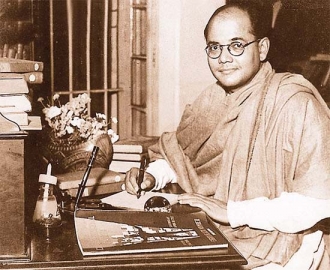
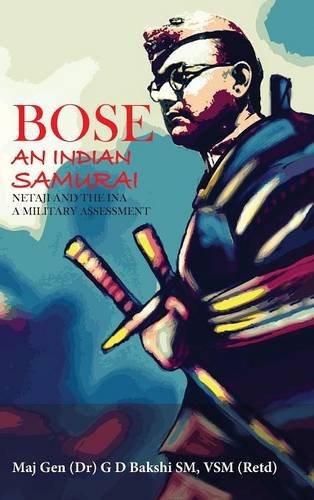
Recent years have seen an increase in the biographies of Netaji Subhas Chandra Bose, but these have failed to examine his contribution as a military leader and strategist, and tacitly treat him as a failure because the Indian National Army’s fate was intricately linked with that of Japan which lost in the Second World War. Maj-Gen G. D. Bakshi has filled this vacuum with Bose: An Indian Samurai. Netaji and the INA: A Military Assessment (Knowledge World, 2016).
The INA grew on the motivational power of “militant nationalism” like that of the German Wehrmacht and the Imperial Japanese Army. Created out of prisoners-of-war captured by the Japanese Army, Netaji abolished the British caste/religion-based regimental model for an all-India model including all groups and [led] by Indian officers, something the British had never permitted. In pre-independence India, this was revolutionary.
Examining a wealth of combat records and memoirs, Bakshi shows that even in highly adverse circumstances, the INA units performed exceedingly well. In the Imphal-Kohima campaigns, Netaji’s units matched the hard-marching Imperial Japanese Army in its infiltration and envelopment manoeuvres. The INA retained combat cohesion even when units were decimated to the extent of 60-80 percent.
The book reopens the debate on how India won freedom. Should we adhere to the Nehruvian myth that India got freedom through the soft power of ahimsa (non-violence) and satyagraha (soul force), or do we acknowledge the role of the INA? As Germany and Japan were defeated in World War II, it is inexplicable why Britain, which thrived on her colonies, especially India, should retreat before pacifists like Gandhi and Nehru. The colonies could have helped Britain rebuild her economy.
Bose believed that the British would never depart of their own volition and that World War II offered an opportunity to solicit support from Britain’s enemies, Germany and Japan, and fight. This led him to part ways with the Indian National Congress, evade house arrest and escape to Germany, from where he made a perilous submarine journey to Japanese territory and raised his legendary fighting force.
Nehruvian court historians have underplayed the psychological impact of the INA trials which triggered military mutinies in February 1946. The possibility of disloyal armed forces unnerved the British and in less than a year they announced their decision to quit India, with the parting kick of a bloody partition.
The Partition gave the Muslim League the new country of Pakistan, the demand for which was mooted only in 1940 and was not sought in the regions that became Pakistan. Even setting aside the betrayal of non-fundamentalist Muslims of the North West Frontier Province and the refusal to help beleaguered Muslims of Balochistan, the Partition represents the Gandhi-Nehru combine’s grand failure to understand the consequences of loss of strategic territory.
But for the British, the decision to humiliate the valiant INA by putting nine officers on trial at Delhi’s Red Fort was a political miscalculation which boomeranged, as until then, the activities of the INA had been a war secret. But now, the colonial power itself revealed that a sizable army had been raised to liberate the country; that Indians of all castes and creeds had united and fought bravely alongside the 15th Japanese Army and narrowly lost in Manipur and Nagaland. The public outrage over the public trial forced the Congress, which was virtually pulverized after the brutal suppression of the 1942 Quit India Movement, to set up a legal defence committee to defend the undertrials.
Bose’s nationalist army hit the foundations of British rule in India, and unnerved the Raj. Indian troops in the British Indian armed forces felt enraged at the INA trials as the undertrials were former colleagues who had been captured by the Japanese and converted by Netaji. Bakshi reveals that almost 20,000 sailors of the Royal Indian Navy, on board 78 ships, mutinied and went around Mumbai with portraits of Netaji, forcing the British to shout Jai Hind and other INA slogans. They brought down the Union Jack on their ships and refused to obey their British officers. Similar rebellions broke out in the Royal Indian Air Force and in the Army units in Jabalpur.
On one hand, the White troops were fed up of war and wanted to go home, not fight to subdue 2.5 million battle-hardened Indian soldiers who had acquitted themselves well in all theatres of war and had seen the British officers routed by the Japanese in Malaya, Singapore and Burma. Quitting was not an option; the haste is questionable.
It will remain a matter of enduring shame that the Anglophile elite that inherited the country treated the INA and military mutineers as traitors and refused to integrate them with the Indian Army and give them their richly-deserved wartime pensions. Far more scandalous is the recently revealed fact that independent India collaborated with British Intelligence and kept tabs on Netaji’s family and the released INA personnel, till the early 1970s. Historians must thoroughly investigate the nuts and bolts of the transfer of power to the government led by Jawaharlal Nehru to throw light on this astonishing matter.
Tormenting questions remain about the disappearance of Netaji Subhas Bose. Emerging evidence indicates that he did not die in an air crash in Taihoku, Taiwan on 18 August 1945, and may have been imprisoned by Josef Stalin for collaborating with Russia’s (and Britain’s) war-time enemies—Germany and Japan. Amidst rumours that Bose was incarcerated in a Soviet Gulag (Camp No 48 in Lezhnevesky district, 50 km from Suzdal in Siberia), it is unclear if he was ever handed over to the British as their war criminal.
Interestingly, two secret agreements between the NKVD (USSR) and MI-6 (Great Britain) regarding intelligence sharing and cooperation in covert operations were signed in December 1941 and March 1944. Many Indians suspect that the Nehru government connived to spread the falsehood that the hero had died in an air crash. The puerile story of Bose living as a reclusive Gumnami Baba in Faizabad, UP, must be seen as part of an attempt to exonerate the then Indian government. Bakshi writes with passion and verve. The book is a mine of information for the millions of Netaji fans in India and abroad. – Vijayvaani, 24 January 2017
Filed under: india | Tagged: azad hind fauj, british india, INA, india, indian independence movement, indian national army, indian national congress, netaji, subhas chandra bose | 1 Comment »