







When Hindu unity becomes merely an episodic and emotional response rather than a continuous, organised process, it leaves the community vulnerable to profound dispossessions and humiliations by hostile Christians. – Aravindan Neelakandan
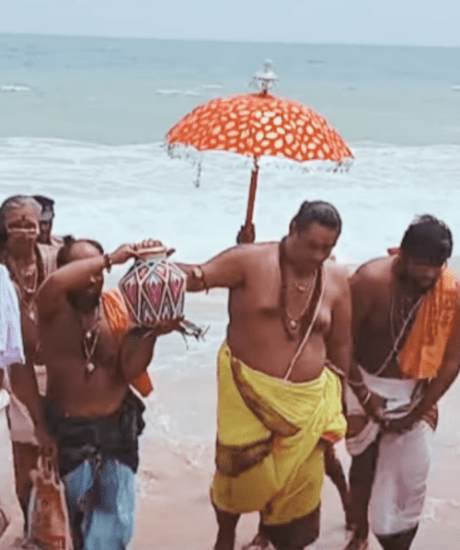
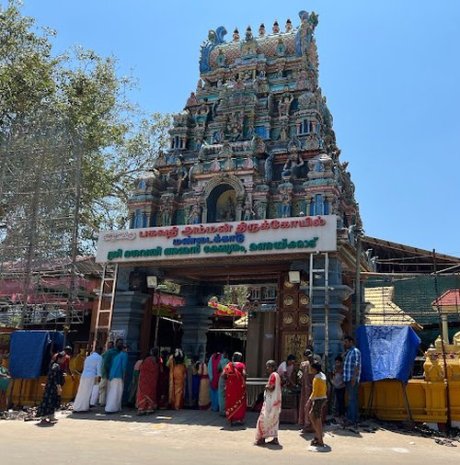
A remarkable scene unfolded earlier this month at the revered shrine of Mandaikadu Bhagawati Amman in Kanyakumari, Tamil Nadu, during the sacred kumbhabhisheka ritual that marked the temple’s symbolic rebirth following a devastating fire in 2021.
The ceremony, which traditionally involves water drawn from the sacred sea, required an elephant to carry the head priest of the Goddess on May 8, with the priest seated atop the animal while bearing the sacred pot.
However, the customary journey to the sea, a path that has been trodden by countless devotees over generations, presented an unexpected and troubling surprise.
As the priest of Mandaikadu began to cover the nominal distance from temple to sea atop his elephant mount, continuing a tradition passed down through generations, individuals near a crucifix-tower-turned-Mary-shrine forced him to dismount from his ceremonial seat.
The priest was ultimately compelled to complete both the journey to the shore and and back on foot, abandoning the sacred elephant procession that forms an integral part of the ritual.
Mandaikadu holds particular significance as the “Sabarimala of women,” attracting countless female devotees from across southern Tamil Nadu and Kerala in pilgrimages that mirror the fervent religious journeys to Sabarimala. These women arrive to perform purifying sea baths before worshipping the Goddess as the primordial consciousness of the universe, making the disruption of this sacred pathway particularly significant.
The positioning of Mary as the Goddess’s “sister” represents a theological demotion of immense consequence, exploiting the characteristically open-minded and universal vision of Hinduism that might unwittingly welcome such comparisons while remaining oblivious to the spiritual undermining such equations entail. The shrine to Mary has evolved from what was once a humble pillar into a formidable edifice, creating a palpable sense of competition with the ancient Bhagawati Amman temple.
While the Bishop House projects a conciliatory image through organised inter-faith dialogues, the ground reality tells a markedly different story, characterised by ongoing conflict and attitudes that appear reminiscent of medieval-era religious tensions.
The manner in which Tamil news channels reported these events revealed another layer of the problem. Most outlets ignored what many viewed as a humiliating transgression against Hindu practices, while channels like Thanti TV that did cover the story praised the priest’s accommodation as preservation of communal harmony.
Although the head priest demonstrated considerable spiritual strength by calmly walking toward the sea after being forced to dismount, the incident represents what many observers characterised as a deliberate and planned humiliation of Hindu religious practices.
The events inevitably evoked memories of much darker episodes from the region’s past.
Historical Context: The 1982 Violence
In 1982, when the current shrine to Mary existed merely as a nascent pillar, Catholic zealots encouraged by fanatical clergy unleashed what witnesses described as a torrent of humiliation and violence upon Hindu women taking their sacred baths. The haunting image of laughing fanatics chasing terrified devotees culminated in police opening fire and the tragic loss of lives, creating a searing memory that continues to influence community relations decades later.
This tragedy subsequently ignited a wave of attacks on nearby Hindu villages, sometimes met with unorganised retaliation, while posters defaming India and then-Tamil Nadu Chief Minister M.G. Ramachandran appeared throughout the district as part of what many viewed as cynical political maneuvering.
However, this harrowing period also witnessed an unprecedented renaissance of Hindu unity and a powerful consolidation of religious identity, led by figures such as the late Thanulinga Nadar, ultimately forging a formidable Hindu vote bank that transformed the region’s political landscape.
The Tamil Nadu government responded by announcing that an inquiry commission would investigate the riots’ causes, identify the culprits, and establish protocols to prevent future violence. The commission was constituted under retired Judge Venugopal, known as a staunch Dravidianist who emphasized in his report that the RSS was a fanatical organization requiring opposition.
Despite such apparent biases, a careful reading of the Commission’s report reveals that even this ideologically predisposed judge clearly identified the aggressive, expansionist, and intolerant behaviour of Christian radicals as the primary instigation for the riots. The staunch Dravidianist became genuinely alarmed when he visited Kanyakumari district and observed the ground situation firsthand, even learning of attempts to rename the district from Kanyakumari to “Kanni Mary” (Virgin Mary) district.
Decades later, in 2003-04, he would write an article in the RSS-associated magazine Organiser, defending the anti-conversion legislation introduced by the late J. Jayalalithaa.
Consequently, he recommended that the government enact laws banning fraudulent and compulsory conversions, while Hindu leaders of the time conducted excellent documentation of the sufferings endured by their community and the atrocities committed by Christian fanatics.
Testimony of Victims
One of the most disturbing sections of the Commission report describes how the retired judge himself was moved by testimony from victims of molestation, including that of a 19-year-old Hindu girl who had come to worship the Goddess but was forced to flee without clothing by the fanatical Christian mob.
She represented one among dozens of women who endured traumatic experiences near the temple, with four women courageously appearing before the Commission to describe their humiliation.
The young woman faced an equally cruel cross-examination process though, as the Christian side heartlessly suggested that the women were paid witnesses fabricating their allegations. The situation was so dire that even the retired Justice felt compelled to make the following observation:
The accounts of the Govt. Witnesses (Go.W) 1 to 4 and the women who came in their teams, clearly show that when they were taking bath in the A.V.M. Canal the fishermen harmed their respect…. That a girl nineteen years old, who is unmarried, should come here and stand before the commission, with tears in her eyes should give witness as to how her womanhood was humiliated, and stand before the cross examination of well known lawyers in a room full of males and knowing that the details of the cross examination, word by word, would be sensationalised in the local media, is quite a traumatic experience and horrible nightmare for her. That this girl should face all these humiliations to give false witness to the police, is an allegation unacceptable to the Commission. … Despite several hours of cross examination by various lawyer teams belonging to different groups, the true essence of the testimony of the Govt. Witnesses 1-5 (which include the four women victims) did not change. … The conclusion of the Commission is that the women devotees who had come to worship, who were taking the sacred bath [Go.W 1-4 and other women with them], fishermen caused trouble for them, humiliated them and molested them. – Tamil Nadu Govt. Venugopal Commission Report [Trans. from Tamil] p.48 & p. 204
Contemporary Dynamics
More than four decades later, while overt violence may have receded, observers note that simmering communal tensions against Hindus persist in the region. Simultaneously, the initial surge of Hindu unity, despite its historical potency, appears to have lost sustained momentum over time.
The Catholic Church, recognizing shifting power dynamics, has adopted what appears to be a more submissive public posture while strategically propagating what critics describe as the “sisterhood” fabrication.
This narrative has found unexpected allies among Marxists and Leftist folklorists, who consistently attempt to reduce Hindu deities to mere ancestral figures, thereby stripping them of their spiritual significance. Such interpretations have paved the way for what critics consider the absurd characterization of Mandaikaadu Bhagavathi Amman as merely a historical woman, possibly even a devotee of Virgin Mary.
Meanwhile, the Church has methodically expanded its influence by establishing institutions such as a dairy cooperative that now dominates the district’s milk supply, subtly integrating itself into the predominantly Hindu farming community’s economic fabric. The Bishop House has transformed from primarily a religious centre into a hub for “progressive” workshops and programmes, extending its reach throughout the community.
The intellectual challenge to Hindu identity has been further reinforced through literature, particularly the novel Marupakkam, heavily promoted by Leftist and Christian networks. Written by Ponneelan, a Tamil author with significant institutional access and political connections, this fictional work subtly demonises Hindus, particularly those associated with Hindutva movements, while portraying Christians, even extremist elements, with a veneer of innocence and victimhood.
The absence of an authentic Hindu counter-narrative has allowed this distorted fictional account to become widely accepted as the actual history of the Mandaikaadu riots, demonstrating the considerable power of narrative control in shaping public perception.
According to the Commission’s findings, the crucifix tower was constructed only ten years before the 1982 riots, with the Venugopal Commission explicitly recommending that district administration avoid such constructions in religiously sensitive locations. However, the post-UPA-I era appears to have emboldened the Catholic Church to escalate its confrontational approach.
A particularly profound humiliation occurred when Hindus were denied access to a small hillock traditionally revered as the location for lighting the first flames of Karthikai Deepam, an important Hindu festival. The area is now part of a Church-owned engineering college. Even a former Central Minister, Pon. Radhakrishnan, found himself powerless against the clergy’s unyielding stance.
Additional indignities have followed, including the removal of a Hanuman statue despite permission having been granted by a Panchayat president who happened to be a Catholic woman, suggesting that even local administrative approvals carry little weight when they conflict with Church interests.
The most recent and deeply painful act of humiliation unfolded with the denial of elephant access to the head priest during the sacred procession. Members of the Catholic coastal community ordered the priest to dismount while police stood by as silent witnesses, and Hindu organizations appeared capable of mustering only verbal protests in response.
The “sisterhood” fabrication, exposed during this incident as the calculated illusion many had long suspected it to be, effectively evaporated in that crucial moment when the head priest found himself stripped of the traditional symbol of his sacred journey and forced to walk to the sea to collect the hallowed water on foot.
This agonising moment underscores a crucial reality—when Hindu unity becomes merely an episodic and emotional response rather than a continuous, organised process, it leaves the community vulnerable to such profound dispossessions and humiliations.
The incident highlights the institutional strength and strategic planning of opposing forces compared to the ad hoc nature of Hindu community responses. – Swarajya, 29 May 2025
› Aravindan Neelakandan is an academic, author (mostly in Tamil) , and columnist in Nagerkoil.
See also
Filed under: india, tamil nadu | Tagged: christian aggression, hindu rituals, hinduphobia, mandaikadu bhagawati amman, religious intolerance | Comments Off on Kanyakumari: Intolerant Christians beleaguer ancient Hindu ritual – Aravindan Neelakandan