










Many Hindu activist groups in the United States once hoped that the American right-wing, despite its evangelical roots, would embrace Hindus with mutual respect. However, if the reality as unveiled by this Religious Liberty Commission is any hint, it proves different. – Aravindan Neelakandan
The phrase ‘religious liberty’ evokes ideals of profound freedom, theological diversity, and the protection of a space where all faiths can harmoniously coexist. It should indeed be the cornerstone of any healthy democracy, promising a vibrant presence of beliefs and worldviews coexisting peacefully.
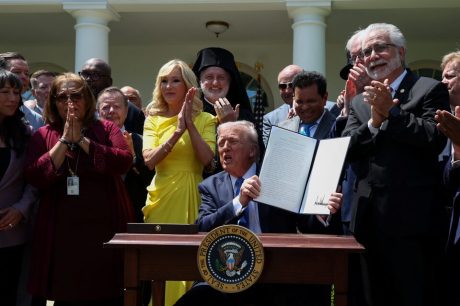
On May 1, 2025, Donald Trump, the 47th President of the United States, established a Commission “by the authority vested in [him] as President by the Constitution and the laws of the United States of America” – a “Religious Liberty Commission” (RLC).
With 14 members hand-picked by Trump himself and also supported by two advisory boards, one with 15 religious leaders and another with 15 laypeople. The mission of the RLC is to “produce a comprehensive report on the foundations of religious liberty in America, the impact of religious liberty on American society, current threats to domestic religious liberty, strategies to preserve and enhance religious liberty protections for future generations, and programs to increase awareness of and celebrate America’s peaceful religious pluralism.”
Yet, a closer examination of the composition of the RLC reveals a troubling picture. Under the purview of RLC, the term “religious liberty” is morphing into a burgeoning challenge to these very ideals, subtly advancing a narrow, conservative Christian agenda at the expense of genuine pluralism and established scientific understanding.
In 2009, Lisa Miller, in a compelling Newsweek cover story, boldly suggested that most Americans were, in essence, becoming “Hindu”.
This observation pointed to a growing acknowledgement of the Hindu perspective on theo-diversity, where Truth is understood to be multifaceted—Ekam Sat Vipra Bahudha Vadanti (Truth is One, Sages Call It by Various Names). It implied a societal shift away from claims of a singular monopoly on truth, and consequently, a rejection of the notion that a loving God would condemn all others to eternal hell.
Against such an evolution, the RLC’s approach is deeply concerning. Hinduism, with its inherent pluralism and profound respect for diverse spiritual paths, views aggressive conversion, particularly when coercive, strategically planned, or materially induced, as problematic and antithetical to genuine spiritual freedom. This stands in stark contrast to the RLC’s discernible orientation, which appears to prioritise a specific Christian interpretation of religious freedom.
The very mandate of the RLC, while ostensibly broad, subtly betrays its true priorities. It nobly declares its aim to “safeguard and promote America’s founding principle of religious freedom”. However, this laudable goal is immediately qualified by the simultaneous establishment of a “task force to eradicate anti-Christian bias“.
This dual approach strongly implies that the RLC’s primary concern is not religious pluralism in its entirety, but rather the perceived grievances of a dominant religious group. This framing risks defining “religious liberty” not as a universal right equally applicable to all faiths, but as a distorted euphemism designed to assert the values and protections of a specific religious community, potentially leading to its supremacy.
The implications of this narrow interpretation are profound. It suggests that the unique challenges and perspectives of non-Abrahamic traditions like Hinduism may be overlooked or implicitly excluded. This concern is not new; the U.S. Commission on International Religious Freedom (USCIRF) has been shown through exhaustive documentation to exhibit anti-Hindu bias, with India consistently rejecting its reports.
This historical context provides a critical backdrop, indicating a broader systemic challenge within certain U.S. religious policy bodies regarding their understanding and treatment of Hinduism. What USCIRF may be doing internationally with suave duplicity—perhaps with the aim of accumulating “atrocity literature” to label any nation it wishes to subdue as “evil”—Trump’s RLC may be seeking to replicate within the U.S.
Indeed, the RLC draws from similar ideological currents and personnel. In fact, it is the very composition of the RLC that solidifies these concerns. It is heavily populated by prominent Christian leaders whose public records and past actions reveal a strong inclination towards a conservative, if not fundamentalist, Christian worldview.
This strong evangelistic bent among key RLC members is particularly alarming from a Hindu perspective. Hinduism’s pluralistic ethos, which validates multiple spiritual paths and considers coercive conversion illegitimate, stands in direct opposition to the exclusive truth claims often inherent in Christian evangelism.
When a commission dedicated to “religious liberty” is largely composed of individuals committed to converting non-Christians, it raises serious questions about its capacity to genuinely uphold the freedom of traditions that do not share this proselytising imperative. The concern is that the RLC’s work might inadvertently facilitate or legitimise efforts to convert adherents of other faiths, including Hindus, under the guise of promoting “religious liberty”.
More than one member of the RLC has shown open hostility to the Hindu family of religions, including Buddhism. Influential evangelist and son of the famous Billy Graham, Pastor Franklin Graham, explicitly mocks Hinduism, stating that “no elephant with 100 arms can do anything for me. … None of their 9,000 gods is going to lead me to salvation.” He believes “only Christians have God’s ear” and that “Muslims and Hindus don’t pray to the same God he does.” He also views Hinduism and Buddhism as belief systems that “keep persons captive and keep them from coming to faith in the Lord Jesus Christ … is a demonstration of satanic power.” So his very concept of “religious liberty” is converting a non-Christian to Christianity.
Paula White, another member and a “spiritual” adviser to Trump, tells people that they should “know not to follow the gods of other religions like Buddha … and more.” Archbishop Elpidophoros of America, who is in the Advisory Board, loves to share the story of a Christian elder who tells the disciple of a Hindu guru that “techniques do not matter at all … there is just the devil. The god is Christ”, indicating a strong rejection of Hindu spiritual techniques in favour of Christ. With such people in the body, it is clear the body can institutionalise the “othering” of Hinduism and Hindus will be seen as targets of evangelism.
Beyond religious pluralism, the RLC’s composition and underlying ideology also pose a significant threat to science education and public trust in scientific consensus. The presence of outspoken Creationists and Intelligent Design proponents on federal advisory bodies could lead to increased pressure to introduce pseudo-scientific theories like Creationism or Intelligent Design into public school science curricula, either through “academic freedom” laws or “school choice” initiatives.
The RLC’s chair, Texas Lieutenant Governor Dan Patrick, has publicly declared that “when it comes to Creationism, not only should it be taught, it should be triumphed, it should be heralded.” Dr. Ben Carson, the vice chair, openly rejects evolution, stating that “150 years after Darwin, there is still no evidence for evolution” and that evolution is more a matter of faith than science. Pastor Graham explicitly states that “man did not evolve from apes”. Paula White is also a strong advocate of Intelligent Design—a thoroughly discredited attempt to bring creationism through the backdoor. All these should be of concern to every citizen who values science education.
The appointments to President Trump’s commission on “religious liberty” reveal distinct patterns of ideological alignment, particularly concerning views on evolution. The concentration of individuals with explicit or implicit pro-Creationist or Intelligent Design views predominantly within the RLC is significant and disturbing. This suggests a strategic intent to utilise the framework of “religious liberty” to advance a specific religious-conservative agenda that includes challenging mainstream scientific consensus on evolution.
This pattern of concern extends to the realm of Christian evangelism. An analysis of the RLC members’ public stances and affiliations reveals a significant inclination towards active evangelism.
Figures like Pastor Franklin Graham explicitly articulate a mission to convert non-Christians, believing “the only way to God was through Jesus” and warning of “Hell” for those who “turn their backs on God”—referring, of course, to the Christian God.
Another member, Bishop Robert Barron, emphasises that “evangelisation is priority one” for the Catholic Church, describing it as a fervent desire to share “good news”. Even those members who advocate for interfaith dialogue, such as Cardinal Timothy Dolan, operate within a framework where the ultimate goal is often to proselytise and expand their faith.
From a Hindu perspective, the collective presence of individuals with such strong evangelistic mandates on a commission ostensibly dedicated to “religious liberty” presents a profound concern. Hinduism’s pluralistic ethos, which acknowledges the validity of multiple spiritual paths and views coercive conversion as illegitimate, stands in direct contrast to the exclusive truth claims inherent in much of Christian evangelism.
Many Hindu activist groups in the United States once hoped that the American right-wing, despite its evangelical roots, would embrace Hindus with mutual respect. However, if the reality as unveiled by this Religious Liberty Commission is any hint, it proves different. Some Hindu groups, including certain ideologues of the RSS back home, have even attempted to ape the American right-wing by taking an anti-evolutionary stance, advocating for Intelligent Design.
However, what they are missing is the larger, holistic perspective. While Creationism/Intelligent Design and Christian exclusivist evangelism are complementary, the Hindu vision of theo-diversity and the evolutionary worldview are, in fact, complementary. The Hindu worldview inherently embraces universal inclusivity, a stark contrast to the strict sectarian religious exclusivity often found in evangelical thought.
Hindus have thus received a timely reminder of this fundamental civilisational truth. This unwitting reality check, provided by Trump’s initiatives, may ultimately guide them in establishing strong boundary conditions for their engagement with the American Christian Right. – Swarajya, 25 June 2025
› Aravindan Neelakandan is an academic, author (mostly in Tamil) , and columnist in Nagerkoil.

Filed under: india, USA | Tagged: christian evangelism, hinduphobia, religious bigotry, religious pluralism, USA religious liberty commission | Comments Off on Is Trump’s Religious Liberty Commission a Trojan horse against Hindu pluralism? – Aravindan Neelakandan