














 You cannot run a temple with mere employees. You need passion and devotion for it. But right now, temples are in government control, and someone who has no feeling for the temple is managing it, so naturally, they will not keep it well. – Sadhguru Jaggi Vasudev
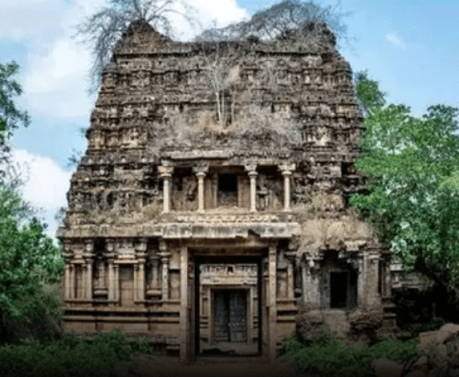
Last year, the government of Tamil Nadu submitted a report to the Madras High Court stating that in 11,999 temples in the state, there is no puja or ritual taking place as there is no revenue. In 34,000 temples, there is only one person to manage all the affairs of the space. While 37,000 temples record a revenue less than Rs 10,000 per annum. They estimated that around 12,000 temples will die in the next few years.
An official statement by the government attests that 1,200 deities have gone missing, stolen. Several police officers have written books claiming that thousands of deities are fake, as the original idols have been stolen and replaced with counterfeits in the last 25 years.
This is not social media sensationalism. This is a stark reality that we are facing. If we continue like this, in another 100 years, except for a few major temples, all of them will be extinct.
How did we end up here?
First of all, a temple is a subjective affair. You cannot run a temple with mere employees. You need passion and devotion for it. But right now, temples are in government control, and someone who has no feeling for the temple is managing it, so naturally, they will not keep it well. A temple is not a business but the soul of the community. It can only be managed with tremendous involvement and devotion.
Stranglehold on temples: A colonial legacy
Why is the government managing temples? There is a long history to this.
In 1817, the first Madras Regulation was passed and the East India Company—a corporate—took over the temples. Their idea of a temple was land, gold, diamonds—wealth. They transported everything they could, and what they could not is left here in the temples. Then in 1840, there was a directive to release the temples back; this was a consequence of Christian missionaries who protested that it was disgraceful for Christians to manage Pagan temples. Anyway, the gold was taken, so they had no business there anymore. In 1925, temples were becoming the hubs of organising freedom movements, so the Madras Religious and Charitable Endowments Act was brought in, to bring them under government control. Since the minority communities strongly protested, their places of worship were released, and only Hindu temples were held.
After independence, the Tamil Nadu Religious and Charitable Endowments Act was passed. The Tamil Nadu temples are under the control of the Hindu Religious and Charitable Endowments (HR & CE) Department.
If you read the fundamental rights granted to every Indian citizen in the Constitution and then look at the HR & CE laws, it is absolutely outrageous. The very fact that a certain community is targeted, and cannot keep its own places of worship, amounts to nothing less than apartheid. Why is it that everyone else can manage their religious affairs, but one community, which is the majority community, cannot?
Devotees can unleash the potential of temples
Currently, 44,000 temples with over half a million acres of land are under the management of the government of Tamil Nadu. However, the revenue from all this is only Rs 128 crore per annum. In comparison, the Shiromani Gurdwara Parbandhak Committee has 85 gurdwaras in their hands, but their budget is over Rs 1,000 crore. For 44,000 temples that belong to a community comprising 87 percent of the population, a revenue of Rs 128 crore smacks of abysmal mismanagement.
A common argument is, “If you give the temples back to the community, will they manage them better? Maybe they will do worse.” What this means to say is that in 87 percent of the population, you cannot find a handful of people with the necessary integrity and competence to do this. This is ridiculous.
If you leave the temples to the devotees, they will manage them in a wonderful, vibrant way. There are many modules you could use to run temples. For example, look at the way gurdwaras are run—the amount of food that the langars provide, and how they reach out to people in times of need. Imagine the budget that temples could have, given the amount of land revenue they could earn. They could do so much more. You could attend to pandemics, natural disasters, and other crises that occur in the region. Above all, because they are connected with the community, they can handle such situations in a very effective way by using money efficiently—unlike the government where money is filtered through the system, and only a few drops trickle down most of the time.
Also, the volume of people’s sweat and blood that has been invested in the last few thousand years in these temples is not small. You can run the entire state just on temple tourism. Because the temple is not only about a certain religion. The temple is about art, history, culture. Especially in Tamil Nadu, the temple tower is the state emblem. Many of our towns are called “temple towns” as the temple is the core of that town. Because of the temple, there is a town—not the other way around. The amount of work that has been done is absolutely incredible, in terms of architecture, sculpture, art and engineering. There is nothing like it anywhere else in the world, but we are just letting it languish because of our apathy. It is time to fix that.
Exercise your democratic right for temples
I firmly believe that in a democratic country, before the election, every responsible citizen must clearly articulate what are the few things that must happen in their country or state. Political parties must know that this is what the people want and they must make their manifestos based on that. But if the people do not say anything now and then protest, cry, and make comments after the election is over—this is irresponsible citizenry. This is why I am pitching the issue now.
In terms of action, my focus is on Tamil Nadu right now because the Tamil Nadu HR & CE laws are the most draconian. Of all the states, the Tamil Nadu government holds the highest number of temples under its control; if we can set an example here, the movement will naturally take off everywhere else.
Recently the major political parties in Tamil Nadu announced sums of money for temple restoration and travel allowance for making pilgrimages. Unfortunately, what is missed here is that the concept of giving remuneration was meant for minorities because the origin of their religion is far away; their places of pilgrimage are in foreign countries and they cannot afford the travel expenditure. For Hindus, our temple is our pilgrimage. You can drive, take a train or walk. Even today, thousands of people make pilgrimages from the Himalayas to Rameswaram and back by foot. They do it quietly, and the government need not participate in that. It is our business. We do not need money for that.
What we need is for the government to return temples to be managed by devotees. The community should stand up and say to political parties, “If you do not hand over the temples to us, we are not going to vote for you.” The handover need not be done hastily in one-shot. It is a complex process and should be done properly. The important thing is to first show an intent. A commission could be appointed to evolve a process of devolution of our temples back to the community.
Above all, after 74 years of free India, if people do not have the freedom to practice their religion the way they want, what kind of freedom is that? Before the 75th Independence Day, we must free the temples. – Firstpost, 25 March 2021
› Sadhguru Jaggi Vasudev is an influential international guru focused on yoga, social upliftment and ecological conservation. He is the founder of the Isha Foundation in Coimbatore.
Filed under: india, tamil nadu | Tagged: freedom of religion, hindu temples, HR&CE department, temple administration | Comments Off on India’s temples must be freed from government control – Jaggi Vasudev











