












 The vast majority of the fires have been set by loggers and ranchers to clear land for cattle. The practice is on the rise, encouraged by Jair Bolsonaro, Brazil’s populist pro-business president, who is backed by the country’s so-called “beef caucus.” – Eliza Mackintosh
While the wildfires raging in the Amazon rainforest may constitute an “international crisis,” they are hardly an accident.
The vast majority of the fires have been set by loggers and ranchers to clear land for cattle. The practice is on the rise, encouraged by Jair Bolsonaro, Brazil’s populist pro-business president, who is backed by the country’s so-called “beef caucus.”
While this may be business as usual for Brazil’s beef farmers, the rest of the world is looking on in horror.
So, for those wondering how they could help save the rainforest, known as “the planet’s lungs” for producing about 20% of the world’s oxygen, the answer may be simple. Eat less meat.
It’s an idea that Finland has already floated. On Friday, the Nordic country’s finance minister called for the European Union to “urgently review the possibility of banning Brazilian beef imports” over the Amazon fires.
Brazil is the world’s largest exporter of beef, providing close to 20% of the total global exports, according the United States Department of Agriculture (USDA)—a figure that could rise in the coming years.
Last year the country shipped 1.64 million tonnes of beef—the highest volume in history—generating $6.57 billion in revenue, according to the Brazilian Beef Exporters Association (Abiec), an association of more than 30 Brazilian meat-packing companies.
The growth of Brazil’s beef industry has been driven in part by strong demand from Asia—mostly China and Hong Kong. These two markets alone accounted for nearly 44% of all beef exports from Brazil in 2018, according to the USDA.
And a trade deal struck in June between South America’s Mercosur bloc of countries and the European Union could open up even more markets for Brazil’s beef-packing industry.
Speaking after the agreement as announced, the head of Abiec, Antônio Camardelli, said the pact could help Brazil gain access to prospective new markets, like Indonesia and Thailand, while boosting sales with existing partners, like the EU. “A deal of this magnitude is like an invitation card for speaking with other countries and trade blocs,” Camardelli told Reuters in July.
Once implemented, the deal will lift a 20% levy on beef imports into the EU.
But, on Friday, Ireland said it was ready to block the deal unless Brazil took action on the Amazon.
In a statement Irish Prime Minister Leo Varadkar described as “Orewellian” Bolsonaro’s attempt to blame the fires on environmental groups. Varadkar said that Ireland will monitor Brazil’s environmental actions to determine whether to block the Mercosur deal, which is two years away.
He added Irish and European farmers could not be told to use fewer pesticides and respect biodiversity when trade deals were being made with countries not subjected to “decent environmental, labor and product standards.”
In June, before the furor over the rainforest began, the Irish Farmers Association called on Ireland not to ratify the deal, arguing its terms would disadvantage European beef farmers.
Deal or no deal, Brazil’s beef industry is projected to continue expanding, buoyed by natural resources, grassland availability and global demand, according to the Organisation for Economic Co-operation and Development (OECD).
And, with that growth, comes steep environmental costs.
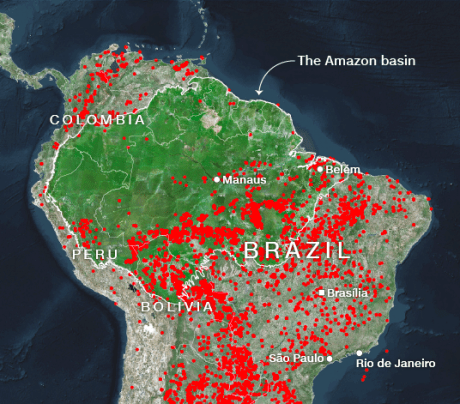
Brazil’s space research center (INPE) said this week that the number of fires in Brazil is 80% higher than last year. More than half are in the Amazon region, spelling disaster for the local environment and ecology.
Alberto Setzer, a senior scientist at INPE, told CNN that the burning can range from a small-scale agricultural practice, to new deforestation for mechanized and modern agribusiness projects.
Farmers wait until the dry season to start burning and clearing areas so their cattle can graze, but this year’s destruction has been described as unprecedented. Environmental campaigners blame this uptick on Bolsonaro, who they say has encouraged ranchers, farmers, and loggers to exploit and burn the rainforest like never before with a sense of impunity.
Bolsonaro has dismissed accusations of responsibility for the fires, but a clear shift seems to be underway.
And if saving the rainforest isn’t enough to convince carnivores to stop eating Brazilian beef—the greenhouse gas emissions the cattle create may be.
Beef is responsible for 41% of livestock greenhouse gas emissions, and that livestock accounts for 14.5% of total global emissions. And methane—the greenhouse gas cattle produce from both ends—is 25 times more potent that carbon dioxide.
An alarming report released last year by the UN Intergovernmental Panel on Climate Change (IPCC) report, said changing our diets could contribute 20% of the effort needed to keep global temperatures from rising 2°C above pre-industrial levels. Namely, eating less meat.Still, global consumption of beef and veal is set to rise in the next decade according to projections from the Organisation for Economic Co-operation and Development (OECD) and the Food and Agricultural Organization of the United Nations (FAO).
A joint report predicted global production would increase 16% between 2017 and 2027 to meet demand.
The majority of that expansion will be in developing countries, like Brazil.
– CNN, 23 August 2019
› Eliza Mackintosh is a London-based digital producer covering Europe, the Middle East and Africa for CNN International. Arnaud Siad contributed to this report from London.
› See also The beef with beef by Thomas Page

Filed under: brazil | Tagged: amazon, beef consumption, beef production, climate change, forest fires | Comments Off on Beef producers and consumers behind Amazon forest fires – Eliza Mackintosh