














 “It is amazing that Indians still don’t have the confidence to stand by their own wisdom. Are they not aware that Indian ancient scriptures are an amazing source of knowledge about the human being? Writings of a Swami Vivekananda or a Sri Aurobindo easily outshine western notions on personality. Are not at least some of those who design the curricula aware of it? It seems that only when it is very obvious that the west appreciates something Indian, will Indians also appreciate.” – Maria Wirth
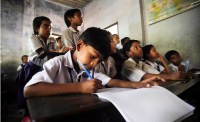 Indians have brains. This news has spread by now. I read about an Indian girl in a school in U.S. who complained that her American peers expected her to excel simply because she was Indian. There are statistics which show that NRIs in U.S. are doing exceptionally well, that their percentage in organizations like NASA or Microsoft is far above average.
I used to think that the Indian education system has something to do with it. But recently I realized that Indians are brainy and successful in spite of their education. This may be too much of a generalization. There are hopefully many institutes with good curricula and excellent faculty, especially in science and technology. Yet one thing is certain: general education in India can do with improvement, and urgently so.
A few years ago I looked for the first time into a textbook of a 5-year-old. He was learning rhymes and I was shocked: “London Bridge is falling down, falling down, my fair Lady…” he learnt. Meanwhile he is eight and he still knows the rhyme. Good memory. But couldn’t it have been used for something better? Recently he learnt Roman numbers: X, C, L etc. I told him that he won’t need them, as Indians have come up with the far superior decimal system which is in use all over the world. He stunned me with his reply: “But it is GK (general knowledge), no?”
It struck me that GK is very much dictated by the west. What about knowing what ‘prananyama’ means? My laptop makes a red line underneath. It never heard of this word. My sister once told me that the one million Euro question in the German version of ‘Kaun banega crorepati?’ was: ‘Who accompanied Edmund Hillary to Mount Everest?’ The organizers were probably certain that Germans had never heard that name. Yet was it not Sherpa Tenzing Norgay who made it possible for Hillary to reach the top and take all the laurels?
 A few days ago I looked into the notes of a Bachelor of Science student. She was preparing for a psychology test. It was again a shock: she had copied 7 ½ pages on Sigmund Freud’s psychoanalytical theory of personality development. She learnt about oral, anal, phallic, genital stages, about Oedipus complex, etc. Nobody told her that this theory is outdated. Simply because Sigmund Freud, for whatever reason, is a famous name, the students have to lap it all up. Of course there were more theories for her to learn: by Carl Jung (who by the way fell out with Freud and visited India in 1938), Skinner, Maslow, etc. Not a single Indian was mentioned in her notes. Yet German students hear of the Bhagavad Gita. Incidentally I myself was asked to write a chapter on the Yoga of the Bhagavad Gita for a university reader meant for German psychology students which was published in 1989. In the 1970s at the height of the India wave in the west, a new stream was added to the existing therapies in western psychology. It was called ‘Transpersonal Psychotherapy’ and as the name suggests, postulates the reality of something that transcends the person. Ever heard of Atman? Some prominent representatives of this line like Stanislaw and Christina Groff had Indian gurus. I doubt, however, that the Indian contribution is getting acknowledged in their work.
It is amazing that Indians still don’t have the confidence to stand by their own wisdom. Are they not aware that Indian ancient scriptures are an amazing source of knowledge about the human being? Writings of a Swami Vivekananda or a Sri Aurobindo easily outshine western notions on personality. Are not at least some of those who design the curricula aware of it? It seems that only when it is very obvious that the west appreciates something Indian, will Indians also appreciate.
 For example now, since Hollywood is interested in making a film on Ramayana and Indian mythology is becoming a hit in the West and of course exploited economically, Indian children (and adults), too, hear more about their mythology. Or now, since yoga is taught even in educational institutions in the west, there is at least a chance that yoga will be taught in Indian schools, as well.
It occasionally happened at some get together here in Dehradun that somebody quoted Shakespeare and expected me to know the passage. It is considered a sign of being highly educated. I have no knowledge of English literature. Our focus in school was on German literature. Incidentally, famous German writers like Hesse, Heine, Herder, Rilke, Jean Paul, Novalis, Schopenhauer and others read Indian scriptures and were influenced by them. Most of them had never been to India, but they appreciated the spiritual value of the Upanishads and the Bhagavad-Gita. Some clearly expressed that wider knowledge of Indian wisdom would make the west aware of the ‘colossal one-sidedness’ in which ‘our whole religious and philosophical thought is stuck’ (Prof. Paul Deussen in 1920).
Back to being educated. It is common knowledge that the British colonial masters intended to subdue India with the help of their education system and it worked. What prevents India from radically changing this system for the better 60 years after independence? Since Indians no doubt are brainy, they could easily come up with a better idea how to use those 12 or more years of education and not just copy the so called ‘first world’. Why are today’s Indians still so proud of having been educated at a convent? Why should Indians learn about Freud? Because Freud is general knowledge and Indian wisdom is not? Because it may come in some TV quiz? Because at some dinner party one may be considered highly educated? It certainly is odd.
 A lot is done regarding child labour, laws are put in place, etc., yet school kids don’t get any protection from being overworked? Their working day often starts at 6 a.m. if not earlier with tuition even in winter and they have to cram their brains with often unnecessary stuff for many hours a day and their parents don’t even realize. This non stop slogging under pressure to pass the exams, takes its toll.
Once I was in an auto in Delhi. At a red light, it came to a halt right next to a Maruti van full of school kids. I bent and looked at them from my auto till the green signal came. Not one of them discovered me. They all silently stared straight ahead, maybe lost in thoughts, or maybe simply dead tired.
That’s when I felt that street kids are more alive, present in the moment and aware. They generally don’t lack in self-esteem and know more about psychology and life skills than most B.Sc. students. Yet in all likelihood “a BA” or “a B.Sc.” or “a PhD” will feel infinitely superior to them. Does anyone know why? – Maria Wirth, 31 December 2012
» Maria Wirth lives in Uttarakhand. She studied psychology at the University of Hamburg and her articles are published in various German and Indian media. Many of her articles are available on the Maria Wirth Blog.
Filed under: india | Tagged: education, educational system, general knowledge, india, indian education system, indian politics, psychological warfare, psychology, self-esteem, society, street kids, transpersonal psychology | 3 Comments »











