











 Conversion has always been anathema to the Hindu mind because unlike other religions, Hinduism does not claim an exclusive right to divinity – Dr. Vivek Gumaste
The passage by the Karnataka Assembly of the Protection of Right to Freedom of Religion Bill, 2021 (or Anti-Conversion Bill) has once again brought the contentious issue of religious conversion to the forefront compelling us to introspect on the matter.
First, is the right to convert a fundamental right enshrined in the Constitution?
Secondly, does religious conversion conform to our civilisational morality?
To fully evaluate an anti-conversion bill (now in existence in eight other states), we need to understand its historical background, test its constitutional validity and analyse its moral legitimacy.
India has a long history of anti-conversion laws that predate the rise of the BJP. In pre-independent India several princely states restricted religious conversions by law.
After Independence, the Congress government in Madhya Pradesh tasked the Niyogi Committee headed by Bhawani Shankar Niyogi, a retired chief justice, to investigate Christian missionary activity. The Committee said:
Enormous sums of foreign money flow into the country for missionary work, comprising educational, medical and evangelist activities. Conversions are mostly brought about by undue influence, misrepresentation, etc., or in other words not by conviction but by inducements.
Schools, hospitals and orphanages are used to facilitate proselytization.
Tribals and ‘Harijans’ are the special targets of aggressive evangelisation for the reason that there is no adequate provision of hospitals, schools, orphanages and other social welfare services in the scheduled or specified areas.
The Committee recommended that “Suitable control on conversions brought about through illegal means should be imposed. If necessary legislative measures should be enacted.”
This led to the enactment of anti-conversion laws that are now in force in eight out of twenty-nine states; several of these were introduced by non-BJP governments, including the Congress.
Article 25 of the Indian Constitution states: “Subject to public order, morality and health and to the other provisions of this Part, all persons are equally entitled to freedom of conscience and the right freely to profess, practice and propagate religion.”
However, the right to propagate is not co-terminus with the right to convert. In the case of Rev. Stainislaus vs State of Madhya Pradesh (1977), a Supreme Court Bench unequivocally ruled: “It has to be appreciated that the freedom of religion enshrined in the Article (25) … covers all religions alike. … What is freedom for one, is freedom for the other, in equal measure, and there can therefore be no such thing as a fundamental right to convert any person to one’s own religion.”
Additionally, the apex court invoked the ‘public order’ and highlighted the focus on ‘forcible conversion’ to uphold the validity of both the Madhya Pradesh Dharma Swatantraya Adhiniyam, 1968, and the Orissa Freedom of Religion Act,1967 (two of the first anti-conversion bills).
In short, the Constitution does not guarantee a fundamental right to convert and anti-conversion bills in general have been scrutinised and validated by the SC.
Conversion has always been anathema to the Hindu mind because unlike other religions, Hinduism has never claimed an exclusive right to divinity. The ability to realise that there could be more than one way to God has pervaded our scriptures for centuries. Truth is one; the wise call it by different names is an old quote from the Vedas.
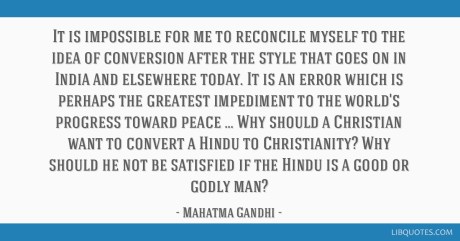
Mahatma Gandhi said: “I came to the conclusion long ago, after prayerful search and study and discussion with as many people as I could meet, that all religions are true … and whilst I hold my own, I should hold others as dear as Hinduism….”
When one is willing to concede that all religions are equal, the concept of conversion becomes redundant.
In another message Gandhi concludes, “It was impossible for me to believe that I could go to heaven or attain salvation only by becoming a Christian….”
Gandhi’s views on conversion were equally blunt: “I disbelieve in the conversion of one person by another. My effort should never be to undermine another’s faith but to make him a better follower of his own faith.”
He was even against propagation: “But no propaganda can be allowed which reviles other religions. For that would be negation of toleration.”
Anti-conversion bills are therefore backed by the spiritual might of the Mahatma. He once unequivocally declared: “If I had the power and could legislate, I should stop all proselytising. – The Pioneer, 3 January 2022
› Dr. Vivek Gumaste is an academic and political commentator based in the USA.
Filed under: india | Tagged: abrahamic religions, anti-conversion bills, dharmic religions, religious conversion, supreme court of india | Comments Off on Freedom of religion does not equal right to convert – Vivek Gumaste