









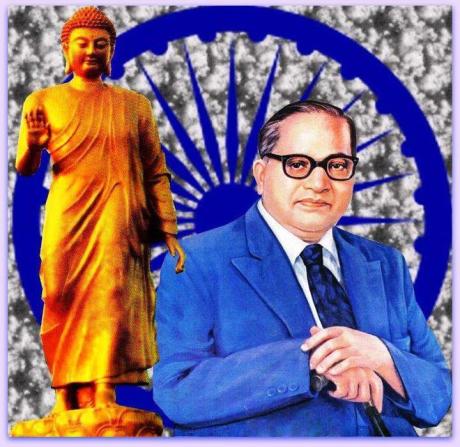
 Dr. Ambedkar always insisted on “spiritual and cultural unity” as the basis of modern nation-state formation, and he emphasized the Vedic as well as Buddhist contribution to it. – Prof. Phirmi Bodo
Dr. Bhim Rao Ambedkar’s work and philosophy were built on the sensibility of India’s ethos, a passionate desire for India’s unity and cultural nationalism. He was one of the leading nation-builders of modern India as early as 1916, in his famed paper presented at an anthropology seminar at Columbia University, Dr. Ambedkar made an observation that may well become the definition of what is today called “cultural nationalism” in the Indian context:
It may be granted that there has not been a thorough amalgamation of the various stocks that make up the peoples of India, and to a traveller from within the boundaries of India, the East presents a marked contrast in physique and even in colour to the West, as does the South to the North. But amalgamation can never be the sole criterion of homogeneity as predicated of any people.
Ethnically all people are heterogeneous. It is the unity of culture that is the basis of homogeneity. Taking this for granted, I venture to say that there is no country that can rival the Indian Peninsula with respect to the unity of its culture. It has not only a geographic unity, but it has over and above all a deeper and a much more fundamental unity—the indubitable cultural unity that covers the land from end to end.
Dr. Ambedkar always insisted on this “spiritual and cultural unity” as the basis of modern nation-state formation, and he emphasized the Vedic as well as Buddhist contribution to it. He was advocating for the Buddhist-Vedic organic fraternity as part of a greater pan-Indian identity. It is in this context that one could understand how he was extremely appreciative of all genuine reform work done in the country. Dr. Ambedkar always took care that he should never allow his people to get denationalized in their quest for justice and liberation. However, this part of Dr. Ambedkar has never been highlighted and rather projected as an anti-thesis of the cultural unity of the nation.
The Idea of a Nation
There are innumerable definitions given by various thinkers on “nation”. Patterson defines nation as, “people, a folk, held together by some or all of such more or less immutable characteristics as common descent, territory, history, language, religion, way of life or other attributes that members of a group have birth on the ward” (Patterson 1975).
However, according to Sri Aurobindo, nationalism is a religion that has come from God; nationalism is a creed that you shall have to live. He elevated the demand for national freedom to a religious faith so that the masses could be awakened. His concept of nation was deeply influenced by Bankim Chandra. He believed that the nation is not just a piece of land or a mass of human beings. Sri Aurobindo was convinced that imitation of Europe was not at all conducive to India’s regeneration. He knew that India would never share the feeling of nationalism if a large number of its citizens remained branded as untouchables
Nation and Nationality:
While talking about nations, Ambedkar asserted that the realisation of the fact that India was not a nation can be called the first step towards nation-building. According to him, “The sooner we realize that we are not as yet a nation … we shall realize the necessity of becoming a nation and seriously think of ways and means of realizing the goal” (Ambedkar 1994: 1217). Taking a clue from Renan who had sighted the case of the union of northern and southern France after a struggle of nearly a hundred years, Ambedkar emphasized forgetfulness as a second factor in the creation of a nation (Ambedkar 1990:36)
Ambedkar contends nationality is “consciousness of a kind, awareness of the existence of that tie of kinship” and nationalism is “the desire for a separate national existence for those who are bound by this tie of kinship”. Ambedkar was never against the idea of nationalism but against the Congress’s version of nationalism which entailed freedom of India from British colonialism but not from caste hierarchy through which millions of scheduled castes had been yoked for hundreds of years. Ambedkar took up the question from the social below and elevated it to a political high by linking this social question of caste with the political question of democracy and nationalism.
According to Ambedkar “without social union, political unity is difficult to be achieved. If achieved, it would be as precarious as a summer sapling, liable to be uprooted by the gust of hostile wind. With mere political unity, India may be a state. But to be a state is not to be a nation and a state, which is not a nation, has small prospects of survival in the struggle for existence”. He had faith in the spiritual aspect of Indian texts and codes but not in its ritualistic aspect which had developed in the last 1200 years. He talked about the “annihilation of caste not Dharma”. He had the option of declaring himself an atheist but his rootedness in Indian ethos compelled him to choose Buddhism.
He emphasizes that Hindus need not “borrow from foreign sources” concepts to build a society on the principle of equality, fraternity and liberty. They “could draw for such principles on the Upanishads”. Even in Riddles in Hinduism he points out that Hinduism has the potential to become the spiritual basis of social democracy.
The Constitution of India has abolished untouchability. But what Dr. Ambedkar had visualized, “If social conscious is such that it is prepared to recognize the rights which law chosen to enact, rights will be safe and secure. But if the fundamental rights are opposed by the community, no law, no parliament, no judiciary can guarantee them in the real sense of the word,” appears to be true.
Ambedkar argued that race, language and country do not suffice to create a nation. Quoting Renan, Ambedkar argued that: A nation is a living soul, a spiritual principle. Two things, which in truth are but one, constitute the soul, this spiritual principle. One is in the past, the other in the present. One is the common possession of a rich heritage of memories; the other is the actual consent, the desire to live together, the will to preserve worthily the undivided inheritance which has been handed down. … (Ambedkar 1990: 35).
On the day when the Constitution of India was to be finally passed, Ambedkar told the Constituent Assembly to have self-introspection. He said: “… My mind is so full of the future of our country. … On 26th January 1950, India will be an independent country. What would happen to her independence? Will she maintain her independence or will she lose it again? … It is not that India was never an independent country. The point is that she once lost the independence she had. Will she lose it a second time? What perturbs me greatly is the fact that not only India has once before lost her independence, but she lost it through the infidelity and treachery of some of her people.” (Ambedkar 1994: 1213-14). – The Pioneer, 13 April 2023
› Prof. Phirmi Bodo teaches at the Centre for Study of Social Systems, JNU.

Filed under: india | Tagged: b.r. ambedkar, buddhism, cultural nationalism, nation-state, untouchability | Comments Off on Ambedkar’s idea of cultural nationalism – Phirmi Bodo





 BHARATA BHARATI