












As a result of a series of military and diplomatic talks, the two sides completed withdrawal of troops and weapons from the north and south banks of Pangong lake in February in line with an agreement on disengagement. India has been insisting that a resolution of outstanding issues including in Depsang, Hot Springs and Gogra is essential for overall ties between the two countries. – PTI
China-India border tensions “remain high” despite some force pullbacks this year, the US intelligence community has told Congress, asserting that Beijing seeks to use coordinated, whole-of-government tools to demonstrate its growing strength and compel regional neighbours to acquiesce to its preferences, including its claims over disputed territory.
The Office of the Director of National Intelligence (ODNI) said in its latest annual threat assessment report to the US Congress that Beijing will continue to promote the multi-billion-dollar Belt and Road Initiative (BRI) to expand its economic, political and military presence abroad, while trying to reduce waste and exploitative practices, which have led to international criticism.
The BRI is a multi-billion-dollar initiative launched by Chinese President Xi Jinping when he came into power in 2013. It aims to link Southeast Asia, Central Asia, the Gulf region, Africa and Europe with a network of land and sea routes.
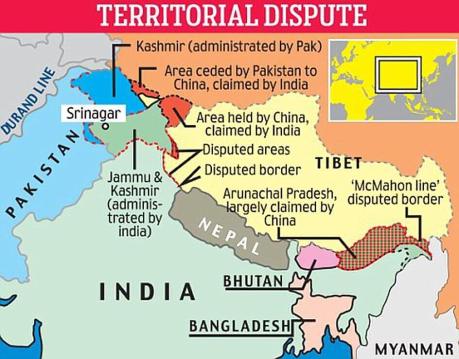
“China-India border tensions remain high, despite some force pullbacks this year. China’s occupation since May 2020 of contested border areas is the most serious escalation in decades and led to the first lethal border clash between the two countries since 1975,” the report said.
“As of mid-February, after multiple rounds of talks, both sides were pulling back forces and equipment from some sites along the disputed border,” it said.
The border standoff between the armies of India and China erupted on May 5 last following a violent clash in the Pangong Lake areas and both sides gradually enhanced their deployment by rushing in tens of thousands of soldiers as well as heavy weaponry.
As a result of a series of military and diplomatic talks, the two sides completed withdrawal of troops and weapons from the north and south banks of Pangong lake in February in line with an agreement on disengagement. India has been insisting that a resolution of outstanding issues including in Depsang, Hot Springs and Gogra is essential for overall ties between the two countries.
According to the report, China seeks to use coordinated, whole-of-government tools to demonstrate its growing strength and compel regional neighbours to acquiesce to Beijing’s preferences, including its claims over disputed territory and assertions of sovereignty over Taiwan.
In the South China Sea, Beijing will continue to intimidate rival claimants and will use growing numbers of air, naval, and maritime law enforcement platforms to signal to Southeast Asian countries that China has effective control over contested areas. China is similarly pressuring Japan over contested areas in the East China Sea.
China has been fast expanding military and economic influence in the Indo-Pacific region, triggering concern in various countries of the region and beyond. It is engaged in hotly contested territorial disputes in both the South China Sea and East China Sea.
Beijing has built up and militarised many of the islands and reefs it controls in the region. Both areas are stated to be rich in minerals, oil and other natural resources and are vital to global trade. China claims almost all of the South China Sea. Vietnam, the Philippines, Malaysia, Brunei and Taiwan have counter claims over the strategically vital area.
Beijing will press Taiwan authorities to move toward unification and will condemn what it views as increased US-Taiwan engagement, the report said.
China views Taiwan as a rebel province that must be reunified, even by force.
“We expect that friction will grow as Beijing steps up attempts to portray Taipei as internationally isolated and dependent on the mainland for economic prosperity, and as China continues to increase military activity around the island,” it said.
China’s increasing cooperation with Russia on areas of complementary interest includes defence and economic cooperation, it added.
China will try to increase its influence using “vaccine diplomacy,” giving countries favored access to the COVID-19 vaccines it is developing. It will also promote new international norms for technology and human rights, emphasising state sovereignty and political stability over individual rights, the ODNI said.
“China will remain the top threat to US technological competitiveness as the Chinese Communist Party targets key technology sectors and proprietary commercial and military technology from US and allied companies and research institutions associated with defence, energy, finance, and other sectors.
“Beijing uses a variety of tools, from public investment to espionage and theft, to advance its technological capabilities,” it said.
According to the report, China will continue expanding its global intelligence footprint to better support its growing political, economic, and security interests around the world, increasingly challenging the United States’ alliances and partnerships.
Across East Asia and the western Pacific, which Beijing views as its natural sphere of influence, China is attempting to exploit doubts about the US commitment to the region, undermine Taiwan’s democracy, and extend Beijing’s influence, it said.
“Beijing has been intensifying efforts to shape the political environment in the United States to promote its policy preferences, mold public discourse, pressure political figures whom Beijing believes oppose its interests, and muffle criticism of China on such issues as religious freedom and the suppression of democracy in Hong Kong,” it said. – India Today, 14 April 2021
Read Also
Filed under: china, india | Tagged: armies disengagement incomplete, chinese imperialism, india-china border dispute, ladakh | Comments Off on China-India border tensions remain high – PTI