










 “The prophecy—attributed to the Prophet Muhammad but which many experts call of dubious origin—imagines a Muslim army emerging from the Khorasan region and conquering the Middle East, including Jerusalem, under their black flags. This great victory, Soufan writes, amounts to ‘the Islamic version of Armageddon.'” – Michael Crowley
 It was six days after the Sept. 11 attacks, and with dark smoke still rising from lower Manhattan, Ali Soufan was face-to-face with the most senior al-Qaeda leader in American custody.
Soufan, an FBI counterterrorism agent, was inside a Yemen prison, interrogating a captured al-Qaeda operative named Abu Jandal, a former bodyguard and confidante to Osama bin Laden.
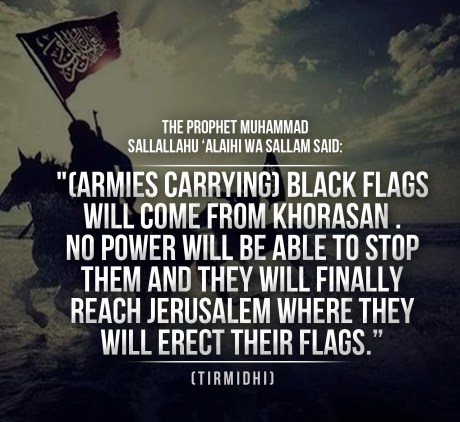
He continued with a grin: “The hadith says … ‘If you see the black banners coming from Khurasan, join that army, even if you have to crawl over ice; no power will be able to stop them.’”
Soufan recognized this Islamic saying immediately, and interrupted Abu Jandal to complete it: “And they will finally reach Baitul Maqdis [Jerusalem], where they will erect their flags,” he said.
The grin was gone. “‘You know the hadith?” Abu Jandal asked with surprise. “Do you really work for the FBI?’”
Abu Jandal had failed to appreciate that knowing the Khorasan hadith was part of the job of an Islamic terrorism expert like Soufan. As the former FBI agent explains in his 2013 book The Black Banners, the hadith of Khorasan — sometimes also spelled Khurasan — is fundamental to radical Islamist ideology. A prophecy describing a Muslim army from Central Asia storming across the Middle East and into Jerusalem has long inspired violent jihadists.
 The hadith of Khorasan is newly relevant thanks to the disclosure by U.S. officials of a terrorist group by that name operating in Syria. The Khorasan Group was a surprise target of American air strikes in Syria on Monday night mostly aimed at the Islamic State of Iraq and Greater Syria (ISIS).
While America obsessed over ISIS in recent weeks, Khorasan remained unknown to the public until this month. President Obama had never publicly mentioned its name before Tuesday morning. But U.S. officials say they have tracked the group for two years.
Khorasan, they explain, consists of about two dozen members of al-Qaeda’s core leadership. Previously based in Afghanistan, Pakistan and Iran, the men recently relocated to Syria. Unlike al-Qaeda operatives who fight the Syrian regime under the name of al-Nusra Front, the members of Khorasan reportedly took advantage of the country’s lawlessness exclusively to plot terrorist attacks against the West. (Officials are trying to confirm whether the group’s leader, Muhsin al-Fadhli, was killed in Monday night’s strikes.)
Even as Americans try to understand this new threat, many terrorism analysts are skeptical of the moniker. They question whether Khorasan truly constitutes an independent group, or simply a clique within al-Qaeda.
“I’d certainly never heard of this group while working at the agency,” says Aki Peritz, a CIA counterterrorism analyst until 2009 and co-author of Find, Fix, Finish. Peritz wonders if the group is meaningfully different from bin Laden’s al-Qaeda. “If senior members from a company’s headquarters go work in a branch office, are they still part of the main office or a superempowered part of the branch?” Peritz says. “It’s not like al-Qaeda operatives carry business cards.”
Peritz isn’t alone in his skepticism. “We used the term [Khorasan] inside the government, we don’t know where it came from,” Robert Ford, who served until this spring as Obama’s ambassador to Syria, told al-Jazeera on Wednesday. “All I know is that they don’t call themselves that.” Two U.S. intelligence officials did not respond to requests for comment on the name’s origins.
Amid that confusion, however, it’s clear that the word Khorasan sheds important light on the grandiose, even apocalyptic vision that drives many Sunni radicals to terrorism.
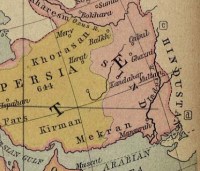 The word itself refers to a historic region centered around modern Afghanistan and which spills into Iran, Turkmenistan, Tajikistan and Uzbekistan. It was once an important part of the pre-OttomanIslamic caliphate.
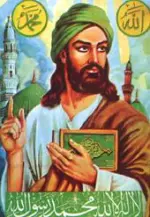
The prophecy cited by Abu Jandal — attributed to the Prophet Muhammad but which many experts call of dubious origin — imagines a Muslim army emerging from the region and conquering the Middle East, including Jerusalem, under their black flags. This great victory, Soufan writes, amounts to “the Islamic version of Armageddon.”
Soufan says many of the al-Qaeda operatives he has interviewed believed they were helping to fulfill the Khorasan prophecy.
Bin Laden was well aware of Khorasan. As former State Department counterterrorrism official Daniel Benjamin notes in the new issue of TIME, the founder of al-Qaeda announced from Afghanistan in 1996 that he had found “a safe base … in the high Hindu Kush mountains in Khorasan.” Bin Laden may have chosen al-Qaeda’s black flag as an homage to mythical black banner. The ISIS flag is also mostly black.
Several videos are available online telling the story the black-flag Islamic army. One of them, titled The Emergence of Prophecy: The Black Flags of Khorasan, was part of a YouTube playlist created by the slain 2013 Boston Marathon bomber Tamerlan Tsarnaev.
The 13-minute video, which depicts the wars in Iraq and Afghanistan as a sign of the prophecy’s fruition, summons Muslims to join the battle. – Time, 25 September 2014
› Michael Leland Crowley is an American journalist who has served as White House correspondent for The New York Times.

Filed under: khorasan, west asia | middle east | Tagged: black flags, hadith, islamic jihad, khorasan, prophet muhammad | 1 Comment »