












 “Research, carried out by the University of Cambridge and India’s Banaras Hindu University, reveals that a series of droughts lasting some 200 years hit the Indus Valley zone—and was probably responsible for the rapid decline of the great Bronze Age urban civilization of that region.” – David Keys
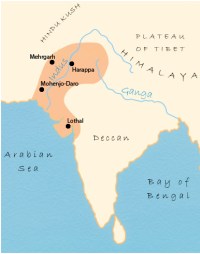 The world’s first great civilisations appear to have collapsed because of an ancient episode of climate change—according to new research carried out by scientists and archaeologists.
Their investigation demonstrates that the Bronze Age ‘megacities’ of the Indus Valley region of Pakistan and north-west India declined during the 21st and 20th centuries BC and never recovered—because of a dramatic increase in drought conditions.
The research, carried out by the University of Cambridge and India’s Banaras Hindu University, reveals that a series of droughts lasting some 200 years hit the Indus Valley zone—and was probably responsible for the rapid decline of the great Bronze Age urban civilization of that region.
The findings correlate chronologically with drought evidence found over recent years by other scientists who have examined deposits from the bottom of the Arabian Sea and the Gulf of Oman as well as stalactites from caves in North east India and southern Arabia.
It’s now thought likely that the droughts at around that time were partly responsible for the collapse not only of the Indus Valley civilization, but also of the ancient Akkadian Empire, Old Kingdom Egypt and possibly Early Bronze Age civilizations in Greece.
“Our evidence suggests that it was the most intense period of drought—probably due to frequent monsoon failure—in the 5000 year-long period we have examined,” said University of Cambridge Palaeoclimate scientist Professor David Hodell.
 The scientists studying the collapse of the Indus Valley Civilization obtained their new evidence from a dried-up lake bed near New Delhi which is just 40 miles east of the eastern edge of the Indus Valley civilization.
They detected the climatic conditions by examining isotopic evidence from the shells of snails that had lived between 6500 years ago and 1500 years ago.
The isotopic values of the calcium carbonate in the snails’ shells reflected the isotopic value in the water in the lakes at the time they lived.
Because water with oxygen 16 isotopes evaporates more quickly than water with ‘heavier’ oxygen 18 isotopes, the scientists were able to measure changes in evaporation rates over time. This allowed them to identify the start and end of a previously unknown 200 year-long severe drought in the north-west India region which lasted from around 2100 BC to approximately 1900 BC.
In that period, the Indus Valley ‘megacities’—some with populations of up to 100,000—rapidly declined. Populations shrank and the old urban civilization, which had lasted 500 years, collapsed.
“Archaeologists are really in a unique position when investigating climate change in the past, because we hopefully get to see what people were doing in the ‘before, during and after’ phases. We therefore get an opportunity to investigate how ancient populations responded to climatic and environmental  change. How did they cope with periods of water stress? Were their existing ways of life resilient? Were they forced to adapt in order to survive, and if so, precisely what did they do,” said University of Cambridge archaeologist, Dr. Cameron Petrie.
“For the Indus populations, it looks as though living in large groups became untenable, and it was much more sustainable to live in smaller groups. This is of course a huge simplification of a complex process, but this transformation is the underlying dynamic.
“By investigating responses to environmental pressures and threats in the past, we can hopefully learn from the past to engage with the public, and the relevant governmental and administrative bodies to be more pro-active in issues such as the management and administration of water supply, the balance of urban and rural development, and even the importance of preserving cultural heritage in the future,” said Dr Petrie.
The new research is reported in the journal Geology. – Times of India, 3 March 2014
Filed under: egypt, india, pakistan | Tagged: agriculture, ancient civilizations, bronze age, climate change, culture, drought, egypt, india, indology, indus, indus valley civilisation, monsoon, pakistan, science, sindhu saraswati civilization, urbanisation | Leave a comment »