












 If India stops meat exports, it will live up to the Indian Constitution; to the unique and priceless Indian principles of ahimsa and reverence for all life; to our timeless farming wisdom; thus showing the sustainable, scientific and humanitarian Indian way of living to the rest of the world. – Mina Anand
At the outset, let me say that this article discusses issues related to meat exports and has nothing to do with the Indian citizen’s right to his/her choice of food. Meat exports clearly and continuously defies the special statute enacted for the welfare of living creatures—the Prevention of Cruelty to Animals Act, 1960—and the enabling Prevention of Cruelty to Animals (Slaughter House) Rules, 2001, which permits slaughter of animals only for local requirements. [Rule 3(3)]
Meat and the ancillary leather exports siphon off copious quantities of the indispensable community reserves of water. Contrary to general belief, water in India is not a private good—but a public resource. The Public Trust Doctrine (judicially affirmed as the law of the land) mandates that the state is the custodian of all natural resources. “These resources meant for public use cannot be converted into private ownership.” [(1997)1SCC388]
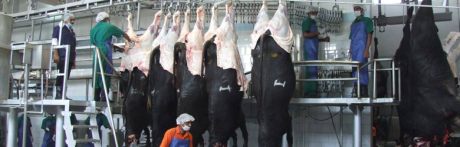
Export processing plants (numbering around 80) slay about 1,000 buffaloes per day per plant, consuming substantially more water than domestic plants (800+ litres per buffalo), as there are stricter hygiene requirements for exports. Plain multiplication shows about 64 million litres of life-giving water is devoured per day. Likewise, the leather industry on an average uses up 4.2 billion litres of water per day. In comparison, a human requires around 50 litres of water (WHO index) per day for the basic purposes of living. The incongruity is obvious. Further, a Bloomberg opinion piece titled “How India’s Water Ends Up Everywhere But India” (5.7.2019) refers to ‘water buffalo meat’ as a leading water-intensive farm export, noting that one kg of frozen bovine meat eats up 15,415 litres of water.
Slaughterhouses and tanneries, largely for export, are also major culprits in polluting the River Ganga and form part of the 764 ‘grossly-polluting’ industries defiling the great river (442 of the polluters are tanneries). Additionally, they are indicted and listed in the “Red Category” (Highest “Pollution Index Score”) of Industries, by the Indian government. [Environment Ministry Report March 2016].
Slaughterhouse and tannery jobs are among the most life-threatening in the world. The US Government Accountability Office states that the “meat and poultry industry still has one of the highest rates of injury and illness of any industry.” American author Gail Eisnitz in her book Slaughterhouse comments: “A worker’s chances of suffering an injury or an illness in a meat plant are six times greater than if that person worked in a coal mine.”
Slaughterhouse workers have to stun, grab, remove faeces and entrails, while battling the continuous surge of blood and excreta from the terrified animals that bleed, bite, claw and lash out desperately for their lives. Tannery workers, the majority of whom are from vulnerable sections of society, work knee-deep in the morass of dangerous chemicals. The V.V. Giri National Labour Institute declares: “Occupations related to slaughterhouses and tanneries remain a last resort for the extreme poor when they fail to get any other work.”
The Economics: The Centre’s policy of slaughtering “useless” buffaloes for exports does not make monetary or agricultural sense. And here’s where chemical farming comes in. Or rather, goes out. The “Green” Revolution may have saved the day—the jury is still out on that—but it was far from safeguarding the future. Chemical farming sends farmers into debt and fertiliser companies into profits. The Kerala State Organic Farming Policy Report (2008) avers: “Farmers are caught in the debt trap” owing to the high costs of chemical farming, leading to “increasing instances of suicides”. However,“organic farming can double the production”. [2014 Report UNCTAD/ UNEP].
In 2005, a seven-judge Constitution Bench of the Supreme Court in the Mirzapur case drew attention to the continued utility of live cattle; that in the absence of soil-nourishing organic fertilisers like cattle dung,“farmers are forced to use costly and harmful chemical fertilisers;” “investment in chemical fertilisers imposes a heavy burden upon the economy;” “subsidies on these items should be reduced or abolished altogether.”
The Indian state contemptuously disregards the Mirzapur findings. One of India’s biggest economic burdens is the huge Central subsidy (Rs 75,000 crore) on synthetic fertilisers, while the organic sector barely gets Rs 500 crore. It is significant to recognise that it is the time-honoured “cattle dung” that largely promotes the farmer-sustaining organic farming. The Centre’s Gobar Dhan Scheme is a step in the right direction. Dr M.S. Swaminathan confirms: “Farmers must possess cattle for organic manure.” A 2014 ILO Report documents that “the dung industry holds the potential of creating 1.985 million additional full-time permanent green jobs”. The need for live cattle is therefore vital in the farmers’ and nation’s interests.
Now, the arithmetic: The total export earnings (2018-2019) in meat and leather, approximately Rs 27,500 crore and Rs 36,562 crore respectively, totals over Rs 64,000 crore. The subsidies on chemical fertilisers and leather are Rs 70,090 crore and Rs 1,360 crore correspondingly, totaling Rs 71,450 crore. It’s evident that the subsidies more than offset the “gains”. And I have not even factored in the humongous sums of Rs 50,000 crore for reviving sick fertiliser plants (2017-2020) and the Ganga Clean-Up Outlay, Rs 20,000 crore (2015-2020). Moreover, organic farming has immense potential to generate export earnings: Rs 50,000 crore per annum! (White Paper Report 2016)
If India stops meat exports, it will not become a “Hindu Rashtra”, but will live up to the Indian Constitution; to the unique and priceless Indian principles of ahimsa and reverence for all life; to our timeless farming wisdom; thus showing the sustainable, scientific and humanitarian Indian way of living to the rest of the world. – The New India Express, 15 January 2020
› Mina Anand is a Chennai-based lawyer and writer.
Filed under: india | Tagged: agriculture, bovine meat export, buffalo slaughter, carabeef, slaughter houses | 1 Comment »